
Rugops
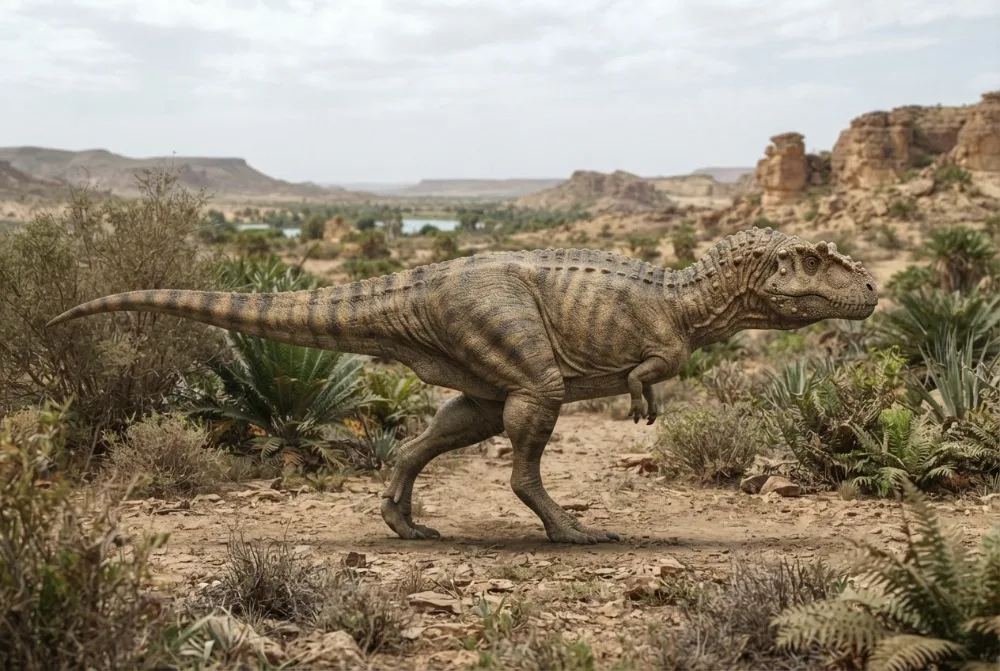
Rugops was a meat-eating dinosaur that lived in what is now Niger, Africa, about 95 million years ago. It had a wrinkled, bumpy face and a delicate skull, which scientists think means it was a scavenger rather than a fierce hunter.12
When did it live?
How big was it?
How long was it?
How tall was it?
at the hips
How heavy was it?
How big was Rugops compared to YOU?
Just maths in your browser. Nothing is saved or sent anywhere.
Fun facts
Rugops is known from only a partial skull, which is about 31.5 centimetres (12.4 inches) long.2
The top of its skull had many pits and bumps, which would have supported scales and a tough, armour-like skin on its snout.2
Rows of holes in the skull may mean Rugops had a crest or some kind of display structure on its head.1
Rugops lived alongside other huge predators like Carcharodontosaurus and Spinosaurus.2
The type specimen might have been a subadult, because its skull bones were not fully fused together.2
Rugops was one of the earliest abelisaurids, a group of horned, short-snouted theropods that lived in the southern continents.2
Most asked questions about Rugops
?How big was Rugops?
Scientists estimate Rugops was about 4.4 to 5.3 metres (14 to 17 feet) long and weighed around 410 kilograms (900 pounds). Some earlier estimates suggested it was up to 6 metres (20 feet) long and 750 kilograms (1,650 pounds).2
?What did Rugops eat?
Rugops was a carnivore, meaning it ate meat. Its delicate skull suggests it was a scavenger that fed on dead animals rather than a hunter that killed its own prey.13
?Where did Rugops live?
Rugops lived in what is now Niger, Africa, about 95 million years ago. Its fossils were found in the Echkar Formation, which was a river and lake environment.2
?Did Rugops have feathers?
Nobody knows for sure. Rugops is known only from a skull, and no feathers or feather impressions have been found with it. Its skull had pits and bumps that supported scales, not feathers.2
?Why is it called Rugops?
Rugops means 'wrinkle face' in Latin and Greek. It was named for the wrinkled, bumpy texture on its skull bones.2
?Was Rugops bigger than T. rex?
No, Rugops was much smaller. Rugops was about 4.4 to 5.3 metres (14 to 17 feet) long, while T. rex was over 12 metres (40 feet) long.2
Ask Rex about Rugops
Rex only answers questions about this page. 3 questions a day.
Rex is an AI and can make mistakes. He runs on servers in the EU and questions are never saved. Never type your name or other personal things.
For dino experts
- Scientific name
- Rugops
- Named by
- Sereno et al. 20044
- Group
- Meat-eating dinos
- Family / clade
- Abelisauridae4
- Classification
- Theropoda > Ceratosauria > Abelisauridae4
- Age of the rocks
- 100 to 94 million years (Cenomanian)4
- Rock formations
- Echkar4
- Countries
- Niger4
- Fossil records
- 1 in the Paleobiology Database4
- Discovery
- Rugops was named in 2004 by paleontologist Paul Sereno and his team, based on a partial skull found in the Echkar Formation of Niger during an expedition funded by the National Geographic Society.2
- Still debated
- Scientists are not sure exactly how Rugops is related to other abelisaurids; some studies place it as the most primitive, while others put it in a group with several other genera.2
Where the facts come from
- Rugops | Natural History Museum (nhm.ac.uk)
- Rugops (en.wikipedia.org)
- Discoveries | Paul Sereno - Paleontologist | The University of Chicago (paulsereno.uchicago.edu)
- Rugops in The Paleobiology Database (CC BY 4.0): age, places, rock formations, classification.
Every fact on this page has a number that points to its source. If we got something wrong, sorry, we are dino fans, not a science journal. Tell us at [email protected] and we will fix it.
 Rex is hungry! Dino Wiki is a dad's project for his dino-loving son, free with no ads. Grown-ups can feed Rex a snack to help keep it online.Feed Rex
 Allosaurus
 Carnotaurus
 Dilophosaurus
 Giganotosaurus
 Compsognathus
 Paronychodon
 Tyrannosaurus
 Triceratops
 Velociraptor
 Spinosaurus
 Ankylosaurus
 Parasaurolophus