
Saturnalia
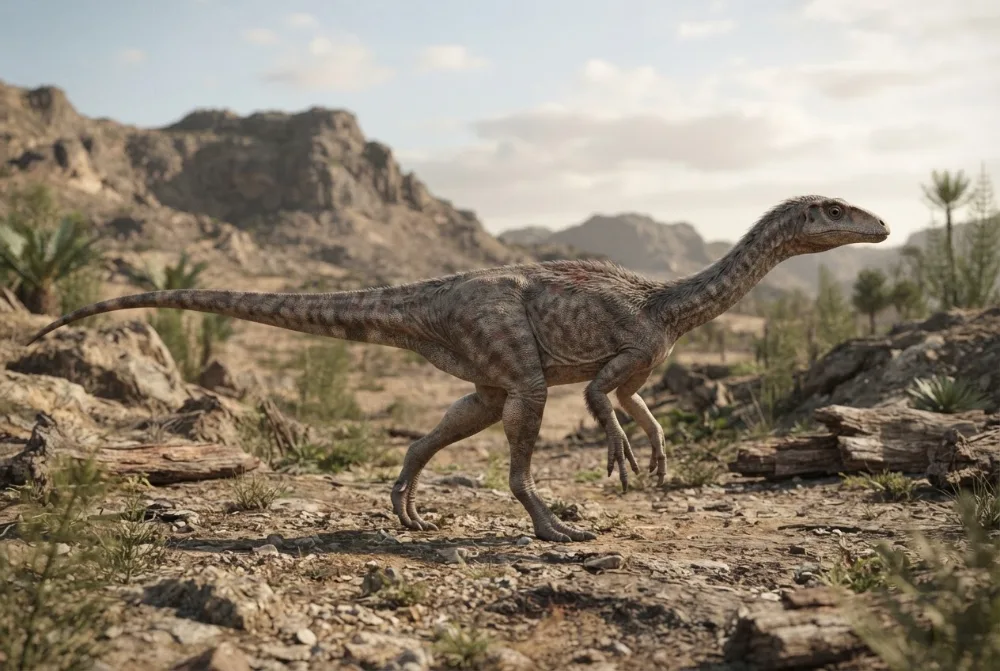
Saturnalia was one of the very first dinosaurs to ever walk the Earth. It was a small, speedy plant-eater that lived in what is now Brazil about 233 million years ago. Scientists have found several skeletons, making it one of the best-known early dinosaurs.1
When did it live?
How big was it?
How long was it?
How heavy was it?
How big was Saturnalia compared to YOU?
Just maths in your browser. Nothing is saved or sent anywhere.
Fun facts
Saturnalia was only about 1.5 metres (4.9 feet) long, about the size of a large dog.1
Its skull was only about 10 centimetres (3.9 inches) long, giving it a tiny head compared to its body.1
Saturnalia had a long neck made of nine or ten vertebrae, which was about half the length of its trunk.1
It lived at the same time as the meat-eating dinosaur Staurikosaurus, which may have hunted it.1
Saturnalia is one of the oldest dinosaurs ever found, dating back to about 233 million years ago.1
The fossils were collected during the Brazilian Carnival, which is why scientists named it after the Roman festival Saturnalia.1

Ask Rex about Saturnalia
Rex only answers questions about this page. 3 questions a day.
Rex is an AI and can make mistakes. He runs on servers in the EU and questions are never saved. Never type your name or other personal things.
Myth buster
Myth: Saturnalia was a plant-eater like later sauropodomorphs.
Truth: Scientists now think Saturnalia was probably an omnivore or carnivore, eating insects and small animals, based on its teeth and skull shape.1
For dino experts
- Scientific name
- Saturnalia
- Named by
- Langer et al. 19992
- Group
- Long-necks
- Family / clade
- Saturnaliidae2
- Classification
- Sauropodomorpha2
- Age of the rocks
- 237 to 227 million years (Carnian)2
- Rock formations
- Santa Maria, Pebbly Arkose2
- Countries
- Brazil, Zimbabwe2
- Fossil records
- 3 in the Paleobiology Database2
- Discovery
- Saturnalia was named in 1999 by Max Cardoso Langer and his team, based on three skeletons found in the Santa Maria Formation of Brazil during the 1998 Carnival.1
- Still debated
- Scientists still debate whether Saturnalia was a true sauropodomorph or more closely related to theropods, because it has a mix of features from both groups.1
Where the facts come from
- Saturnalia tupiniquim (en.wikipedia.org)
- Saturnalia in The Paleobiology Database (CC BY 4.0): age, places, rock formations, classification.
Every fact on this page has a number that points to its source. If we got something wrong, sorry, we are dino fans, not a science journal. Tell us at [email protected] and we will fix it.
 Rex is hungry! Dino Wiki is a dad's project for his dino-loving son, free with no ads. Grown-ups can feed Rex a snack to help keep it online.Feed Rex
 Brachiosaurus
 Diplodocus
 Brontosaurus
 Argentinosaurus
 Camarasaurus
 Morosaurus
 Nothosaurus
 Coelophysis
 Podokesaurus
 Simosaurus
 Eudimorphodon
 Herrerasaurus