
Shingopana
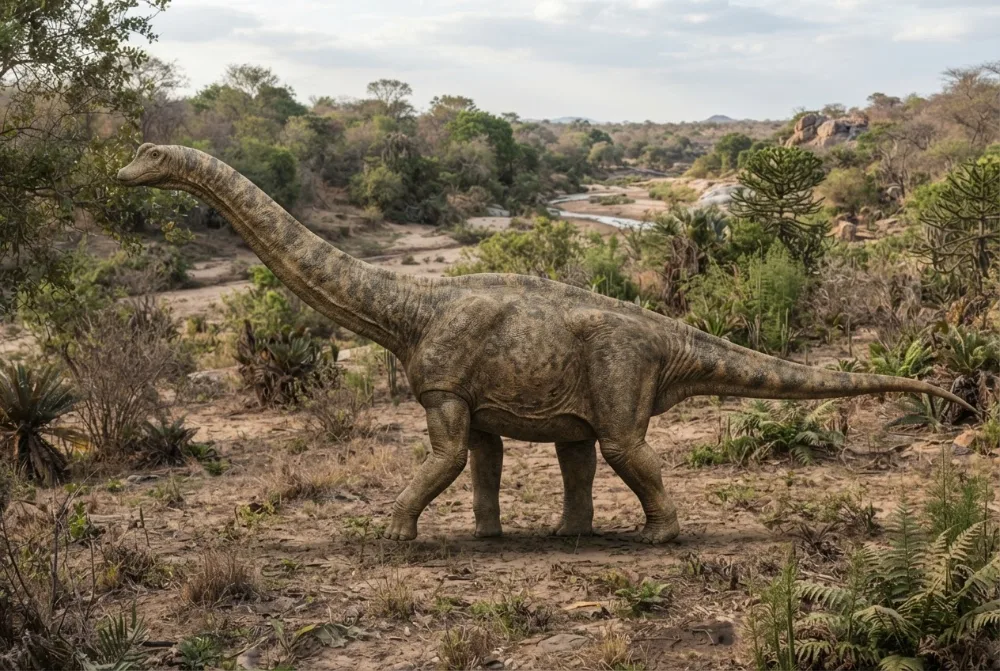
Shingopana was a long-necked dinosaur that munched on plants in ancient Tanzania. It was a titanosaur, a type of sauropod, but smaller than many of its giant cousins. Shingopana lived about 74 to 71 million years ago.12
When did it live?
How big was it?
How big was Shingopana compared to YOU?
Just maths in your browser. Nothing is saved or sent anywhere.
Fun facts
Shingopana's fossils had holes from insect bites that happened shortly after the dinosaur died.1
Scientists think Shingopana was more closely related to South American titanosaurs than to other African ones.1
Shingopana lived alongside other dinosaurs like Rukwatitan and Mnyamawamtuka, as well as crocodile-like reptiles and lungfish.1
The name Shingopana means 'wide neck' in Swahili, because of the bulbous parts on its neck bones.1
Shingopana is known from a partial jaw, neck bones, ribs, a shoulder bone, and a partial hip bone.1
Shingopana's ribs had flanged edges, but scientists are not sure what these were for.1
Most asked questions about Shingopana
?How big was Shingopana?
Shingopana was about 8 metres (26 feet) long, which is smaller than many other sauropods.1
?What did Shingopana eat?
Shingopana was a plant-eater, munching on leaves and other vegetation.1
?Where did Shingopana live?
Shingopana lived in what is now Tanzania, in Africa, about 74 to 71 million years ago.1

Ask Rex about Shingopana
Rex only answers questions about this page. 3 questions a day.
Rex is an AI and can make mistakes. He runs on servers in the EU and questions are never saved. Never type your name or other personal things.
For dino experts
- Scientific name
- Shingopana
- Named by
- Gorscak et al. 20172
- Group
- Long-necks
- Family / clade
- Lithostrotia2
- Classification
- Sauropodomorpha > Sauropoda > Titanosauria > Macronaria2
- Age of the rocks
- 100 to 72 million years (Cenomanian / Campanian)2
- Rock formations
- Galula2
- Countries
- Tanzania2
- Fossil records
- 1 in the Paleobiology Database2
- Discovery
- The first fossils of Shingopana were found in 2002 by scientists from the Rukwa Rift Basin Project. It was named Shingopana songwensis in 2017 by Gorscak and colleagues.12
- Still debated
- Scientists are not sure why the ribs had flanged edges or what the bulbous parts on the neck bones were for.1
Where the facts come from
- Shingopana (en.wikipedia.org)
- Shingopana in The Paleobiology Database (CC BY 4.0): age, places, rock formations, classification.
Every fact on this page has a number that points to its source. If we got something wrong, sorry, we are dino fans, not a science journal. Tell us at [email protected] and we will fix it.
Rex is hungry! Dino Wiki is a dad's project for his dino-loving son, free with no ads. Grown-ups can feed Rex a snack to help keep it online.Feed Rex Brachiosaurus
 Diplodocus
 Brontosaurus
 Argentinosaurus
 Camarasaurus
 Morosaurus
 Triceratops
 Velociraptor
 Spinosaurus
 Ankylosaurus
 Parasaurolophus