 Home
 All dinos
 Dino groups
 Explore
 Dinos by country
 Dino vs dino
 How big were they?
 Dinos A to Z
 Who ate what?
 What dino are you? Quiz
 Dino games
 Dino battle
 Dino race
 Dino mini-games
 Sticker album
 Dino TOP lists
 Timeline
 Surprise me!
 Language: English

Sinornithoides
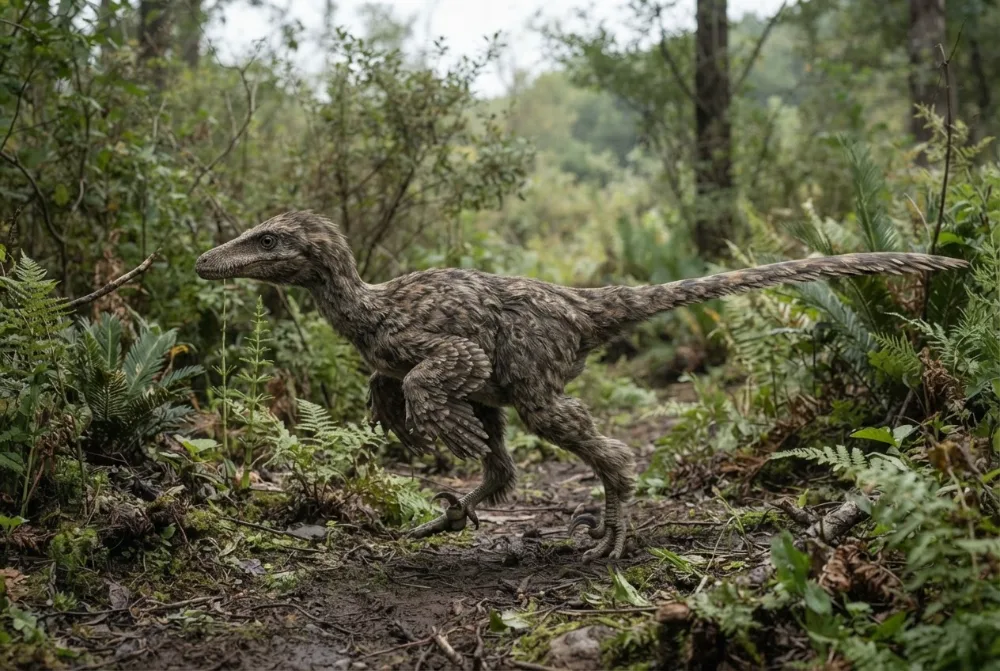
Sinornithoides was a tiny, bird-like dinosaur that lived about 113 million years ago. It was probably a fast hunter of small prey like insects. One fossil was found curled up like a sleeping bird, with its snout tucked under its arm.12
 China
When did it live?
Sinornithoides: 113 to 110 million years ago
How big was it?
How long was it?
How tall was it?
estimate
How heavy was it?
 as long as 2 house cats nose to tail🍌as long as 6 bananas end to endabout as heavy as a house cat🍌as heavy as 21 bananas🏃could run 100 metres in 14 seconds (the fastest human needs 9.6)
How big was Sinornithoides compared to YOU?
Just maths in your browser. Nothing is saved or sent anywhere.
How fast was it?


Fun facts
Sinornithoides had a sickle claw on its second toe, like other troodontids, which it may have used to grip prey.1
The fossil was preserved in a sleeping pose, with its snuck under one hand, just like a modern bird resting.1
Its skull was long and pointed, but the head was short compared to its body length.1
The teeth on the front of its upper jaw had no serrations, but the back teeth had small serrations only on one edge.1
Sinornithoides had a furcula (wishbone) and a basket of fifteen pairs of belly ribs called gastralia.1
Troodontids like Sinornithoides had some of the highest brain-to-body sizes among non-bird dinosaurs, meaning they were probably smart.1
Most asked questions about Sinornithoides
?How big was Sinornithoides?
About 1 metre long, and weighed around 2.5 kilograms. That is about the size of a large chicken.1
?What did Sinornithoides eat?
It probably ate invertebrates and other small prey, like insects and lizards.1
?Was Sinornithoides a dinosaur?
Yes, it was a small, bird-like theropod dinosaur from the Early Cretaceous period.1
?Did Sinornithoides have feathers?
The sources do not mention feathers directly, but as a troodontid closely related to birds, it likely had feathers. Many troodontid fossils show evidence of feathers.1
For dino experts
- Scientific name
- Sinornithoides
- Named by
- Russell and Dong 19943
- Group
- Raptors
- Family / clade
- Troodontidae3
- Classification
- Theropoda > Troodontidae3
- Age of the rocks
- 113 to 110 million years (Albian)3
- Rock formations
- Zhonggou, Ejinhoro3
- Countries
- China3
- Fossil records
- 2 in the Paleobiology Database3
- Discovery
- A Chinese-Canadian expedition found the nearly complete skeleton in 1988 near Huamuxiao, in the Ordos Basin of Inner Mongolia. Dale Russell and Dong Zhiming named it Sinornithoides youngi in 1993/1994, honoring paleontologist Yang Zhongjian.12
Where the facts come from
- Sinornithoides (en.wikipedia.org)
- cdnsciencepub.com (cdnsciencepub.com)
- Sinornithoides in The Paleobiology Database (CC BY 4.0): age, places, rock formations, classification.
Every fact on this page has a number that points to its source. If we got something wrong, sorry, we are dino fans, not a science journal. Tell us at hello@dinowiki.app and we will fix it.
 Rex is hungry! Dino Wiki is a dad's project for his dino-loving son, free with no ads and no cookies. Grown-ups can feed Rex a snack to help keep it online.Feed Rex
 Velociraptor
 Microraptor
 Deinonychus
 Asiamericana
 Richardoestesia
 Saurornitholestes
 Iguanodon
 Archaeopteryx
 Giganotosaurus
 Baryonyx
 Paronychodon
 Diracodon