
Sinornithomimus
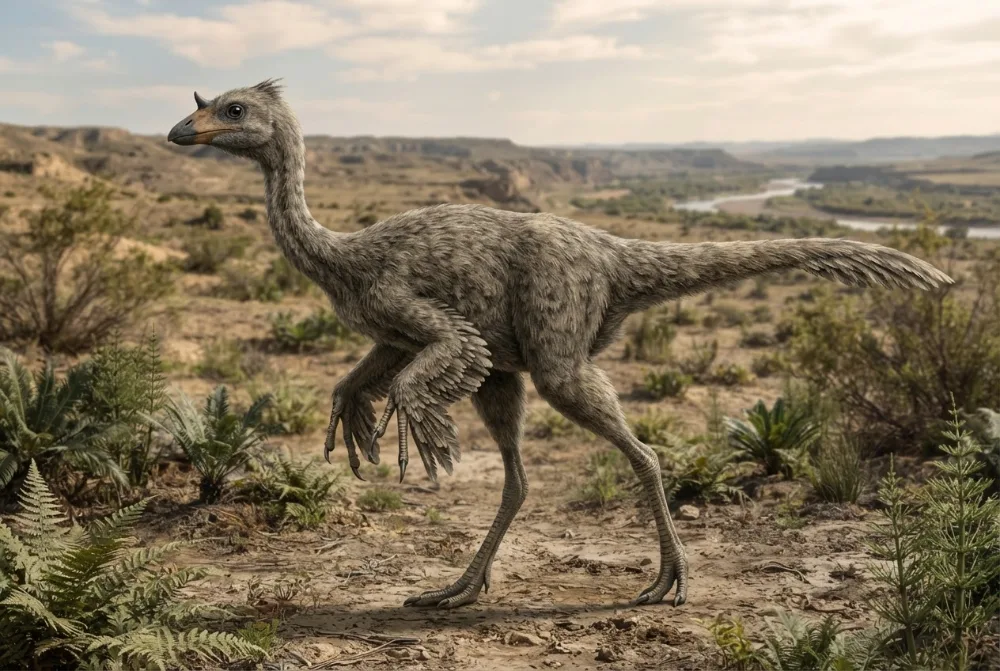
Sinornithomimus was a small, fast dinosaur that looked a bit like an ostrich. It lived in what is now China during the Late Cretaceous Period, about 92 to 90 million years ago. Scientists found many skeletons together, showing that these dinosaurs probably lived in herds.12
When did it live?
How big was it?
How long was it?
How heavy was it?
How big was Sinornithomimus compared to YOU?
Just maths in your browser. Nothing is saved or sent anywhere.
Fun facts
At least fourteen skeletons of Sinornithomimus were found together in one spot, and most of them were young dinosaurs. This suggests they lived in groups, maybe to protect each other from predators.21
Sinornithomimus had gastroliths, or stomach stones, that helped it grind up tough plants. This is rare among bird-like dinosaurs and shows it was a plant-eater.1
The first fossils of Sinornithomimus were discovered in 1997 by Chinese paleontologist Dong Zhiming during the Mongol Highland International Dinosaur Project.1
Sinornithomimus was about 2.5 meters (8.2 feet) long and weighed around 91 kilograms (201 pounds). That is about as heavy as a large adult human.1
Adult Sinornithomimus had longer lower legs compared to their upper legs than juveniles did. This means they could run faster as they grew up.21
A second herd of thirteen young Sinornithomimus was found in 2001. They probably died together after getting stuck in the mud of a drying waterhole.1
Most asked questions about Sinornithomimus
?What did Sinornithomimus eat?
It ate plants. Scientists found gastroliths (stomach stones) in its fossils that helped grind up tough plant food.1
?How fast could Sinornithomimus run?
Nobody knows exactly, but it was a fast runner. Adults had longer lower legs than juveniles, which made them even faster.1
Ask Rex about Sinornithomimus
Rex only answers questions about this page. 10 questions a month.
Rex is an AI and can make mistakes. He runs on servers in the EU and questions are never saved. Never type your name or other personal things.
For dino experts
- Scientific name
- Sinornithomimus
- Named by
- Kobayashi and Lü 20035
- Group
- Ostrich dinos
- Family / clade
- Ornithomimidae5
- Classification
- Theropoda > Ornithomimosauria5
- Age of the rocks
- 94 to 90 million years (Turonian)5
- Rock formations
- Ulansuhai5
- Countries
- China5
- Fossil records
- 1 in the Paleobiology Database5
- Discovery
- Sinornithomimus was named and described by Yoshitsugu Kobayashi and Lü Junchang in 2003. The name means 'Chinese bird mimic' and honors Dong Zhiming, who found the first fossils in 1997.12
- Still debated
- Scientists are not sure whether the herds of Sinornithomimus were family groups with adults protecting young, or if the young lived separately from adults while the adults were busy nesting.1
Where the facts come from
- Sinornithomimus (en.wikipedia.org)
- A new ornithomimid dinosaur with gregarious habits from the Late Cretaceous of China - Acta Palaeontologica Polonica (app.pan.pl)
- PBDB Taxon (paleobiodb.org)
- Young dinosaurs roamed together, died together | University of Chicago News (news.uchicago.edu)
- Sinornithomimus in The Paleobiology Database (CC BY 4.0): age, places, rock formations, classification.
Every fact on this page has a number that points to its source. If we got something wrong, sorry, we are dino fans, not a science journal. Tell us at [email protected] and we will fix it.
 Rex is hungry! Dino Wiki is a dad's project for his dino-loving son, free with no ads. Grown-ups can feed Rex a snack to help keep it online.Feed Rex
 Gallimimus
 Ornithomimus
 Struthiomimus
 Deinocheirus
 Dromiceiomimus
 Archaeornithomimus
 Tyrannosaurus
 Triceratops
 Velociraptor
 Spinosaurus
 Ankylosaurus
 Parasaurolophus