When did it live?

How big was it?
How big was Sinusonasus compared to YOU?
Just maths in your browser. Nothing is saved or sent anywhere.
Fun facts
Sinusonasus had a wavy nose bone, which is why its name means 'wave nose'.1
Its tail had long bones called chevrons that connected to form a flat plate under the tail.1
Sinusonasus had a sickle claw on its second toe, like a Velociraptor, which it could use to grab prey.1
Its lower leg was long, so it was probably a fast runner.1
The front teeth of Sinusonasus had no serrations, but the back teeth had serrations only on the back edge.1
Sinusonasus lived about 125 to 119 million years ago, during the Early Cretaceous.2
Most asked questions about Sinusonasus
?How big was Sinusonasus?
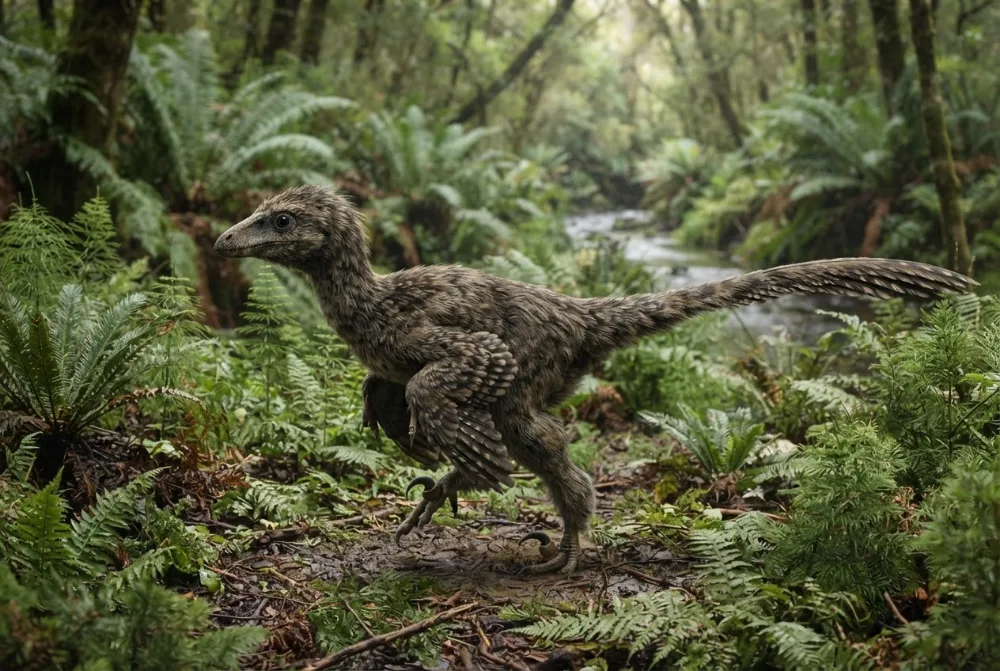
About 1 metre (3.3 feet) long and weighed around 2.5 kilograms (5.5 pounds).1
?What did Sinusonasus eat?
It was probably a carnivore or omnivore, hunting small animals and maybe eating plants too.2
?Did Sinusonasus have feathers?
The sources do not mention feathers, but many troodontid dinosaurs are thought to have had feathers.1

Ask Rex about Sinusonasus
Rex only answers questions about this page. 3 questions a day.
Rex is an AI and can make mistakes. He runs on servers in the EU and questions are never saved. Never type your name or other personal things.
For dino experts
- Scientific name
- Sinusonasus
- Named by
- Xu and Wang 20042
- Group
- Raptors
- Family / clade
- Troodontidae2
- Classification
- Theropoda > Troodontidae2
- Age of the rocks
- 126 to 120 million years (Barremian / Aptian)2
- Rock formations
- Yixian2
- Countries
- China2
- Fossil records
- 1 in the Paleobiology Database2
- Discovery
- Sinusonasus was named and described by Xu Xing and Wang Xiaolin in 2004, based on a partial skeleton found in the Yixian Formation of China.1
- Still debated
- Scientists are not sure whether Sinusonasus was a fast-evolving early troodontid or part of a longer line of troodontids that started in the Jurassic.1
Where the facts come from
- Sinusonasus (en.wikipedia.org)
- Sinusonasus in The Paleobiology Database (CC BY 4.0): age, places, rock formations, classification.
Every fact on this page has a number that points to its source. If we got something wrong, sorry, we are dino fans, not a science journal. Tell us at [email protected] and we will fix it.
Rex is hungry! Dino Wiki is a dad's project for his dino-loving son, free with no ads. Grown-ups can feed Rex a snack to help keep it online.Feed Rex Velociraptor
 Microraptor
 Deinonychus
 Asiamericana
 Richardoestesia
 Saurornitholestes
 Stegosaurus
 Iguanodon
 Archaeopteryx
 Giganotosaurus
 Baryonyx
 Paronychodon