
Suskityrannus
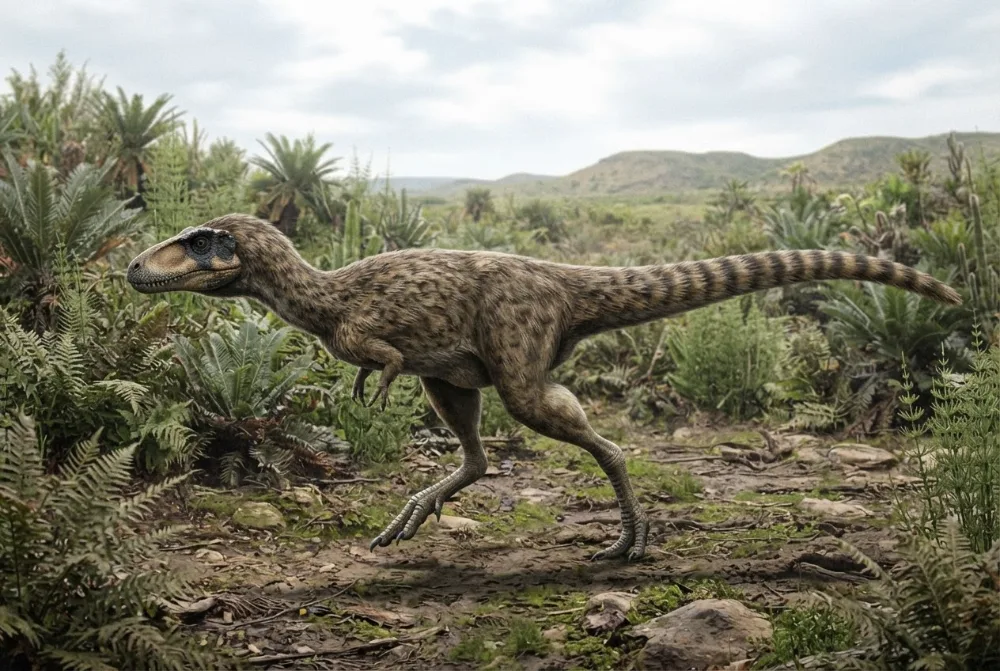
Suskityrannus was a small, fast-running cousin of the giant T. rex. It lived about 92 million years ago in what is now New Mexico, USA. This little predator had long legs and a foot built for speed.21
When did it live?
How big was it?
How big was Suskityrannus compared to YOU?
Just maths in your browser. Nothing is saved or sent anywhere.
Fun facts
Suskityrannus had the earliest known arctometatarsalian foot among its group, meaning its foot bones were pinched together for running fast.21
The fossils were discovered in 1998 by a geologist named Robert Denton and a teenage museum volunteer named Sterling Nesbitt.1
Suskityrannus lived during a time when sea levels were high and much of North America was underwater.2
Its name means 'coyote tyrant' in the Zuni language, because it was a small, clever predator like a coyote.1
The two known skeletons belong to young individuals that were still growing, but adults were still much smaller than later tyrannosaurs like T. rex.1
Suskityrannus filled a big gap in the fossil record, showing how small early tyrannosaurs evolved into giant ones.2
Most asked questions about Suskityrannus
?How big was Suskityrannus?
Suskityrannus was a small dinosaur. Its skull was only 25 to 32 centimetres (9.8 to 12.6 inches) long, and the known specimens were still growing, so adults were much smaller than later tyrannosaurs like T. rex.1
?What did Suskityrannus eat?
Suskityrannus was a predator, so it likely ate small animals like lizards, early mammals, and maybe baby dinosaurs. Its sharp teeth and fast legs helped it hunt.12
?When did Suskityrannus live?
Suskityrannus lived about 92 million years ago during the Turonian stage of the Late Cretaceous period.12
?Where was Suskityrannus found?
Suskityrannus fossils were found in the Moreno Hill Formation of the Zuni Basin in western New Mexico, USA.1
?Was Suskityrannus a dinosaur?
Yes, Suskityrannus was a dinosaur. It was a small tyrannosauroid theropod, which is a group of meat-eating dinosaurs that includes T. rex.1

Ask Rex about Suskityrannus
Rex only answers questions about this page. 3 questions a day.
Rex is an AI and can make mistakes. He runs on servers in the EU and questions are never saved. Never type your name or other personal things.
For dino experts
- Scientific name
- Suskityrannus
- Named by
- Nesbitt et al. 20193
- Group
- Tyrannosaurs
- Family / clade
- Tyrannosauroidea3
- Classification
- Theropoda > Tyrannosauroidea3
- Age of the rocks
- 94 to 90 million years (Turonian)3
- Rock formations
- Moreno Hill3
- Countries
- USA3
- Fossil records
- 1 in the Paleobiology Database3
- Discovery
- The first fossils were found in 1998 by geologist Robert Denton and teenager Sterling Nesbitt in New Mexico. The species was officially named Suskityrannus hazelae in 2019.1
- Still debated
- Scientists are not sure exactly how big adult Suskityrannus grew, because only young skeletons have been found.1
Where the facts come from
- Suskityrannus (en.wikipedia.org)
- A mid-Cretaceous tyrannosauroid and the origin of North American end-Cretaceous dinosaur assemblages | Nature Ecology & Evolution (nature.com)
- Suskityrannus in The Paleobiology Database (CC BY 4.0): age, places, rock formations, classification.
Every fact on this page has a number that points to its source. If we got something wrong, sorry, we are dino fans, not a science journal. Tell us at [email protected] and we will fix it.
Rex is hungry! Dino Wiki is a dad's project for his dino-loving son, free with no ads. Grown-ups can feed Rex a snack to help keep it online.Feed Rex Tarbosaurus
 Albertosaurus
 Daspletosaurus
 Gorgosaurus
 Alectrosaurus
 Triceratops
 Velociraptor
 Spinosaurus
 Ankylosaurus
 Parasaurolophus
 Pteranodon