
Thapunngaka
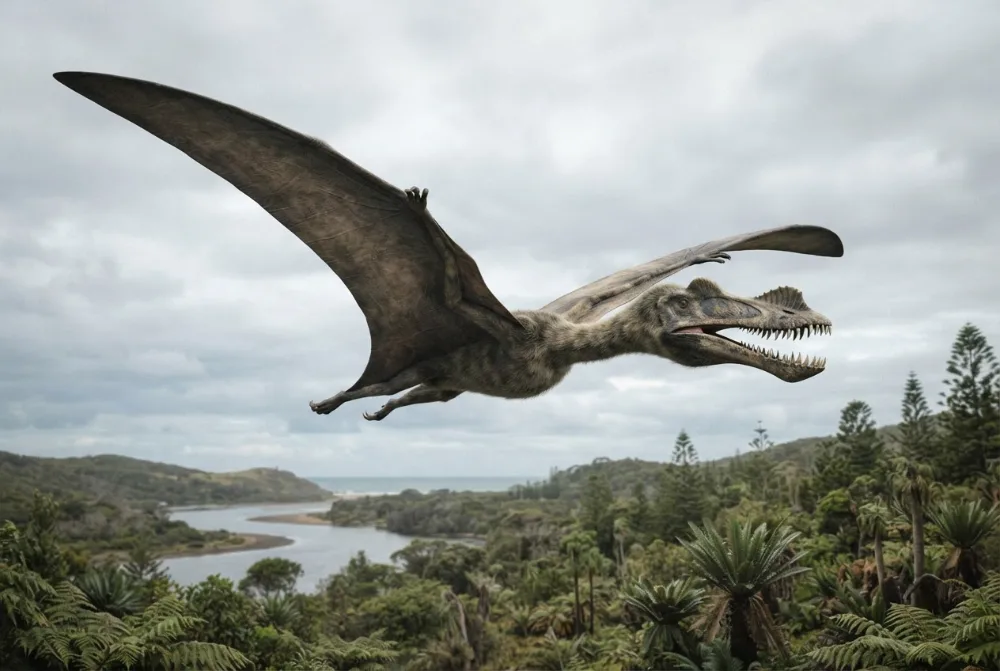
Thapunngaka was a huge flying reptile that soared over the seas of ancient Australia. It had a long, pointed beak with a big crest on its chin, perfect for scooping up fish. It was one of the biggest flying animals of its time!1
When did it live?
How big was it?
How wide were its wings?
How big was Thapunngaka compared to YOU?
Just maths in your browser. Nothing is saved or sent anywhere.
Fun facts
Thapunngaka is the largest pterosaur ever found in Australia, based on the size of its jaw bone.1
It had the biggest chin crest of any pterosaur in its family, which might have been used for show or steering.1
Its name means 'spear mouth' in the language of the local Aboriginal people, because its jaws were shaped like a spear.1
Thapunngaka lived about 106 million years ago, during the Cretaceous Period, when Australia was part of the supercontinent Gondwana.4
Scientists think Thapunngaka was a fast flyer, using its long wings to glide over the ocean and snatch fish with its beak.4
Most asked questions about Thapunngaka
?How big was Thapunngaka?
Its wingspan was probably about 6 to 7 metres (20 to 23 feet), though estimates range from 5.83 to 9.47 metres (19.1 to 31.1 feet).23
?What did Thapunngaka eat?
It ate fish. Its long, spear-like jaws were perfect for scooping up large predatory fish from the ancient Eromanga Sea.3
?Is Thapunngaka a dinosaur?
No, it is a pterosaur, a flying reptile that lived during the time of dinosaurs. Pterosaurs were the first back-boned animals to fly.3

Ask Rex about Thapunngaka
Rex only answers questions about this page. 10 questions a month.
Rex is an AI and can make mistakes. He runs on servers in the EU and questions are never saved. Never type your name or other personal things.
Myth buster
Myth: Some people think Thapunngaka was a dinosaur.
Truth: It was actually a pterosaur, a flying reptile that is a close cousin of dinosaurs, but not a dinosaur itself.1
For dino experts
- Scientific name
- Thapunngaka
- Named by
- Richards et al. 20214
- Group
- Flying reptiles
- Family / clade
- Anhangueridae4
- Classification
- Pterosauria > Pterodactyloidea4
- Age of the rocks
- 113 to 100 million years (Albian)4
- Rock formations
- Toolebuc4
- Countries
- Australia4
- Fossil records
- 2 in the Paleobiology Database4
- Discovery
- Thapunngaka was named in 2021 by Timothy Richards and colleagues from a fossil jaw found near Richmond, Queensland, Australia. The fossil was discovered in the Toolebuc Formation, which is famous for ancient marine life.1
- Still debated
- Scientists are still debating how big Thapunngaka really was, because only its lower jaw has been found so far. They use the jaw size to estimate its total size, but the exact numbers are not known.1
Where the facts come from
- A new species of crested pterosaur (Pterodactyloidea, Anhangueridae) from the Lower Cretaceous (upper Albian) of Richmond, North West Queensland, Australia: Journal of Vertebrate Paleontology: Vol 41 , No 3 - Get Access (tandfonline.com)
- Thapunngaka (en.wikipedia.org)
- Researchers find a ‘fearsome dragon’ that soared over outback Queensland - News - The University of Queensland (news.uq.edu.au)
- Thapunngaka in The Paleobiology Database (CC BY 4.0): age, places, rock formations, classification.
Every fact on this page has a number that points to its source. If we got something wrong, sorry, we are dino fans, not a science journal. Tell us at [email protected] and we will fix it.
 Rex is hungry! Dino Wiki is a dad's project for his dino-loving son, free with no ads. Grown-ups can feed Rex a snack to help keep it online.Feed Rex
 Pteranodon
 Quetzalcoatlus
 Dorygnathus
 Rhamphorhynchus
 Anhanguera
 Pterodactylus
 Stegosaurus
 Iguanodon
 Archaeopteryx
 Giganotosaurus
 Microraptor
 Deinonychus