
Vescornis
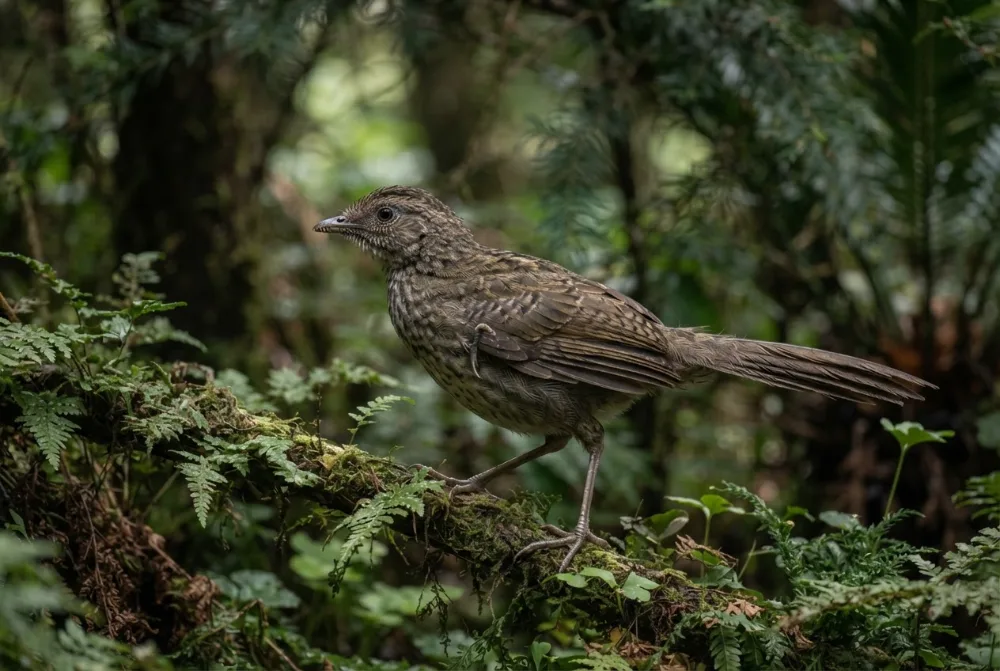
Vescornis was a tiny, feathered dinosaur that could fly. It lived during the Early Cretaceous, about 122 million years ago, in what is now China. This little bird had long foot claws and short wing fingers, which made it great at flying but not so good at climbing trees.12
When did it live?
Fun facts
Vescornis had very small wing claws and long, strong foot claws, which helped it fly better but made it worse at climbing than many other early birds.2
The only known fossil of Vescornis was first thought to come from the Yixian Formation, but later geologists realized it was actually from the Huajiying Formation.1
Vescornis might be the same animal as another early bird called Jibeinia, but scientists are not sure because the Jibeinia fossil got lost.1
The name 'Hebeiornis' was given to the same fossil in 1999, but that name is not used because it was not described well enough.1
Vescornis lived about 122 million years ago, during the Early Cretaceous period.1

Ask Rex about Vescornis
Rex only answers questions about this page. 3 questions a day.
Rex is an AI and can make mistakes. He runs on servers in the EU and questions are never saved. Never type your name or other personal things.
Myth buster
Myth: Some people think Vescornis was a true bird like modern birds.
Truth: Vescornis was an enantiornithine, a group of ancient birds that had teeth and claws, and it is not a direct ancestor of today's birds.1
For dino experts
- Scientific name
- Vescornis
- Named by
- Zhang et al. 20044
- Group
- Early birds
- Family / clade
- Enantiornithes4
- Classification
- Theropoda > Avialae4
- Age of the rocks
- 126 to 120 million years (Barremian / Aptian)4
- Rock formations
- Yixian4
- Countries
- China4
- Fossil records
- 1 in the Paleobiology Database4
- Discovery
- The fossil was found in Hebei Province, China, and was described by Zhang and colleagues in 2004. It is stored at the Nanjing Institute of Geology and Paleontology.1
- Still debated
- Scientists still debate whether Vescornis is the same species as Jibeinia, because the Jibeinia fossil is lost and the two look very similar.1
Where the facts come from
- Vescornis (en.wikipedia.org)
- Description of a new enantiornithine bird from the Early Cretaceous of Hebei, northern China (cdnsciencepub.com)
- PBDB Taxon (paleobiodb.org)
- Vescornis in The Paleobiology Database (CC BY 4.0): age, places, rock formations, classification.
Every fact on this page has a number that points to its source. If we got something wrong, sorry, we are dino fans, not a science journal. Tell us at [email protected] and we will fix it.
 Rex is hungry! Dino Wiki is a dad's project for his dino-loving son, free with no ads. Grown-ups can feed Rex a snack to help keep it online.Feed Rex
 Archaeopteryx
 Hesperornis
 Ichthyornis
 Baptornis
 Jurapteryx
 Gobipteryx
 Stegosaurus
 Iguanodon
 Giganotosaurus
 Microraptor
 Deinonychus
 Baryonyx