
Vesperopterylus
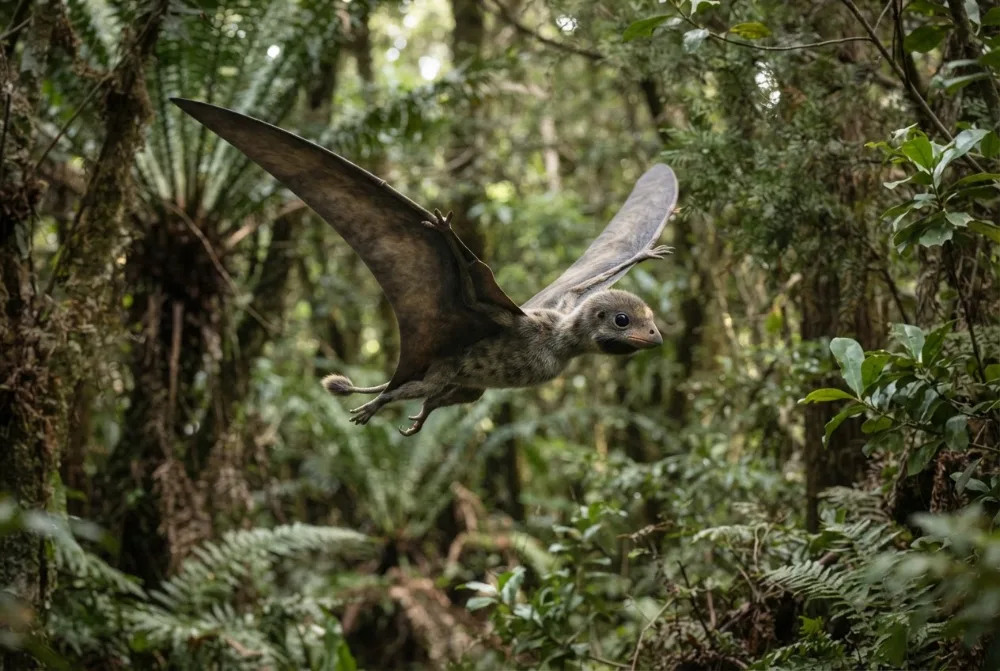
Vesperopterylus was a tiny pterosaur that lived in the trees. It had a reversed first toe that helped it grip branches, like a bird perching. It was one of the youngest anurognathid pterosaurs ever found.1
When did it live?
Fun facts
Vesperopterylus had a reversed first toe, which is the first time such a feature has been seen in a pterosaur. This toe helped it perch on branches.1
It is the first anurognathid pterosaur from China with a definitely short tail.1
Vesperopterylus lived during the Early Cretaceous, about 121 to 113 million years ago.3
Its name means 'evening wing', referring to its likely crepuscular or nocturnal habits.3
The reversed first toe of Vesperopterylus suggests it spent much of its time in trees, an unusual lifestyle for a pterosaur.1
Most asked questions about Vesperopterylus
?How big was Vesperopterylus?
Its exact size is not given in the sources, but it was a tiny pterosaur, small enough to perch on tree branches.2
?What did Vesperopterylus eat?
The Paleobiology Database lists it as a volant piscivore, meaning it likely ate fish while flying.3
?Could Vesperopterylus fly?
Yes, it was a pterosaur, a flying reptile, and it could fly. Its name means 'dusk wing'.2

Ask Rex about Vesperopterylus
Rex only answers questions about this page. 3 questions a day.
Rex is an AI and can make mistakes. He runs on servers in the EU and questions are never saved. Never type your name or other personal things.
For dino experts
- Scientific name
- Vesperopterylus
- Named by
- Lu et al. 20173
- Group
- Flying reptiles
- Family / clade
- Anurognathidae3
- Classification
- Pterosauria3
- Age of the rocks
- 121 to 113 million years (Aptian)3
- Rock formations
- Jiufotang3
- Countries
- China3
- Fossil records
- 1 in the Paleobiology Database3
- Discovery
- Vesperopterylus was named in 2017 by Lu and colleagues based on a complete skeleton with a skull found in Liaoning, China.31
Where the facts come from
- nnhm.org.cn (nnhm.org.cn)
- Vesperopterylus (en.wikipedia.org)
- Vesperopterylus in The Paleobiology Database (CC BY 4.0): age, places, rock formations, classification.
Every fact on this page has a number that points to its source. If we got something wrong, sorry, we are dino fans, not a science journal. Tell us at [email protected] and we will fix it.
Rex is hungry! Dino Wiki is a dad's project for his dino-loving son, free with no ads. Grown-ups can feed Rex a snack to help keep it online.Feed Rex Pteranodon
 Quetzalcoatlus
 Dorygnathus
 Rhamphorhynchus
 Anhanguera
 Pterodactylus
 Stegosaurus
 Iguanodon
 Archaeopteryx
 Giganotosaurus
 Microraptor
 Deinonychus