
Yelaphomte
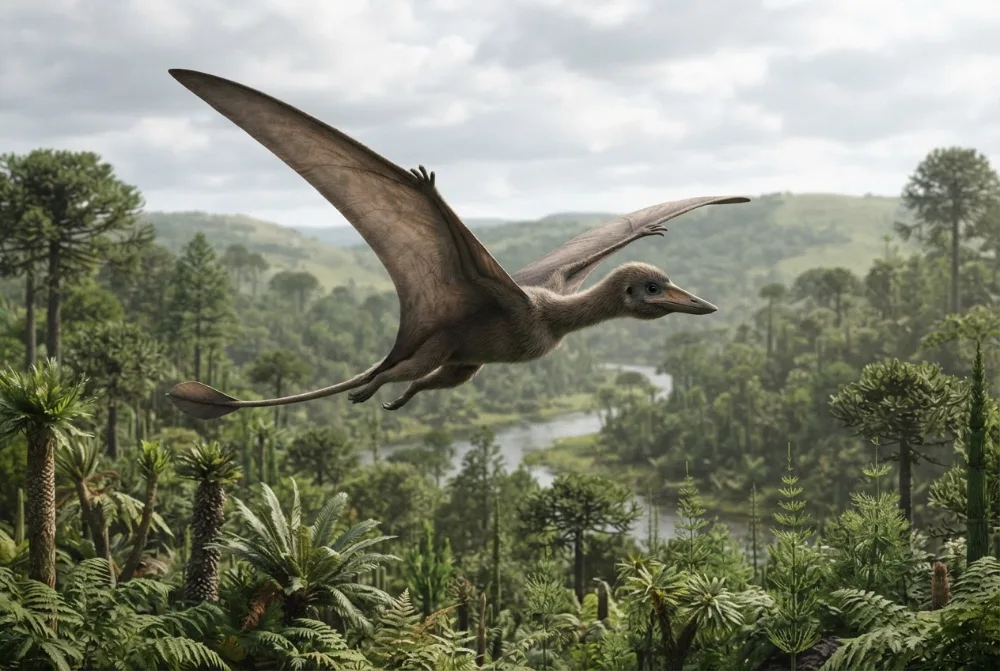
Yelaphomte was a small flying reptile that lived during the Late Triassic in what is now Argentina. It had a tall, thin crest on its snout and was one of the first pterosaurs found in the southern half of the world.12
When did it live?
Fun facts
Yelaphomte is one of the only known Triassic pterosaurs from the southern hemisphere, along with its relative Pachagnathus.12
Its snout was full of air spaces, making it lightweight for flying. The name Yelaphomte means 'beast of the air' in the language of the Huarpe people.1
The only known fossil is a piece of the snout only 15.4 mm long, including parts of the upper jaw and palate.1
Yelaphomte lived far from the sea, in a dry inland environment, unlike many other early pterosaurs that lived near coasts.1
The crest on its snout had a unique pattern of grooves that is not seen in any other pterosaur.1
Scientists think Yelaphomte may have been a small adult, because the bones in its snout were tightly fused together, which often happens when an animal is fully grown.1

Ask Rex about Yelaphomte
Rex only answers questions about this page. 3 questions a day.
Rex is an AI and can make mistakes. He runs on servers in the EU and questions are never saved. Never type your name or other personal things.
For dino experts
- Scientific name
- Yelaphomte
- Named by
- Martínez et al. 20223
- Group
- Flying reptiles
- Family / clade
- Raeticodactylidae3
- Classification
- Pterosauria3
- Age of the rocks
- 227 to 206 million years (Norian)3
- Rock formations
- Quebrada del Barro3
- Countries
- Argentina3
- Fossil records
- 1 in the Paleobiology Database3
- Discovery
- Yelaphomte was discovered by a team led by Ricardo Martínez between 2012 and 2014 in Argentina. It was named and described in 2022 by Martínez, Andres, Apaldetti, and Cerda.13
- Still debated
- Scientists are not sure exactly how big Yelaphomte grew, because only a small piece of its snout has been found.1
Where the facts come from
- Yelaphomte (en.wikipedia.org)
- The dawn of the flying reptiles: first Triassic record in the southern hemisphere (onlinelibrary.wiley.com)
- Yelaphomte in The Paleobiology Database (CC BY 4.0): age, places, rock formations, classification.
Every fact on this page has a number that points to its source. If we got something wrong, sorry, we are dino fans, not a science journal. Tell us at [email protected] and we will fix it.
 Rex is hungry! Dino Wiki is a dad's project for his dino-loving son, free with no ads. Grown-ups can feed Rex a snack to help keep it online.Feed Rex
 Pteranodon
 Quetzalcoatlus
 Dorygnathus
 Rhamphorhynchus
 Anhanguera
 Pterodactylus
 Nothosaurus
 Massospondylus
 Plateosaurus
 Coelophysis
 Podokesaurus
 Simosaurus