
Yutyrannus
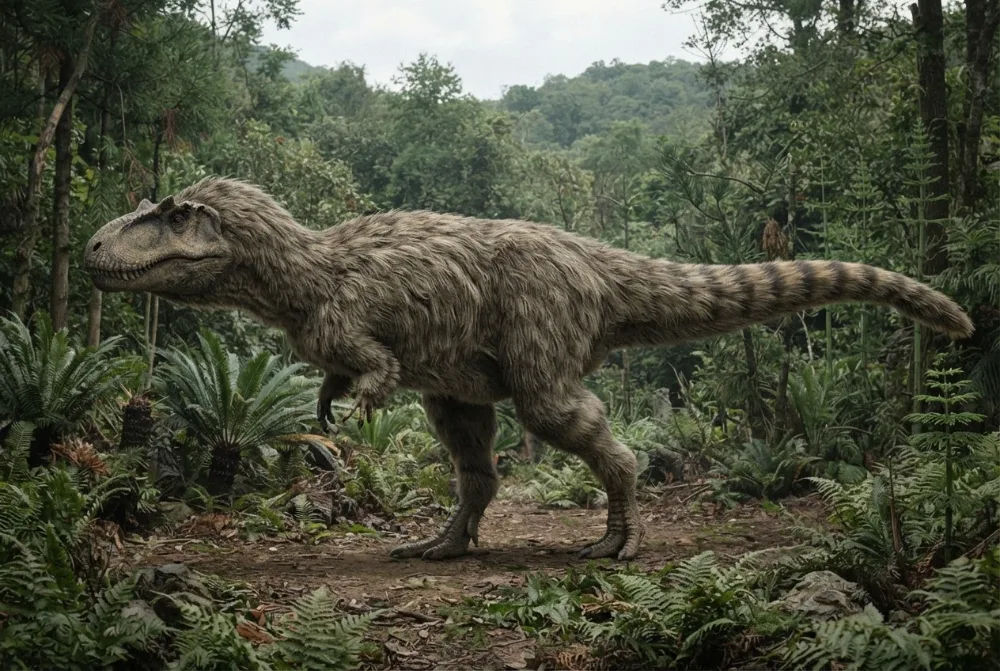
Yutyrannus was a big, feathered dinosaur that lived in China about 125 million years ago. It was a cousin of T. rex, but it had feathers all over its body. Scientists found three nearly complete skeletons, which helps us learn a lot about this amazing creature.21
When did it live?
How big was it?
How long was it?
How tall was it?
hip height estimated from femur length and typical theropod proportions
How heavy was it?

 as long as 2 cars parked in a row🍌as long as 56 bananas end to end🍉as heavy as 280 watermelons🧸as heavy as 74 kindergarten kids🎒as heavy as 44 school kids🐻❄️as heavy as 3 polar bears🏃could run 100 metres in 11 seconds (the fastest human needs 9.6)
How big was Yutyrannus compared to YOU?
Just maths in your browser. Nothing is saved or sent anywhere.
How fast was it?


Fun facts
Yutyrannus is the largest dinosaur ever found with direct evidence of feathers. It was about 40 times heavier than the previous record holder, Beipiaosaurus.1
The feathers of Yutyrannus were long and filamentous, up to 20 centimetres (7.9 inches) long. They may have covered most of its body.1
Yutyrannus lived during the early Cretaceous period, about 125 million years ago. That is about 55 million years before T. rex appeared.21
The three known Yutyrannus fossils were found together, which suggests they may have lived and hunted in packs.1
Yutyrannus had a bite force of about 2,405 newtons (540 pounds-force). That is strong, but much weaker than the bite of T. rex.1
The climate where Yutyrannus lived was cool, with an average annual temperature of about 10 °C (50 °F). Its feathers may have helped keep it warm.1
Most asked questions about Yutyrannus
?Did Yutyrannus have feathers?
Yes. Fossil imprints show it had long, filamentous feathers up to 20 centimetres long, making it the largest dinosaur with direct evidence of feathers.21
?What did Yutyrannus eat?
It was a carnivore, meaning it ate meat. It may have hunted in packs to take down large prey like sauropods.3
?Was Yutyrannus bigger than T. rex?
No. Yutyrannus was about 7.5 to 10 metres long, while T. rex could grow to over 12 metres. T. rex was larger.3
?When did Yutyrannus live?
It lived during the Early Cretaceous period, about 125 million years ago. That is about 55 million years before T. rex appeared.31
?Where was Yutyrannus found?
Its fossils were found in Liaoning Province, northeastern China, in rocks of the Yixian Formation.31
?Why did Yutyrannus have a crest?
The wavy crest on its snout was probably used for display, like to attract mates or show off.14
?How fast could Yutyrannus run?
Scientists are not sure exactly, but its short foot was not specialized for running, so it was probably not very fast.1

Ask Rex about Yutyrannus
Rex only answers questions about this page. 10 questions a month.
Rex is an AI and can make mistakes. He runs on servers in the EU and questions are never saved. Never type your name or other personal things.
For dino experts
- Scientific name
- Yutyrannus
- Named by
- Xu et al. 20125
- Group
- Tyrannosaurs
- Family / clade
- Proceratosauridae5
- Classification
- Theropoda > Tyrannosauroidea5
- Age of the rocks
- 126 to 120 million years (Barremian / Aptian)5
- Rock formations
- Yixian5
- Countries
- China5
- Fossil records
- 1 in the Paleobiology Database5
- Discovery
- Yutyrannus was named and described by Xu Xing and colleagues in 2012. The three fossils were bought from a fossil dealer who said they came from a single quarry in Liaoning, China.1
- Still debated
- Scientists are not sure if the feathers covered the whole body or only certain parts. They also debate whether later, larger tyrannosaurs like T. rex had feathers as adults.1
Where the facts come from
- Yutyrannus (en.wikipedia.org)
- A gigantic feathered dinosaur from the Lower Cretaceous of China | Nature (nature.com)
- Yutyrannus | Natural History Museum (nhm.ac.uk)
- Dinosaurs - Yutyrannus huali - The Australian Museum (australian.museum)
- Yutyrannus in The Paleobiology Database (CC BY 4.0): age, places, rock formations, classification.
Every fact on this page has a number that points to its source. If we got something wrong, sorry, we are dino fans, not a science journal. Tell us at [email protected] and we will fix it.
 Rex is hungry! Dino Wiki is a dad's project for his dino-loving son, free with no ads. Grown-ups can feed Rex a snack to help keep it online.Feed Rex
 Tyrannosaurus
 Tarbosaurus
 Albertosaurus
 Daspletosaurus
 Gorgosaurus
 Alectrosaurus
 Stegosaurus
 Iguanodon
 Archaeopteryx
 Giganotosaurus
 Microraptor
 Deinonychus