
Zhuchengtyrannus
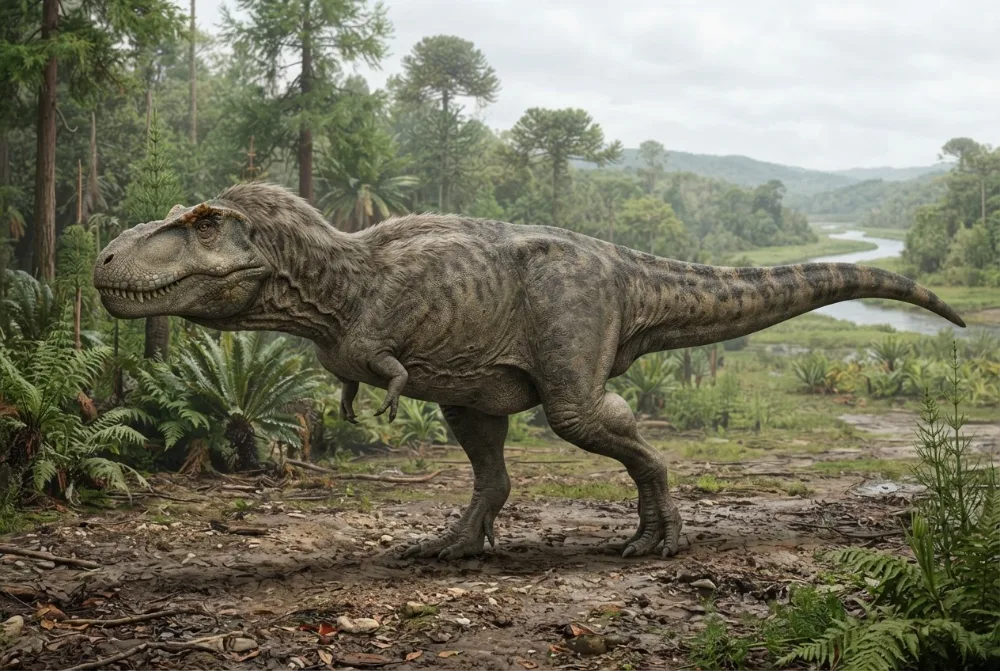
Zhuchengtyrannus was a huge, meat-eating dinosaur that lived in what is now China. It was as big as the famous T. rex and Tarbosaurus, and it ruled the land about 73 million years ago.21
When did it live?
How big was it?
How big was Zhuchengtyrannus compared to YOU?
Just maths in your browser. Nothing is saved or sent anywhere.
Fun facts
Zhuchengtyrannus is known from only a few bones: a right upper jaw bone (maxilla) and a left lower jaw bone (dentary).21
It lived in a floodplain that had one of the highest concentrations of dinosaur bones in the world.1
The name Zhuchengtyrannus magnus means 'great Zhucheng tyrant' because it was so big.1
Scientists think Zhuchengtyrannus was about 10 metres (33 feet) long and weighed about 5 metric tons (5.5 short tons).1
It belonged to a group of tyrannosaurs called Tyrannosaurinae, which includes T. rex and Tarbosaurus.23
The fossils were found in the Hongtuya Formation, which is about 73.5 million years old.1
Other dinosaurs found in the same quarry include the horned dinosaur Sinoceratops and the duck-billed Shantungosaurus.1
Most asked questions about Zhuchengtyrannus
?How big was Zhuchengtyrannus?
Zhuchengtyrannus was about 10 metres (33 feet) long and weighed about 5 metric tons (5.5 short tons). Some estimates suggest it was about 11 metres long and weighed close to 6 tonnes.14
?Was Zhuchengtyrannus bigger than T. rex?
No, Zhuchengtyrannus was similar in size to Tarbosaurus but smaller than the largest T. rex specimen called 'Sue'. Its jaw bones were a few centimetres smaller than Sue's.14
?What did Zhuchengtyrannus eat?
Zhuchengtyrannus was a meat-eating dinosaur that likely hunted and scavenged other dinosaurs, such as the horned Sinoceratops and the duck-billed Shantungosaurus that lived in the same area.14
?Where was Zhuchengtyrannus found?
Zhuchengtyrannus was discovered in Zhucheng, Shandong Province, eastern China, in a floodplain that has one of the highest concentrations of dinosaur bones in the world.14
?When did Zhuchengtyrannus live?
Zhuchengtyrannus lived during the Late Cretaceous Period, about 73.5 million years ago.1
?Did Zhuchengtyrannus have feathers?
Scientists are not sure, but since it was a large tyrannosaurid related to T. rex, it may have had some feathers, though no direct evidence has been found yet.1
?How fast could Zhuchengtyrannus run?
Nobody knows for sure, but because it was a large tyrannosaur similar to T. rex, it probably could not run very fast, maybe around 20 to 30 km/h (12 to 19 mph).1
?Is Zhuchengtyrannus a dinosaur?
Yes, Zhuchengtyrannus is a dinosaur. It is a theropod dinosaur from the tyrannosaurid family.1

Ask Rex about Zhuchengtyrannus
Rex only answers questions about this page. 3 questions a day.
Rex is an AI and can make mistakes. He runs on servers in the EU and questions are never saved. Never type your name or other personal things.
For dino experts
- Scientific name
- Zhuchengtyrannus
- Named by
- Hone et al. 20115
- Group
- Tyrannosaurs
- Family / clade
- Tyrannosauridae5
- Classification
- Theropoda > Tyrannosauroidea > Tyrannosauridae5
- Age of the rocks
- 84 to 72 million years (Campanian)5
- Rock formations
- Hongtuya5
- Countries
- China5
- Fossil records
- 1 in the Paleobiology Database5
- Discovery
- Zhuchengtyrannus was named in 2011 by David Hone and his team. The fossils were found in 2008 during big digs near Zhucheng, China.21
- Still debated
- Scientists are not sure if other tyrannosaur bones found in the same quarry belong to Zhuchengtyrannus or to a different species.21
Where the facts come from
- Zhuchengtyrannus (en.wikipedia.org)
- A new, large tyrannosaurine theropod from the Upper Cretaceous of China (sciencedirect.com)
- PBDB Taxon (paleobiodb.org)
- IVPP Researchers Identify Long Lost Cousin Of T. Rex in China--Institute of Vertebrate Paleontology and Paleoanthropology (english.ivpp.cas.cn)
- Zhuchengtyrannus in The Paleobiology Database (CC BY 4.0): age, places, rock formations, classification.
Every fact on this page has a number that points to its source. If we got something wrong, sorry, we are dino fans, not a science journal. Tell us at [email protected] and we will fix it.
Rex is hungry! Dino Wiki is a dad's project for his dino-loving son, free with no ads. Grown-ups can feed Rex a snack to help keep it online.Feed Rex Tarbosaurus
 Albertosaurus
 Daspletosaurus
 Gorgosaurus
 Alectrosaurus
 Triceratops
 Velociraptor
 Spinosaurus
 Ankylosaurus
 Parasaurolophus
 Pteranodon