 Zer dino zara? Galdetegia
 Dino borroka
 Dino lasterketa
 Dino minijokoak
 Pegatina-albuma
 Dino TOP zerrendak
 Harritu nazazu!
Noiz bizi izan zen?

Zein handia zen?
Zein luzea zen?
Zein altua zen?
kalkulua
Zein astuna zen?
 6 txakur bezain luze, sudurretik buztanera🍌bata bestearen atzean jarritako 33 banana bezain luze🍉80 angurria bezain astun🧸haur-eskolako 21 haur bezain astun🎒12 eskolaume bezain astun🏃100 metro 8 segundotan egin zitzakeen korrika (gizakirik azkarrenak 9,6 behar ditu)
Zein handia zen Concavenator ZUREKIN alderatuta?
Zure nabigatzaileko kalkulu hutsak. Ez da ezer gordetzen ez inora bidaltzen.
Zein azkarra zen?


Datu dibertigarriak
Concavenator had a hump on its back made from two tall bones in its spine.1
Scientists found small bumps on its arm bone that might be quill knobs, places where feathers attach.12
It lived about 130 to 125 million years ago during the Early Cretaceous Period.1
Its fossils were found at Las Hoyas in Spain, which was once an inland lake.1
Concavenator belongs to the carcharodontosaur group, which means 'shark-toothed lizards'.1
The hump on Concavenator's back might have been used for display or to store fat, but scientists are not sure.2
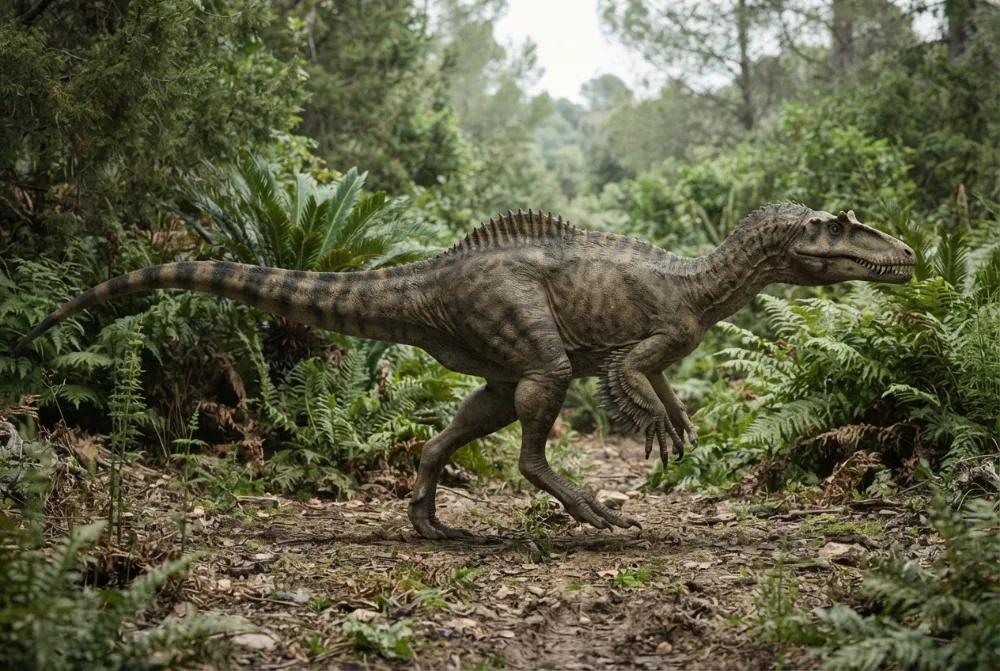
Concavenator: gehien egindako galderak
?How big was Concavenator?
Concavenator was a medium sized dinosaur, about 5 to 6 metres long and weighed around 320 to 400 kilograms.31
?What did Concavenator eat?
Concavenator was a carnivore, meaning it ate meat. It likely hunted other animals that lived in its environment.1
?Did Concavenator have feathers?
Scientists disagree. Some think small bumps on its arm bone were quill knobs where feathers attached, but others think they were muscle scars. Scaly skin was found on its feet and tail.132
?Why did Concavenator have a hump?
Nobody knows for sure. It might have been used for display to recognise each other, or for temperature control like a camel's hump.13
?When did Concavenator live?
Concavenator lived about 130 to 125 million years ago, during the Early Cretaceous Period.13
?Where was Concavenator found?
Its fossils were found at the Las Hoyas site in Cuenca, Spain. That area was once an inland lake.13
?Was Concavenator a dinosaur?
Yes, Concavenator was a theropod dinosaur. It belongs to the carcharodontosaur group, which means 'shark-toothed lizards'.13
?Is Concavenator related to Spinosaurus?
No, Concavenator is not a spinosaur. It is a carcharodontosaur, a different group of meat-eating dinosaurs.1
Mito-hauslea
Mitoa: Some people think Concavenator was a spinosaur because of its hump.
Egia: Concavenator was not a spinosaur. It was a carcharodontosaur, a different group of meat-eating dinosaurs.1
Dino adituentzat
- Izen zientifikoa
- Concavenator
- Izendatzailea:
- Ortega et al. 20104
- Taldea
- Dino haragijaleak
- Familia / klada
- Carcharodontosauridae4
- Sailkapena
- Theropoda > Allosauroidea > Carcharodontosauridae4
- Arroken adina
- 126 eta 121 milioi urte artean (Barremian)4
- Arroka-formazioak
- La Huérguina4
- Herrialdeak
- Espainia4
- Fosil-erregistroak
- 1 The Paleobiology Database datu-basean4
- Aurkikuntza
- Concavenator was named by Ortega, Escaso and Sanz in 2010. The type specimen is MCCM-LH 6666, a nearly complete skeleton found at Las Hoyas, Spain.14
- Oraindik eztabaidagai
- Scientists still debate whether the bumps on Concavenator's arm bone are really quill knobs for feathers or something else.2
Datuak nondik datozen
- Concavenator | Natural History Museum (nhm.ac.uk)
- A bizarre, humped Carcharodontosauria (Theropoda) from the Lower Cretaceous of Spain | Nature (nature.com)
- Concavenator (en.wikipedia.org)
- Concavenator in The Paleobiology Database (CC BY 4.0): adina, tokiak, arroka-formazioak, sailkapena.
Orrialde honetako datu bakoitzak zenbaki bat du, bere iturrira eramaten zaituena. Zerbait gaizki badugu, barkatu, dino-zaleak gara, ez zientzia-aldizkari bat. Idatzi [email protected] helbidera eta konponduko dugu.
 Rex gose da! Dino Wiki aita baten proiektua da, dinosauroak maite dituen bere semearentzat, doakoa, iragarkirik eta jarraitzailerik gabe. Helduek mokadutxo bat eman diezaiokete Rexi, sarean jarraitzen laguntzeko.Eman jaten Rexi
 Allosaurus
 Carnotaurus
 Dilophosaurus
 Giganotosaurus
 Compsognathus
 Paronychodon
 Stegosaurus
 Iguanodon
 Archaeopteryx
 Microraptor
 Deinonychus
 Baryonyx