 Zer dino zara? Galdetegia
 Dino borroka
 Dino lasterketa
 Dino minijokoak
 Pegatina-albuma
 Dino TOP zerrendak
 Harritu nazazu!
Tupandactylus
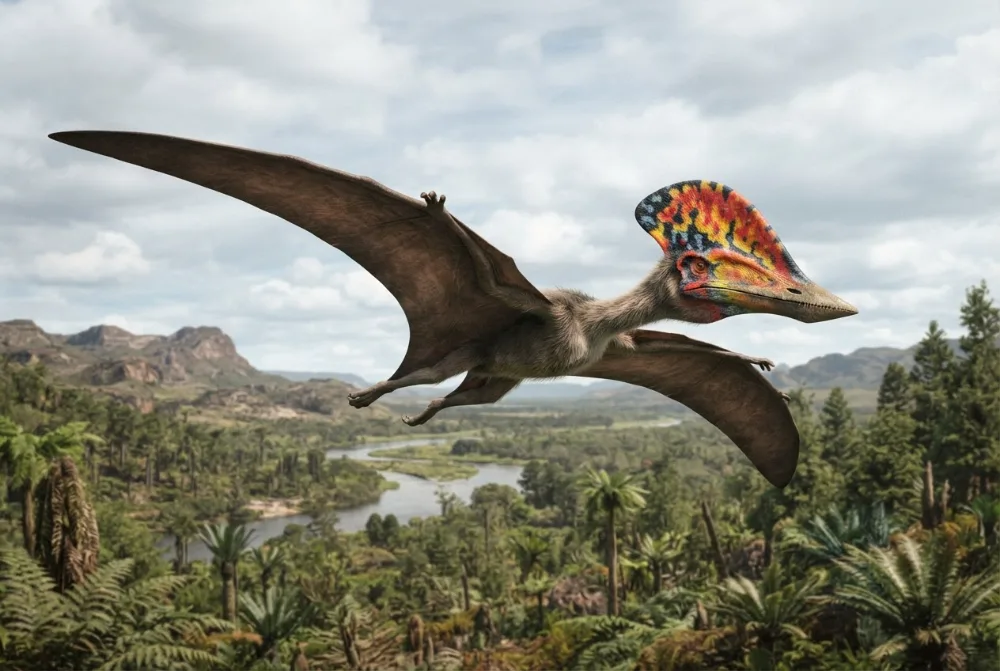
Tupandactylus was a flying reptile with a huge, colorful crest on its head. It lived in what is now Brazil about 115 million years ago and probably ate plants like a flying fruit-lover.12
Noiz bizi izan zen?
Zein handia zen?
Zein zabalak ziren bere hegoak?
Zein altua zen?
 ilaran jarritako 2 bizikleta bezain zabalak diren hegoak⚽futbol zelai oso bat zeharkatu zezakeen hegan 6 segundotan
Zein handia zen Tupandactylus ZUREKIN alderatuta?
Zure nabigatzaileko kalkulu hutsak. Ez da ezer gordetzen ez inora bidaltzen.
Zein azkarra zen?


Datu dibertigarriak
Tupandactylus had a giant head crest made of soft tissue and supported by bone spines. In T. imperator the crest was round, while in T. navigans it was tall and vertical.1
Its name comes from Tupã, the Tupi thunder god, and daktylos, the Greek word for finger.1
Tupandactylus probably spent a lot of time on the ground and only flew short distances, because its big crest made flying harder.1
The first fossil of Tupandactylus was a skull and partial lower jaw found in the Crato Formation of Brazil.1
Scientists think Tupandactylus may have been a terrestrial forager, walking around on the ground to find food.1
Tupandactylus had a fifth toe on its foot with a single bone, a feature seen in some other azhdarchoid pterosaurs.3
Tupandactylus: gehien egindako galderak
?How big was Tupandactylus?
Tupandactylus imperator had a wingspan of about 3 to 4 metres (9.8 to 13.1 feet) and stood about 1.5 metres (4.9 feet) tall to the tip of its crest. The smaller species, T. navigans, had a wingspan of about 2.7 metres (8.9 feet).14
?Why did Tupandactylus have a crest?
Scientists think the crest was used for social or sexual display, like a peacock's tail. It was made of soft tissue and bone, and it was so big it may have made flying harder.14
?What did Tupandactylus eat?
Tupandactylus probably ate plants, like fruit, and may have used its long neck to reach food from higher bushes. Some fossils show plant material near its skull, hinting it was a herbivore.14
?Was Tupandactylus a dinosaur?
No, Tupandactylus was a pterosaur, a flying reptile that is not a dinosaur. It is closely related to dinosaurs but belongs to a separate group.1
?When did Tupandactylus live?
Tupandactylus lived about 112 million years ago, during the Early Cretaceous period, in what is now Brazil.1
Mito-hauslea
Mitoa: Some people think Tupandactylus was a dinosaur.
Egia: Tupandactylus was a pterosaur, a flying reptile that is not a dinosaur.1
Dino adituentzat
- Izen zientifikoa
- Tupandactylus
- Izendatzailea:
- Kellner and Campos 20075
- Taldea
- Narrasti hegalariak
- Familia / klada
- Tapejaridae5
- Sailkapena
- Pterosauria > Pterodactyloidea5
- Arroken adina
- 120 eta 113 milioi urte artean (Aptian)5
- Arroka-formazioak
- Crato5
- Herrialdeak
- Brasil5
- Fosil-erregistroak
- 3 The Paleobiology Database datu-basean5
- Aurkikuntza
- Tupandactylus was first described in 1997 as a species of Tapejara by D. A. Campos and Alexander W. A. Kellner. In 2007, Campos and Kellner gave it its own genus name Tupandactylus.1
- Oraindik eztabaidagai
- Scientists are not sure if Tupandactylus imperator and Tupandactylus navigans are two different species or just males and females of the same species.1
Datuak nondik datozen
- Tupandactylus (en.wikipedia.org)
- PBDB Taxon (paleobiodb.org)
- Redescription of Tupandactylus imperator Campos & Keller, 1997 (Pterosauria, Tapejaridae) based on a new complete specimen from the Crato Formation (Aptian-Albian) of the Araripe Basin, Ceará, Brazil (doi.org)
- Pterosaur had a head crest so tall it may have made it hard to fly | New Scientist (newscientist.com)
- Tupandactylus in The Paleobiology Database (CC BY 4.0): adina, tokiak, arroka-formazioak, sailkapena.
Orrialde honetako datu bakoitzak zenbaki bat du, bere iturrira eramaten zaituena. Zerbait gaizki badugu, barkatu, dino-zaleak gara, ez zientzia-aldizkari bat. Idatzi [email protected] helbidera eta konponduko dugu.
 Rex gose da! Dino Wiki aita baten proiektua da, dinosauroak maite dituen bere semearentzat, doakoa, iragarkirik eta jarraitzailerik gabe. Helduek mokadutxo bat eman diezaiokete Rexi, sarean jarraitzen laguntzeko.Eman jaten Rexi
 Pteranodon
 Quetzalcoatlus
 Dorygnathus
 Rhamphorhynchus
 Anhanguera
 Pterodactylus
 Stegosaurus
 Iguanodon
 Archaeopteryx
 Giganotosaurus
 Microraptor
 Deinonychus