
Foskeia
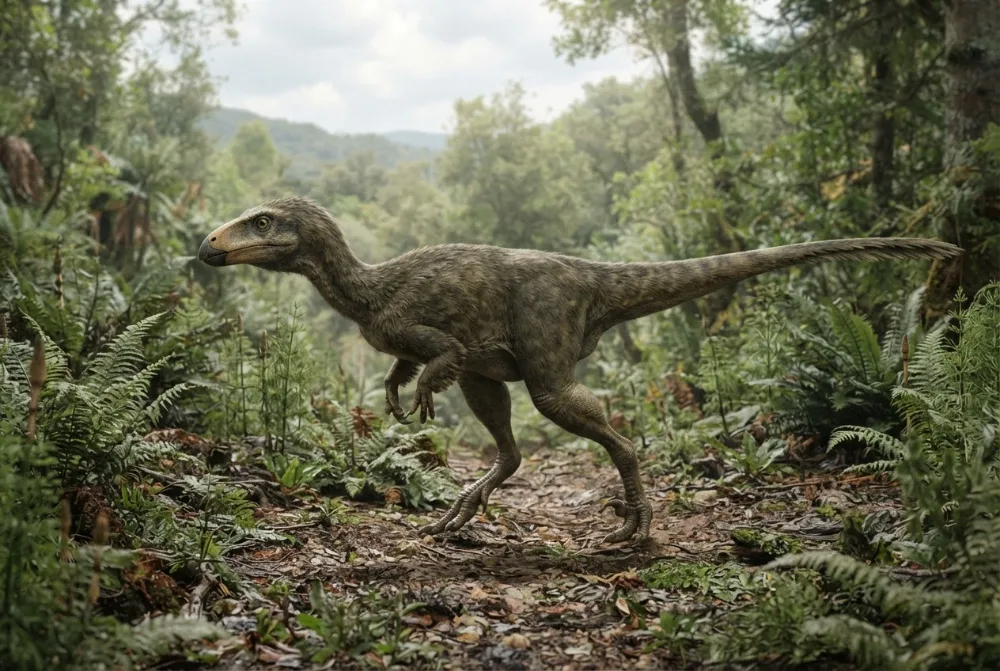
Foskeia was a small, two-legged plant-eater that lived in what is now Spain. It had a beak and a very special skull, and it was one of the earliest members of its dinosaur group.1
Ɗuum wuurii nde?
Hol no o mawni?
No juutuno?
Hol no Foskeia mawninoo, so fondaama bee AAN?
Hiisa tan nder browser maa. Walaa huunde danndetee walla neldetee ka nokku fuu.
How fast was it?
Anndal belɗungal
Foskeia had a beak made of fused premaxillae bones, which is very unusual for an ornithopod dinosaur.1
Its front teeth stuck out forward (procumbent) and the crowns extended beyond the edge of the beak.1
The first tooth in its lower jaw was shaped like a thin thread (filiform), which is a unique feature.1
Foskeia had a very high jaw joint, which helped it bite with extra force.1
Scientists used CT scans to see inside the skull fossils and build a 3D model of the head.1
Foskeia lived about 125 to 119 million years ago, during the Early Cretaceous period.2
This dinosaur is the earliest known member of a group called Rhabdodontia, which lived only in Europe.1
Naamne ɓurɗe naamneede fii Foskeia
?How big was Foskeia?
Foskeia was very small, about 0.5 metres (1.6 feet) long, making it one of the smallest ornithopods known.31
?What did Foskeia eat?
Foskeia was a plant-eater (herbivore). Its name means 'light forager', referring to its small size and presumed herbivorous habits.3
?Could Foskeia walk on two legs?
Yes, adults were bipedal. Juveniles started out walking on all fours, but switched to two legs early in life.3
?Why did Foskeia have a beak?
Foskeia had a beak made of fused premaxillae bones, which is unusual for an ornithopod. It likely used it to bite off plant material.3
?When did Foskeia live?
Foskeia lived during the Early Cretaceous, about 125 to 119 million years ago, in what is now Spain.3

Naamnu Rex fii Foskeia
Rex jaabata ƴamle dow hello ngo'o tan. Ƴamle 10 e lewru.
Rex ko AI, o waawi waɗugo juumre. O golla ka serverji nder EU, naamne danndetaake abada. Taa winndu innde maa walla huunde goɗnde ngam maa.
Ngam annduɓe dino
- Innde ganndal
- Foskeia
- Inndoowo
- Dieudonné et al. 20264
- Fedde
- Nyaamooji haako, hunduko maaɗi no colli
- Fedde / clade
- Rhabdodontia4
- Fedde
- Ornithischia > Ornithopoda > Iguanodontia4
- Duuɓi kaaƴe
- 126 haa 120 miliyon duuɓi (Barremian / Aptian)4
- Cuuɗi kaaƴe
- Castrillo de la Reina4
- Leyɗe
- Spain4
- Fosilji tawaaɗi
- 1 nder Paleobiology Database4
- Tawgol
- Foskeia was named in 2026 by a team of scientists led by Dieudonné, based on fossils found at the Vegagete site in Burgos, Spain. The remains were first thought to belong to a different dinosaur, but new skull bones showed it was a new species.12
- Haa jooni ɓe ɗon yeddondira
- Scientists are not sure exactly how big Foskeia grew, because only a few bones have been found so far.1
To haalaaji ummii
- Foskeia pelendonum, a new rhabdodontomorph from the Lower Cretaceous of Salas de los Infantes (Burgos Province, Spain), and a new phylogeny of ornithischian dinosaurs (riull.ull.es)
- PBDB Taxon (paleobiodb.org)
- Foskeia (en.wikipedia.org)
- Foskeia in The Paleobiology Database (CC BY 4.0): duuɓi, nokkuuje, cuuɗi kaaƴe, pecce.
Kala anndal nder ngal hello mari limre holloore iwdi mum. Si min mbaɗii juumre, yaafo min, min ko yiɗɓe dino, min wanaa jaaynde anndal. Haalan min ka [email protected], min moƴƴinan ɗum.
 Rex ɗon weelo! Dino Wiki, ɗum golle baaba ngam ɓiyiiko gorko mo yiɗi dinosauruuji, alaa njoɓdi, alaa ko yeeyata. Mawɓe mbaawi hokkude Rex ñaamdu ngam wallude lowre ndee heddoo e internet.Nyaamnu Rex
 Iguanodon
 Tenontosaurus
 Thescelosaurus
 Zalmoxes
 Camptosaurus
 Rhabdodon
 Stegosaurus
 Archaeopteryx
 Giganotosaurus
 Microraptor
 Deinonychus
 Baryonyx