
Paraxenisaurus
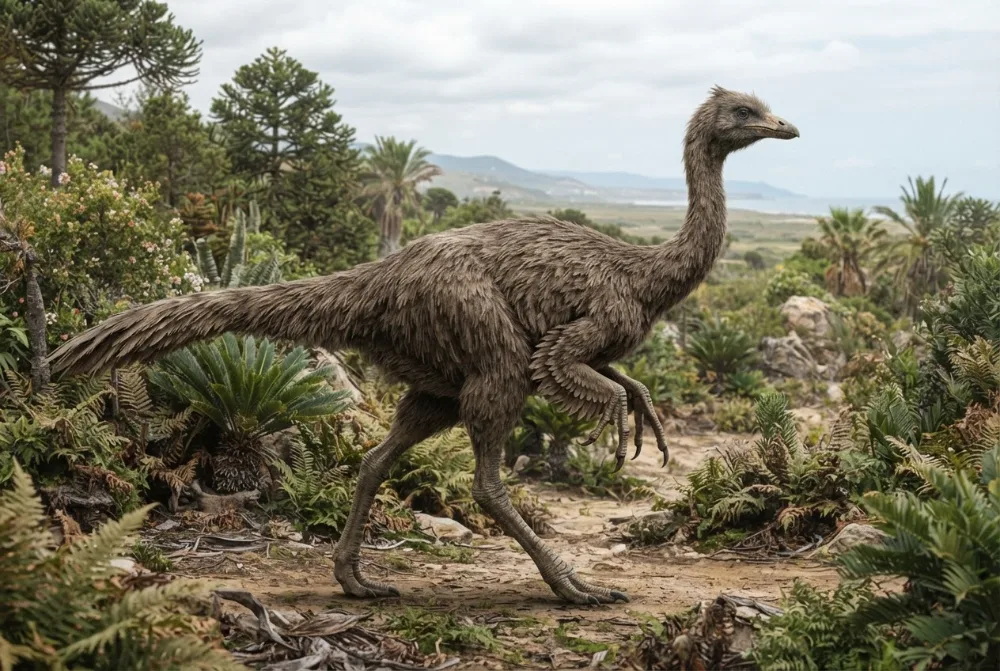
Paraxenisaurus was a large, ostrich-like dinosaur that lived in Mexico during the Late Cretaceous. It had long legs and a stiff tail, and it probably used its clawed hands to grab plants or small animals.1
Ɗuum wuurii nde?
Hol no o mawni?
No juutuno?
No tedduno?
Hol no Paraxenisaurus mawninoo, so fondaama bee AAN?
Hiisa tan nder browser maa. Walaa huunde danndetee walla neldetee ka nokku fuu.
How fast was it?
Anndal belɗungal
Paraxenisaurus is the only member of its family, Deinocheiridae, known from the ancient continent of Laramidia.1
Its tail was very long and stiff, with little up-and-down movement, unlike many other ornithomimosaurs.1
It still had a first toe, a feature lost in many other ornithomimosaurs.1
The species name 'normalensis' honors the Benemérita Normal School of Coahuila, where the fossils are kept.1
Its fossils were found in rocks that were once a coastal floodplain with rivers and forests.1
Naamne ɓurɗe naamneede fii Paraxenisaurus
?How big was Paraxenisaurus?
It was about 5.7 metres (19 feet) long and weighed around 600 kilograms (1,300 pounds). That's roughly as big as a close relative called Beishanlong.1
?What did Paraxenisaurus eat?
It was probably an herbivore or omnivore, meaning it ate plants and maybe small animals. It had clawed hands that could grab food.3
?When did Paraxenisaurus live?
It lived during the Late Cretaceous Period, about 72 to 66 million years ago.1
?Where was Paraxenisaurus found?
Its fossils were found in the Cerro del Pueblo Formation in Coahuila, Mexico. That area was once a coastal floodplain with rivers and forests.1

Naamnu Rex fii Paraxenisaurus
Rex jaabata ƴamle dow hello ngo'o tan. Ƴamle 10 e lewru.
Rex ko AI, o waawi waɗugo juumre. O golla ka serverji nder EU, naamne danndetaake abada. Taa winndu innde maa walla huunde goɗnde ngam maa.
Ngam annduɓe dino
- Innde ganndal
- Paraxenisaurus
- Inndoowo
- Serrano-Brañas et al. 20203
- Fedde
- Dinosauri nannduɗi e ndaw
- Fedde / clade
- Deinocheiridae3
- Fedde
- Theropoda > Ornithomimosauria3
- Duuɓi kaaƴe
- 84 haa 72 miliyon duuɓi (Campanian)3
- Cuuɗi kaaƴe
- Cerro del Pueblo3
- Leyɗe
- Mexico3
- Fosilji tawaaɗi
- 1 nder Paleobiology Database3
- Tawgol
- Paraxenisaurus was named in 2020 by Mexican paleontologists Claudia Serrano-Brañas and colleagues, based on bones collected in the 1990s from three sites in Coahuila, Mexico.1
- Haa jooni ɓe ɗon yeddondira
- Scientists are not sure how big Paraxenisaurus grew, because only a few bones have been found.1
To haalaaji ummii
- Paraxenisaurus (en.wikipedia.org)
- PBDB Taxon (paleobiodb.org)
- Paraxenisaurus in The Paleobiology Database (CC BY 4.0): duuɓi, nokkuuje, cuuɗi kaaƴe, pecce.
Kala anndal nder ngal hello mari limre holloore iwdi mum. Si min mbaɗii juumre, yaafo min, min ko yiɗɓe dino, min wanaa jaaynde anndal. Haalan min ka [email protected], min moƴƴinan ɗum.
 Rex ɗon weelo! Dino Wiki, ɗum golle baaba ngam ɓiyiiko gorko mo yiɗi dinosauruuji, alaa njoɓdi, alaa ko yeeyata. Mawɓe mbaawi hokkude Rex ñaamdu ngam wallude lowre ndee heddoo e internet.Nyaamnu Rex
 Gallimimus
 Ornithomimus
 Struthiomimus
 Deinocheirus
 Dromiceiomimus
 Archaeornithomimus
 Tyrannosaurus
 Triceratops
 Velociraptor
 Spinosaurus
 Ankylosaurus
 Parasaurolophus