 Que dino es ti? O test
 Batalla de dinos
 Carreira de dinos
 Minixogos de dinos
 Álbum de cromos
 Listas TOP de dinos
 Sorpréndeme!
Huayangosaurus
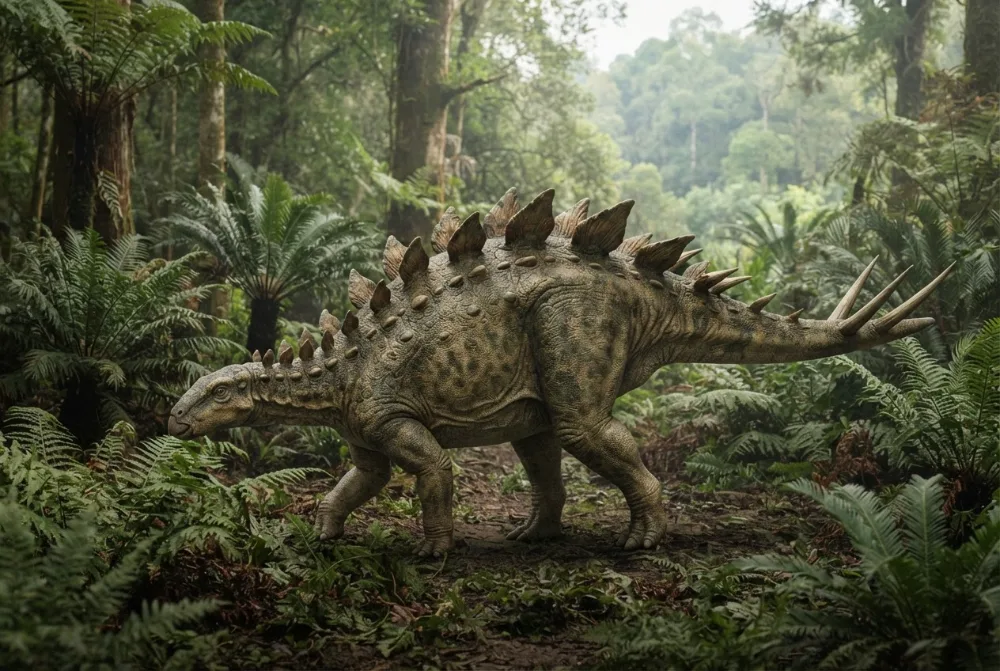
Huayangosaurus was a small, plant-eating dinosaur that lived about 165 million years ago in what is now China. It had a double row of bony plates and spikes along its back and tail, which it probably used for defense and showing off. This early stegosaur was much smaller than its famous relative Stegosaurus.1
Cando viviu?
Como era de grande?
Canto medía de longo?
Canto medía de alto?
Canto pesaba?
 tan longo coma 4 cans do fociño á cola🍌tan longo coma 22 plátanos postos un tras outro🍉tan pesado coma 100 sandías🧸tan pesado coma 26 nenos de infantil🎒tan pesado coma 16 nenos de primaria🏃podería correr 100 metros en 16 segundos (o humano máis rápido necesita 9,6)
Como era de grande Huayangosaurus comparado CONTIGO?
Só son contas no teu navegador. Non se garda nin se envía nada.
Que velocidade alcanzaba?


Datos curiosos
Huayangosaurus had a beak with teeth in the front of its mouth, a feature that later stegosaurs lost.2
Its bony plates had vein-like cavities that may have helped control body temperature or change color to scare off predators or attract mates.2
Huayangosaurus lived about 20 million years before Stegosaurus appeared in North America.1
It had two pairs of long spikes at the end of its tail, forming a weapon called a thagomizer.1
Fossils of at least twelve individual Huayangosaurus were found together in the Dashanpu Quarry.1
Its front legs were longer than those of later stegosaurs, and it had a broader skull.2
As preguntas máis frecuentes sobre Huayangosaurus
?How big was Huayangosaurus?
About 4 metres (13 ft) long and weighed around 500 kilograms (1,100 lb). It was one of the smallest known stegosaurians.1
?What did Huayangosaurus eat?
It was a plant-eater, or herbivore.2
?When did Huayangosaurus live?
It lived during the Middle Jurassic, about 165 million years ago.1
?Where was Huayangosaurus found?
Its fossils were discovered in the Dashanpu Quarry near Zigong in Sichuan Province, China.12
?Did Huayangosaurus have feathers?
No, the sources do not mention feathers. It had bony plates and spikes on its back and tail.1
?Was Huayangosaurus bigger than Stegosaurus?
No, it was much smaller. Stegosaurus was about 9 metres long, while Huayangosaurus was only about 4 metres long.1
Para expertos en dinos
- Nome científico
- Huayangosaurus
- Bautizado por
- Dong et al. 19824
- Grupo
- Dinos con placas
- Familia / clado
- Huayangosauridae4
- Clasificación
- Ornithischia > Stegosauria > Thyreophora4
- Idade das rochas
- de 171 a 155 millóns de anos (Bajocian / Oxfordian)4
- Formacións rochosas
- Shaximiao4
- Países
- China4
- Rexistros fósiles
- 1 na Paleobiology Database4
- Descubrimento
- Huayangosaurus was named in 1982 by Chinese paleontologists Dong Zhiming, Tang Zilu, and Zhou Shiwu, based on fossils found in 1979 and 1980 at Dashanpu Quarry in Sichuan, China.1
- Aínda en debate
- Scientists are not sure whether the bony plates on Huayangosaurus were mainly used for defense, display, or regulating body temperature.2
De onde veñen os datos
- Huayangosaurus (en.wikipedia.org)
- Dinosaurs - Huayangosaurus taibaii - The Australian Museum (australian.museum)
- science-resources.co.uk - Dinosaurs: Huayangosaurus (science-resources.co.uk)
- Huayangosaurus in The Paleobiology Database (CC BY 4.0): idade, lugares, formacións rochosas, clasificación.
Cada dato desta páxina ten un número que leva á súa fonte. Se nos equivocamos nalgo, sentímolo, somos fans dos dinos, non unha revista científica. Escríbenos a [email protected] e arranxámolo.
 Rex ten fame! Dino Wiki é o proxecto dun pai para o seu fillo, que adora os dinosauros, gratis, sen anuncios e sen rastrexadores. Os adultos poden darlle un petisco a Rex para mantelo en liña.Dálle de comer a Rex
 Stegosaurus
 Diracodon
 Hypsirophus
 Dacentrurus
 Miragaia
 Kentrosaurus
 Ichthyosaurus
 Khudiakovia
 Ophthalmosaurus
 Pterodactylus
 Peloneustes
 Rhamphocephalus