 Kwizi: Oli dayinoso ki?
 Olutalo lwa dayinoso
 Empaka z'emisinde gya dayinoso
 Emizannyo emitono egya dayinoso
 Alubaamu ya sitika
 Enkalala za dayinoso eza TOP
 Mpa ekyewuunyisa!
Apatornis
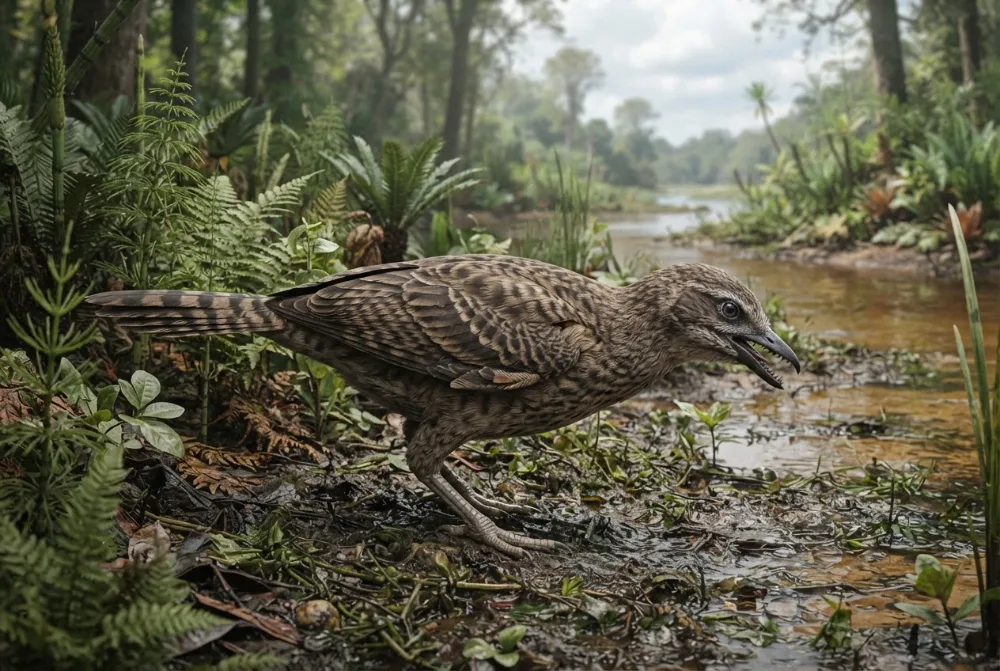
Apatornis was a small, toothed bird that lived in the Late Cretaceous period, about 83.5 million years ago. It was a fast, ground-dwelling hunter that probably chased after small prey. Even though it could fly, it spent much of its time on the ground.12
Yabeerawo ddi?
Yali munene atya?
Yali muwanvu kwenkana wa?
Yali mugulumivu kwenkana wa?
kuteebereza
Apatornis yali munene atya bw'ogeraageranya ku GGWE?
Kubala kwokka mu browser yo. Tewali kiterekebwa wadde okusindikibwa wonna.
Yali wa mbiro kwenkana wa?


Ebyewuunyisa
Apatornis had at least one more rib attached to its hip vertebrae than its close relative Ichthyornis, and maybe more, because the whole hip bone wasn't preserved.1
Unlike Ichthyornis, Apatornis did not have ossified tendons covering the top of its sacral region, which is a unique feature.1
The only known fossil of Apatornis is a synsacrum, which is the fused vertebrae over the hips, and it was found in the Smoky Hill Chalk of Kansas.1
Apatornis was originally classified as a species of Ichthyornis, but scientists now think it's more closely related to modern birds.1
The type specimen of Apatornis was discovered by Othniel Charles Marsh in October 1872 at Butte Creek in Kansas.1
Apatornis lived during the Coniacian to Santonian stages, about 89.8 to 83.6 million years ago.2
Ebibuuzo ebisinga okubuuzibwa ku Apatornis
?How big was Apatornis?
It was very small, about 18 to 20 centimetres long, which is roughly the size of a modern sparrow.1
?What did Apatornis eat?
It was a ground-dwelling carnivore that probably chased after small prey like insects or tiny vertebrates.2
?Could Apatornis fly?
Yes, it could fly, but it spent much of its time on the ground hunting for food.1
?Is Apatornis a dinosaur?
Yes, Apatornis is a genus of ornithuran dinosaurs, specifically a small, toothed bird from the Late Cretaceous.1
Omumenyi w'enfumo
Enfumo: Apatornis was a close relative of Ichthyornis.
Amazima: Scientists used to think so, but in 2004, Julia Clarke showed that Apatornis is actually more closely related to modern birds than to Ichthyornis.1
Eri abakugu mu dayinoso
- Erinnya lya ssaayansi
- Apatornis
- Yatuumibwa
- Marsh 18732
- Ekibinja
- Ebinyonyi eby'olubereberye
- Ekika / ekibinja
- Ornithurae2
- Engabanya
- Theropoda > Avialae2
- Emyaka gy'enjazi
- emyaka obukadde 90 okutuuka ku 84 (Coniacian / Santonian)2
- Ensengeka z'enjazi
- Niobrara2
- Ensi
- Amerika2
- Ebisigalira ebyazuulibwa
- 1 mu The Paleobiology Database2
- Okuzuulibwa
- Apatornis was named by Othniel Charles Marsh in 1873. He found the first fossil, a synsacrum, in October 1872 at Butte Creek in Kansas, USA.1
- Kikyakubaganyizibwako ebirowoozo
- Scientists are still debating whether Apatornis is a valid genus or just a variation of Ichthyornis, because the only fossil is so incomplete.1
Ebituufu gye biva
- Apatornis (en.wikipedia.org)
- Apatornis in The Paleobiology Database (CC BY 4.0): emyaka, ebifo, ensengeka z'enjazi, engabanya.
Buli kituufu ku lupapula luno kirina ennamba eraga ensibuko yaakyo. Bwe tuba nga tukoze ensobi, tusonyiwe, ffe tuli bawagizi ba dayinoso, so si magazini ya ssaayansi. Tubuulire ku [email protected] tujja kugitereeza.
 Rex alumwa enjala! Dino Wiki pulojekiti ya taata eri mutabani we ayagala ennyo dayinoso, ya bwereere, tewali bulango era tewali bikulondoola. Abakulu basobola okuwa Rex akantu ak'okulya okuyamba okugikuuma ku mutimbagano.Liisa Rex
 Archaeopteryx
 Hesperornis
 Ichthyornis
 Baptornis
 Jurapteryx
 Gobipteryx
 Tyrannosaurus
 Triceratops
 Velociraptor
 Spinosaurus
 Ankylosaurus
 Parasaurolophus