 Kwizi: Oli dayinoso ki?
 Olutalo lwa dayinoso
 Empaka z'emisinde gya dayinoso
 Emizannyo emitono egya dayinoso
 Alubaamu ya sitika
 Enkalala za dayinoso eza TOP
 Mpa ekyewuunyisa!
Argentinonectes
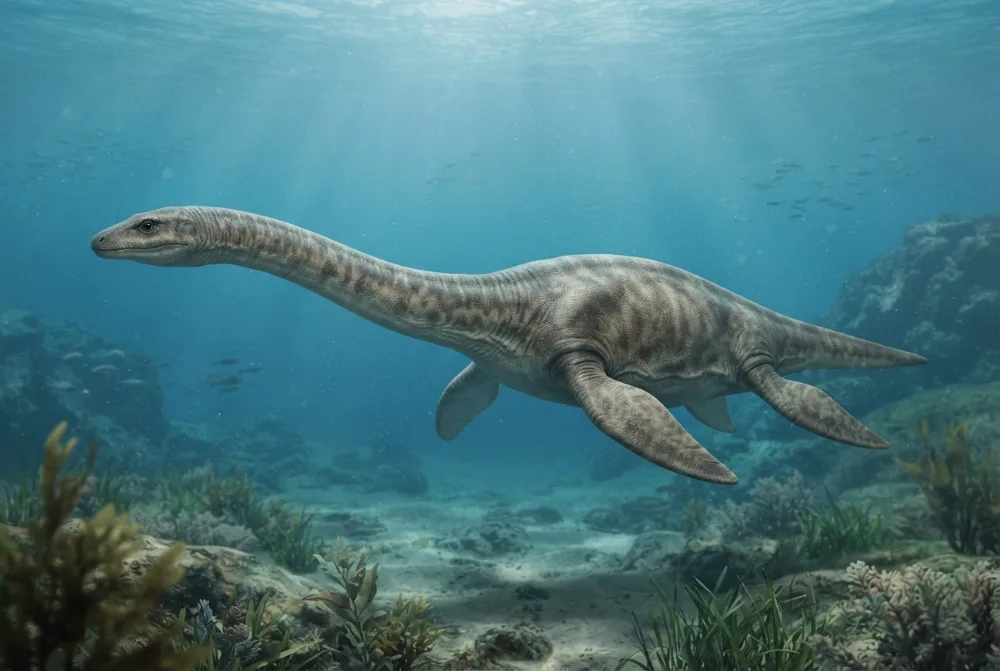
Argentinonectes was a huge, long-necked marine reptile that swam in the seas near Antarctica 66 million years ago. It had four flipper-like legs and a stiff tail that may have had a fin on the end. This plesiosaur is the most complete one ever found in Argentina!1
Yabeerawo ddi?
Yali munene atya?
Yali muwanvu kwenkana wa?
 obuwanvu ng'emmotoka 2 ezisimbiddwa mu lunyiriri🍌obuwanvu ng'amenvu 50 nga gaddiriŋŋana🏊yandiwuze obuwanvu bw'ekidiba ekinene (50 m) mu sikonda 7.8
Argentinonectes yali munene atya bw'ogeraageranya ku GGWE?
Kubala kwokka mu browser yo. Tewali kiterekebwa wadde okusindikibwa wonna.
Yali wa mbiro kwenkana wa?


Ebyewuunyisa
The fossil was found under 50 cm (20 inches) of water in Lake Argentino, making it tricky to dig out.1
Its rib cage and belly bones were very stiff, which helped it dive without its lungs collapsing.1
Shark teeth and scratches on its bones show that sharks ate the dead plesiosaur's body.1
The tail had eight tightly locked vertebrae at the tip, probably supporting a small tail fin.1
Its forelimbs were about 1.8 metres (5.9 feet) long, and the hindlimbs were a bit shorter at 1.3 metres (4.3 feet).1
The skeleton is missing the skull and most of the neck, possibly because they floated away after death.1
Ebibuuzo ebisinga okubuuzibwa ku Argentinonectes
?How big was Argentinonectes?
It was about 7 to 9 metres (23 to 30 feet) long. That is roughly as long as a school bus.1
?What did Argentinonectes eat?
Scientists do not know for sure because the skull is missing. But like other plesiosaurs, it probably ate fish and squid.1
?When did Argentinonectes live?
It lived at the very end of the Cretaceous Period, about 66 million years ago.1
?Is Argentinonectes a dinosaur?
No, it is a plesiosaur, a marine reptile that swam in the ocean. It is not a dinosaur.1
Omumenyi w'enfumo
Enfumo: Some people think all plesiosaurs were slow and clumsy on land.
Amazima: Argentinonectes and other plesiosaurs were fully aquatic and never came onto land. They were fast swimmers in the ocean.1
Eri abakugu mu dayinoso
- Erinnya lya ssaayansi
- Argentinonectes
- Yatuumibwa
- Novas et al. 20263
- Ekibinja
- Pulesiyosawulu
- Ekika / ekibinja
- Elasmosauridae3
- Engabanya
- Plesiosauria > Elasmosauridae > Sauropterygia3
- Emyaka gy'enjazi
- emyaka obukadde 72 okutuuka ku 66 (Maastrichtian)3
- Ensengeka z'enjazi
- Calafate3
- Ensi
- Arigentina3
- Ebisigalira ebyazuulibwa
- 1 mu The Paleobiology Database3
- Okuzuulibwa
- The fossil was found in 2009 in Lake Argentino, Argentina, and was named Argentinonectes calafatensis by Fernando Novas and colleagues in 2026.1
- Kikyakubaganyizibwako ebirowoozo
- Scientists are not sure why the skull and neck are missing. They may have been eroded by waves or detached when the body bloated and floated.1
Ebituufu gye biva
- Argentinonectes (en.wikipedia.org)
- PBDB Taxon (paleobiodb.org)
- Argentinonectes in The Paleobiology Database (CC BY 4.0): emyaka, ebifo, ensengeka z'enjazi, engabanya.
Buli kituufu ku lupapula luno kirina ennamba eraga ensibuko yaakyo. Bwe tuba nga tukoze ensobi, tusonyiwe, ffe tuli bawagizi ba dayinoso, so si magazini ya ssaayansi. Tubuulire ku [email protected] tujja kugitereeza.
 Rex alumwa enjala! Dino Wiki pulojekiti ya taata eri mutabani we ayagala ennyo dayinoso, ya bwereere, tewali bulango era tewali bikulondoola. Abakulu basobola okuwa Rex akantu ak'okulya okuyamba okugikuuma ku mutimbagano.Liisa Rex
 Elasmosaurus
 Pliosaurus
 Plesiosaurus
 Cimoliasaurus
 Colymbosaurus
 Trinacromerum
 Tyrannosaurus
 Triceratops
 Velociraptor
 Spinosaurus
 Ankylosaurus
 Parasaurolophus