 Kwizi: Oli dayinoso ki?
 Olutalo lwa dayinoso
 Empaka z'emisinde gya dayinoso
 Emizannyo emitono egya dayinoso
 Alubaamu ya sitika
 Enkalala za dayinoso eza TOP
 Mpa ekyewuunyisa!
Arthropterygius
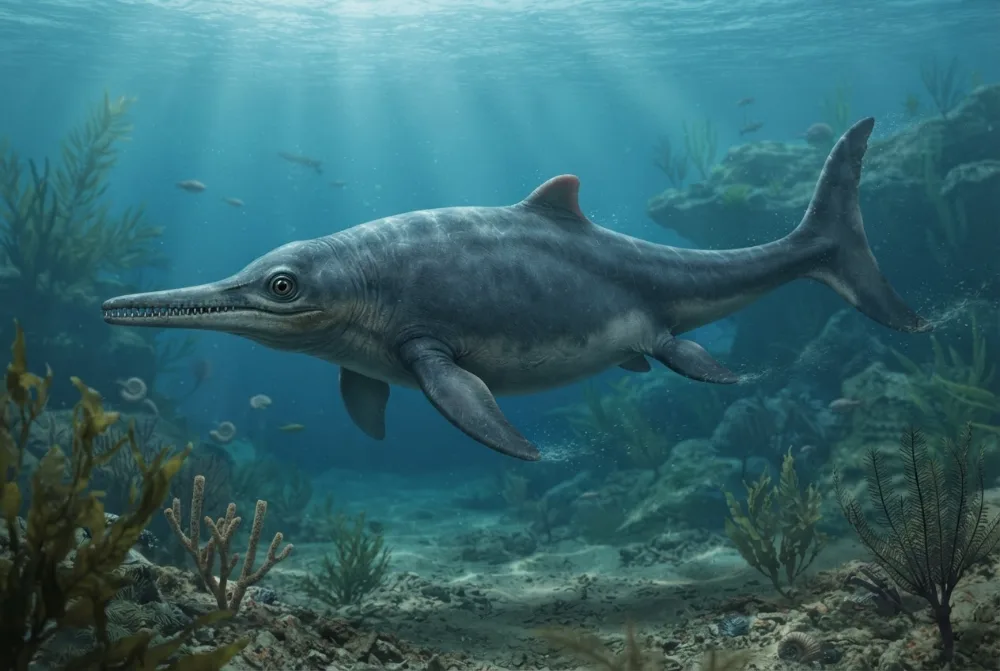
Arthropterygius was a large, fish-shaped marine reptile that swam in the oceans during the late Jurassic period. It had a long snout and strong flippers, and it was a fast hunter of fish and squid.13
Yabeerawo ddi?
Yali munene atya?
Yali muwanvu kwenkana wa?
 obuwanvu ng'embwa 5, ennyindo ku mukira🍌obuwanvu ng'amenvu 28 nga gaddiriŋŋana🏊yandiwuze obuwanvu bw'ekidiba ekinene (50 m) mu sikonda 3.9
Arthropterygius yali munene atya bw'ogeraageranya ku GGWE?
Kubala kwokka mu browser yo. Tewali kiterekebwa wadde okusindikibwa wonna.
Yali wa mbiro kwenkana wa?


Ebyewuunyisa
Arthropterygius had a special opening for the internal carotid artery on the back of its braincase, a feature unique among ichthyosaurs.2
Fossils of Arthropterygius have been found in both the Northern and Southern Hemispheres, showing it lived in warm and cold seas.12
One specimen from Svalbard, Norway, was about 3.8 to 4.3 metres (12 to 14 feet) long and was probably an adult.1
The name Arthropterygius means 'wing fin', referring to the shape of its flippers.1
Arthropterygius lived in shallow seas with methane seeps, where the seafloor was about 150 metres (490 feet) deep and had little oxygen.1
It belonged to a group called ophthalmosaurids, which were the last surviving ichthyosaurs before they went extinct.1
Ebibuuzo ebisinga okubuuzibwa ku Arthropterygius
?How big was Arthropterygius?
Arthropterygius was a relatively large ichthyosaur, with all species measuring between 3 and 5 metres (9.8 to 16.4 feet) long.1
?What did Arthropterygius eat?
It was a fast hunter of fish and squid, using its long snout and strong flippers to catch prey.1
?Was Arthropterygius a dinosaur?
No, Arthropterygius was an ichthyosaur, a type of marine reptile that lived in the oceans, not a dinosaur.1
?Where did Arthropterygius live?
Fossils of Arthropterygius have been found in Canada, Norway, Russia, and Argentina, showing it lived in both warm and cold seas across the Northern and Southern Hemispheres.1
Eri abakugu mu dayinoso
- Erinnya lya ssaayansi
- Arthropterygius
- Yatuumibwa
- Maxwell 20103
- Ekibinja
- Ikisiyosawulu
- Ekika / ekibinja
- Ophthalmosauridae3
- Engabanya
- Ichthyosauria > Ichthyosauromorpha3
- Emyaka gy'enjazi
- emyaka obukadde 162 okutuuka ku 143 (Oxfordian / Tithonian)3
- Ensengeka z'enjazi
- Ringnes, Agardhfjellet, Vaca Muerta3
- Ensi
- Kanada, Nowe, Arigentina, Rwasha3
- Ebisigalira ebyazuulibwa
- 8 mu The Paleobiology Database3
- Okuzuulibwa
- The first fossils of Arthropterygius were found on Melville Island, Canada, and were originally named Ophthalmosaurus chrisorum in 1993. In 2010, scientist Erin Maxwell gave them a new genus name, Arthropterygius.13
- Kikyakubaganyizibwako ebirowoozo
- Scientists are not sure if Arthropterygius lived into the earliest Cretaceous period, or if it went extinct at the end of the Jurassic.1
Ebituufu gye biva
- Arthropterygius (en.wikipedia.org)
- Original article The genus Arthropterygius Maxwell (Ichthyosauria: Ophthalmosauridae) in the Late Jurassic of the Neuquén Basin, Argentina ☆ (sciencedirect.com)
- Arthropterygius in The Paleobiology Database (CC BY 4.0): emyaka, ebifo, ensengeka z'enjazi, engabanya.
Buli kituufu ku lupapula luno kirina ennamba eraga ensibuko yaakyo. Bwe tuba nga tukoze ensobi, tusonyiwe, ffe tuli bawagizi ba dayinoso, so si magazini ya ssaayansi. Tubuulire ku [email protected] tujja kugitereeza.
 Rex alumwa enjala! Dino Wiki pulojekiti ya taata eri mutabani we ayagala ennyo dayinoso, ya bwereere, tewali bulango era tewali bikulondoola. Abakulu basobola okuwa Rex akantu ak'okulya okuyamba okugikuuma ku mutimbagano.Liisa Rex
 Ichthyosaurus
 Platypterygius
 Stenopterygius
 Khudiakovia
 Ophthalmosaurus
 Chonespondylus
 Brachiosaurus
 Diplodocus
 Allosaurus
 Brontosaurus
 Compsognathus
 Camarasaurus