 Kwizi: Oli dayinoso ki?
 Olutalo lwa dayinoso
 Empaka z'emisinde gya dayinoso
 Emizannyo emitono egya dayinoso
 Alubaamu ya sitika
 Enkalala za dayinoso eza TOP
 Mpa ekyewuunyisa!
Brachypterygius
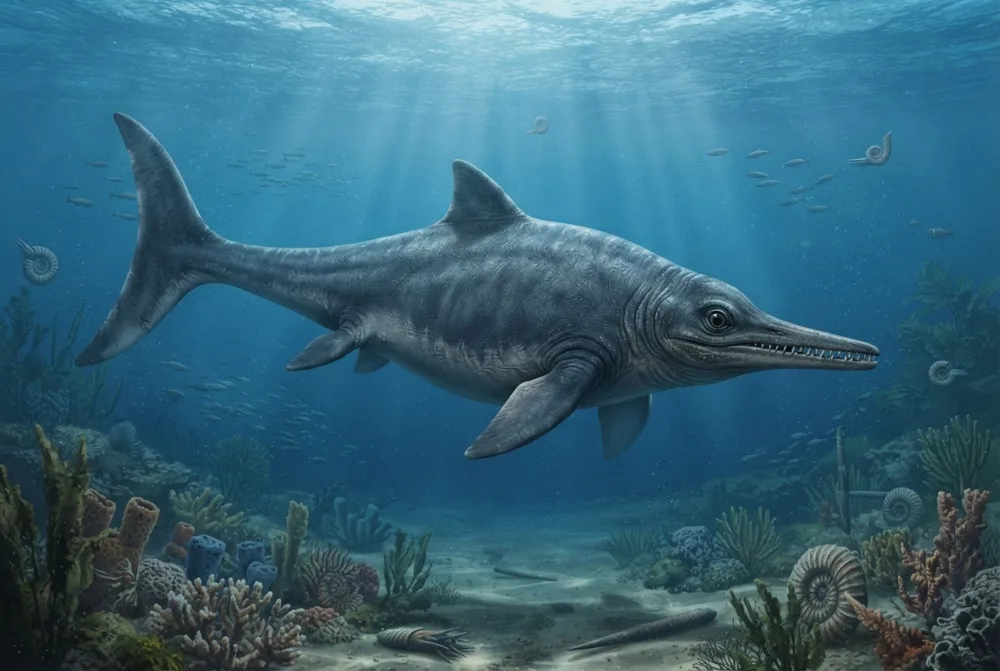
Brachypterygius was a fast-swimming marine reptile that lived in the Late Jurassic seas. It looked a bit like a dolphin but was a reptile, not a fish or a dinosaur. Its short, wide front flippers helped it steer through the water.1
Yabeerawo ddi?
Yali munene atya?
Yali muwanvu kwenkana wa?
 obuwanvu ng'embwa 4, ennyindo ku mukira🍌obuwanvu ng'amenvu 22 nga gaddiriŋŋana🏊yandiwuze obuwanvu bw'ekidiba ekinene (50 m) mu sikonda 3.8
Brachypterygius yali munene atya bw'ogeraageranya ku GGWE?
Kubala kwokka mu browser yo. Tewali kiterekebwa wadde okusindikibwa wonna.
Yali wa mbiro kwenkana wa?


Ebyewuunyisa
Brachypterygius had a short, wide front flipper with up to six fingers, and some fingers had as many as 16 bones.1
Its skull was between 0.5 and 1.2 metres long, about the size of a big dog's head.1
The first fossil of Brachypterygius was just a single right front flipper, found in England.1
Brachypterygius lived during the Kimmeridgian and Tithonian ages, about 154 to 143 million years ago.3
It is closely related to other ichthyosaurs like Platypterygius and Caypullisaurus.1
Scientists once thought Brachypterygius was the same as another ichthyosaur called Grendelius, but now many think they are different.1
Ebibuuzo ebisinga okubuuzibwa ku Brachypterygius
?How big was Brachypterygius?
Brachypterygius was a medium sized ichthyosaur, with a body length up to 4 metres (13 ft) and a skull length of 0.5 to 1.2 metres (1.6 to 3.9 ft).1
?Was Brachypterygius a dinosaur?
No, Brachypterygius was an ichthyosaur, a marine reptile that lived in the sea. It was not a dinosaur, even though it lived at the same time as dinosaurs.1
?What did Brachypterygius eat?
Scientists think Brachypterygius hunted in sunlit waters for slower prey like fish that swam in shoals. Its teeth were larger and more robust than those of some other ichthyosaurs.2
Eri abakugu mu dayinoso
- Erinnya lya ssaayansi
- Brachypterygius
- Yatuumibwa
- Huene 19223
- Ekibinja
- Ikisiyosawulu
- Ekika / ekibinja
- Ophthalmosauridae3
- Engabanya
- Ichthyosauria > Ichthyosauromorpha3
- Emyaka gy'enjazi
- emyaka obukadde 155 okutuuka ku 143 (Kimmeridgian / Tithonian)3
- Ensengeka z'enjazi
- Kimmeridge Clay, Agardhfjellet3
- Ensi
- Bungereza, Rwasha, Nowe3
- Ebisigalira ebyazuulibwa
- 6 mu The Paleobiology Database3
- Era emanyiddwa nga
- Ochevia, Otschevia (amannya ag'edda kati gabalibwa ng'ekisolo kye kimu)3
- Okuzuulibwa
- The first fossil, a right front flipper, was described as Ichthyosaurus extremus by Boulenger in 1904. In 1922, Friedrich von Huene gave it the new name Brachypterygius because of its short, wide flipper.1
- Kikyakubaganyizibwako ebirowoozo
- Scientists still debate whether the species Grendelius mordax is the same as Brachypterygius extremus or a separate animal.1
Ebituufu gye biva
- Brachypterygius (en.wikipedia.org)
- Brachypterygius (prehistoric-wildlife.com)
- Brachypterygius in The Paleobiology Database (CC BY 4.0): emyaka, ebifo, ensengeka z'enjazi, engabanya.
Buli kituufu ku lupapula luno kirina ennamba eraga ensibuko yaakyo. Bwe tuba nga tukoze ensobi, tusonyiwe, ffe tuli bawagizi ba dayinoso, so si magazini ya ssaayansi. Tubuulire ku [email protected] tujja kugitereeza.
 Rex alumwa enjala! Dino Wiki pulojekiti ya taata eri mutabani we ayagala ennyo dayinoso, ya bwereere, tewali bulango era tewali bikulondoola. Abakulu basobola okuwa Rex akantu ak'okulya okuyamba okugikuuma ku mutimbagano.Liisa Rex
 Ichthyosaurus
 Platypterygius
 Stenopterygius
 Khudiakovia
 Ophthalmosaurus
 Chonespondylus
 Brachiosaurus
 Diplodocus
 Allosaurus
 Brontosaurus
 Compsognathus
 Camarasaurus