 Kwizi: Oli dayinoso ki?
 Olutalo lwa dayinoso
 Empaka z'emisinde gya dayinoso
 Emizannyo emitono egya dayinoso
 Alubaamu ya sitika
 Enkalala za dayinoso eza TOP
 Mpa ekyewuunyisa!
Djupedalia
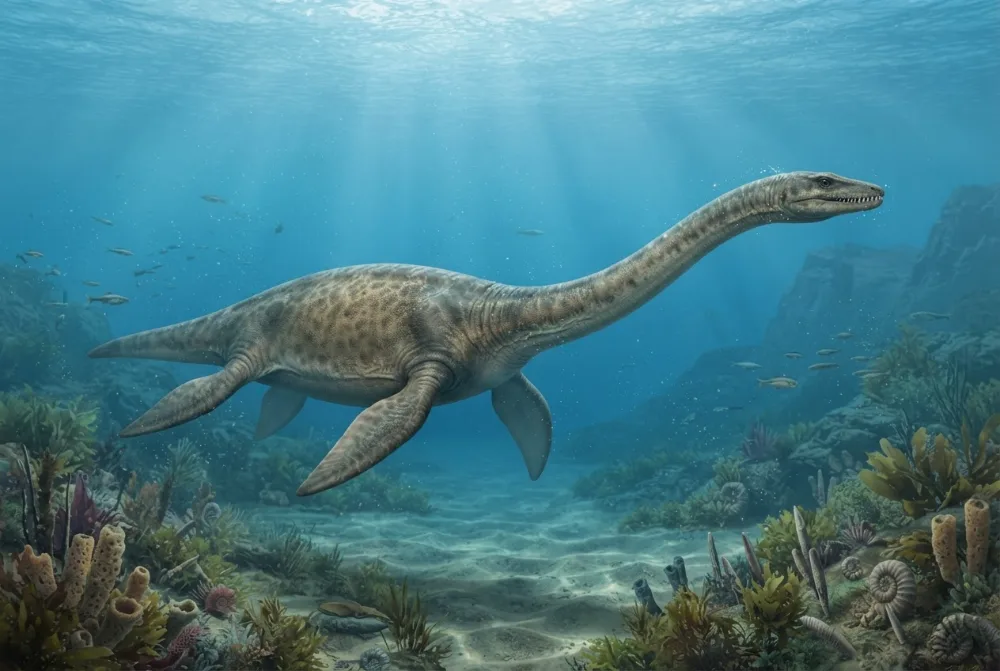
Djupedalia was a long-necked marine reptile that swam in the warm, shallow seas near Svalbard, Norway, about 150 million years ago. It was not a dinosaur, but a plesiosaur, a type of ocean predator. With its small head and long neck, it likely snapped up fish and squid while paddling through the water.42
Yabeerawo ddi?
Yali munene atya?
Yali muwanvu kwenkana wa?
 obuwanvu ng'embwa 6, ennyindo ku mukira🍌obuwanvu ng'amenvu 33 nga gaddiriŋŋana🏊yandiwuze obuwanvu bw'ekidiba ekinene (50 m) mu sikonda 6.7
Djupedalia yali munene atya bw'ogeraageranya ku GGWE?
Kubala kwokka mu browser yo. Tewali kiterekebwa wadde okusindikibwa wonna.
Yali wa mbiro kwenkana wa?


Ebyewuunyisa
Djupedalia is known from a single juvenile skeleton that is one of the most complete marine reptile fossils ever found in Spitsbergen.2
Its neck bones were special: the neural spines (the parts that stick up from the vertebrae) were shifted far back, and the postzygapophyses (the joints that connect vertebrae) were very long.2
Djupedalia had femora (thigh bones) that were longer than its humeri (upper arm bones), which is unusual for plesiosaurs.2
The fossil was found about 20 metres below a rock layer called the Dorsoplanites bed, which is full of ammonite shells.2
Djupedalia lived during the Tithonian age, about 150 to 145 million years ago, in the Late Jurassic period.1
Omumenyi w'enfumo
Enfumo: Some people might think Djupedalia was a dinosaur because it lived in the sea and had a long neck.
Amazima: Djupedalia was a plesiosaur, a marine reptile, not a dinosaur. Dinosaurs lived on land, while plesiosaurs swam in the ocean.4
Eri abakugu mu dayinoso
- Erinnya lya ssaayansi
- Djupedalia
- Yatuumibwa
- Knutsen et al. 20124
- Ekibinja
- Pulesiyosawulu
- Ekika / ekibinja
- Cryptoclididae4
- Engabanya
- Plesiosauria > Sauropterygia4
- Emyaka gy'enjazi
- emyaka obukadde 149 okutuuka ku 143 (Tithonian)4
- Ensengeka z'enjazi
- Agardhfjellet4
- Ensi
- Nowe4
- Ebisigalira ebyazuulibwa
- 1 mu The Paleobiology Database4
- Okuzuulibwa
- Djupedalia was named in 2012 by Espen M. Knutsen, Patrick S. Druckenmiller, and Jørn H. Hurum. The fossil was excavated in the summer of 2009 by the University of Oslo Natural History Museum from the Slottsmøya Member near Janusfjellet mountain.2
- Kikyakubaganyizibwako ebirowoozo
- Scientists are still debating exactly how Djupedalia is related to other plesiosaurs, since it shares features with several different groups from England and other places.2
Ebituufu gye biva
- Djupedalia (en.wikipedia.org)
- A new plesiosauroid (Reptilia: Sauropterygia) from the Agardhfjellet Formation (Middle Volgian) of central Spitsbergen, Norway (foreninger.uio.no)
- PaleoCodex :: Djupedalia (paleocodex.com)
- Djupedalia in The Paleobiology Database (CC BY 4.0): emyaka, ebifo, ensengeka z'enjazi, engabanya.
Buli kituufu ku lupapula luno kirina ennamba eraga ensibuko yaakyo. Bwe tuba nga tukoze ensobi, tusonyiwe, ffe tuli bawagizi ba dayinoso, so si magazini ya ssaayansi. Tubuulire ku [email protected] tujja kugitereeza.
 Rex alumwa enjala! Dino Wiki pulojekiti ya taata eri mutabani we ayagala ennyo dayinoso, ya bwereere, tewali bulango era tewali bikulondoola. Abakulu basobola okuwa Rex akantu ak'okulya okuyamba okugikuuma ku mutimbagano.Liisa Rex
 Elasmosaurus
 Pliosaurus
 Plesiosaurus
 Cimoliasaurus
 Colymbosaurus
 Trinacromerum
 Brachiosaurus
 Diplodocus
 Allosaurus
 Brontosaurus
 Compsognathus
 Camarasaurus