 Kwizi: Oli dayinoso ki?
 Olutalo lwa dayinoso
 Empaka z'emisinde gya dayinoso
 Emizannyo emitono egya dayinoso
 Alubaamu ya sitika
 Enkalala za dayinoso eza TOP
 Mpa ekyewuunyisa!
Fluvionectes
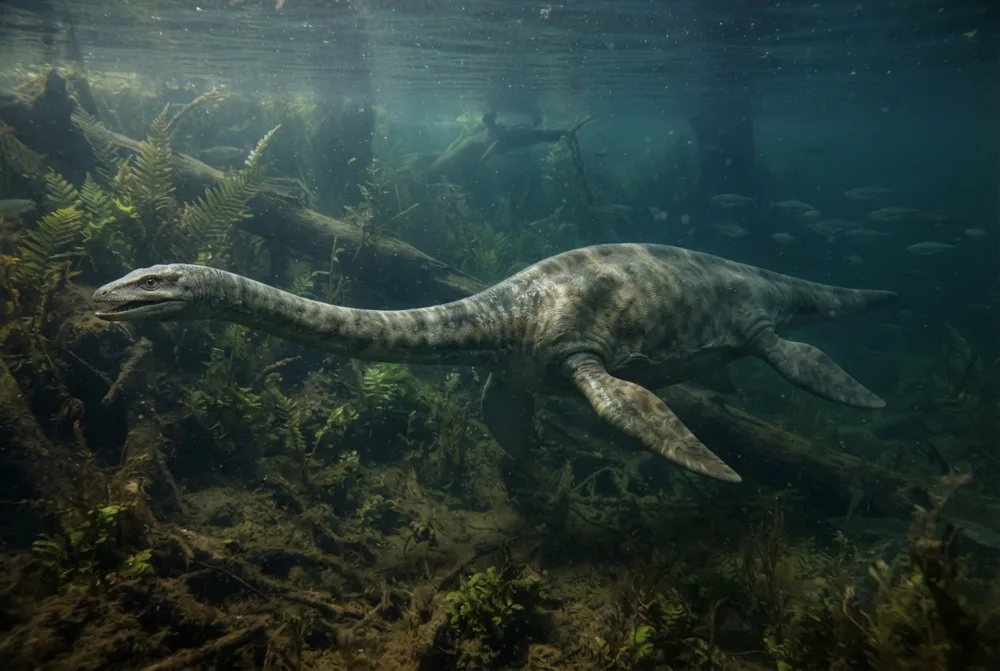
Fluvionectes was a long-necked marine reptile that swam in rivers and estuaries, not the open ocean. It was a type of plesiosaur called an elasmosaur, and it hunted fish and other prey in the water.1
Yabeerawo ddi?
Yali munene atya?
Yali muwanvu kwenkana wa?
Yali muzito kwenkana wa?
 obuwanvu ng'embwa 7, ennyindo ku mukira🍌obuwanvu ng'amenvu 39 nga gaddiriŋŋana🍉obuzito ng'obwa wotamerooni 78🧸obuzito ng'obw'abaana 21 ab'omu nnasale🎒obuzito ng'obw'abaana b'essomero 12🏊yandiwuze obuwanvu bw'ekidiba ekinene (50 m) mu sikonda 6.2
Fluvionectes yali munene atya bw'ogeraageranya ku GGWE?
Kubala kwokka mu browser yo. Tewali kiterekebwa wadde okusindikibwa wonna.
Yali wa mbiro kwenkana wa?


Ebyewuunyisa
Fluvionectes is one of the few plesiosaurs found in non-marine rocks, meaning it lived in rivers and estuaries, not the open ocean.1
The holotype skeleton was found disarticulated, scattered over an area of about 2.5 square metres, with only two rib bones still connected.1
Fluvionectes had 22 dorsal vertebrae, which is a unique feature that helps scientists identify it as a new species.1
The name Fluvionectes comes from Latin and Greek words meaning 'river swimmer', because it lived in rivers.1
The species name sloanae honours Donna Sloan, who discovered the holotype and worked as a scientific illustrator at the Royal Tyrrell Museum.1
Fluvionectes was smaller than many other elasmosaurids that lived in the ocean, which might be because it lived in rivers.1
Ebibuuzo ebisinga okubuuzibwa ku Fluvionectes
?How big was Fluvionectes?
About 5 to 5.2 metres (16 to 17 ft) long for the holotype, and the largest known specimen may have reached 7 metres (23 ft).23
?What did Fluvionectes eat?
It hunted fish and other vertebrates in the water, using its slender tooth and powerful flippers to catch prey.4
?Where did Fluvionectes live?
It lived in rivers and estuaries (brackish water) in what is now Alberta, Canada, not in the open ocean like most other elasmosaurs.23
?Is Fluvionectes a dinosaur?
No, it is a plesiosaur, a type of marine reptile that lived in the water during the time of dinosaurs.2
Omumenyi w'enfumo
Enfumo: Some people think all plesiosaurs lived only in the ocean.
Amazima: Fluvionectes shows that some plesiosaurs lived in rivers and estuaries, not just the open sea.1
Eri abakugu mu dayinoso
- Erinnya lya ssaayansi
- Fluvionectes
- Yatuumibwa
- Campbell et al. 20215
- Ekibinja
- Pulesiyosawulu
- Ekika / ekibinja
- Elasmosauridae5
- Engabanya
- Plesiosauria > Elasmosauridae > Sauropterygia5
- Emyaka gy'enjazi
- emyaka obukadde 84 okutuuka ku 72 (Campanian)5
- Ensengeka z'enjazi
- Dinosaur Park5
- Ensi
- Kanada5
- Ebisigalira ebyazuulibwa
- 6 mu The Paleobiology Database5
- Okuzuulibwa
- The holotype was discovered by Donna Sloan in the Dinosaur Park Formation in Alberta, Canada. It was named by Campbell and colleagues in 2021.1
- Kikyakubaganyizibwako ebirowoozo
- Scientists are still debating why Fluvionectes was smaller than ocean-living elasmosaurids, and whether it spent its whole life in rivers or moved between fresh and salt water.1
Ebituufu gye biva
- PeerJ A new elasmosaurid (Sauropterygia: Plesiosauria) from the non-marine to paralic Dinosaur Park Formation of southern Alberta, Canada (peerj.com)
- Fluvionectes (en.wikipedia.org)
- A new elasmosaurid (Sauropterygia: Plesiosauria) from the non-marine to paralic Dinosaur Park Formation of southern Alberta, Canada (pmc.ncbi.nlm.nih.gov)
- New Late Cretaceous Marine Reptile publication by M. Ryan and J. Campbell | Department of Earth Sciences (earthsci.carleton.ca)
- Fluvionectes in The Paleobiology Database (CC BY 4.0): emyaka, ebifo, ensengeka z'enjazi, engabanya.
Buli kituufu ku lupapula luno kirina ennamba eraga ensibuko yaakyo. Bwe tuba nga tukoze ensobi, tusonyiwe, ffe tuli bawagizi ba dayinoso, so si magazini ya ssaayansi. Tubuulire ku [email protected] tujja kugitereeza.
 Rex alumwa enjala! Dino Wiki pulojekiti ya taata eri mutabani we ayagala ennyo dayinoso, ya bwereere, tewali bulango era tewali bikulondoola. Abakulu basobola okuwa Rex akantu ak'okulya okuyamba okugikuuma ku mutimbagano.Liisa Rex
 Elasmosaurus
 Pliosaurus
 Plesiosaurus
 Cimoliasaurus
 Colymbosaurus
 Trinacromerum
 Tyrannosaurus
 Triceratops
 Velociraptor
 Spinosaurus
 Ankylosaurus
 Parasaurolophus