 Kwizi: Oli dayinoso ki?
 Olutalo lwa dayinoso
 Empaka z'emisinde gya dayinoso
 Emizannyo emitono egya dayinoso
 Alubaamu ya sitika
 Enkalala za dayinoso eza TOP
 Mpa ekyewuunyisa!
Yabeerawo ddi?

Yali munene atya?
Yali muwanvu kwenkana wa?
Yali mugulumivu kwenkana wa?
Yali muzito kwenkana wa?
 obuwanvu ng'emmotoka 4 ezisimbiddwa mu lunyiriri🍌obuwanvu ng'amenvu 110 nga gaddiriŋŋana
 obuzito ng'obw'enjovu 1.5🍉obuzito ng'obwa wotamerooni 1800🎒obuzito ng'obw'ebibiina 11 ebijjuvu eby'abaana b'essomero🐻❄️obuzito ng'obwa ddubu enjeru 20🏃yandidduse mita 100 mu sikonda 22 (omuntu asinga embiro yeetaaga 9.6)
Galvesaurus yali munene atya bw'ogeraageranya ku GGWE?
Kubala kwokka mu browser yo. Tewali kiterekebwa wadde okusindikibwa wonna.
Yali wa mbiro kwenkana wa?


Ebyewuunyisa
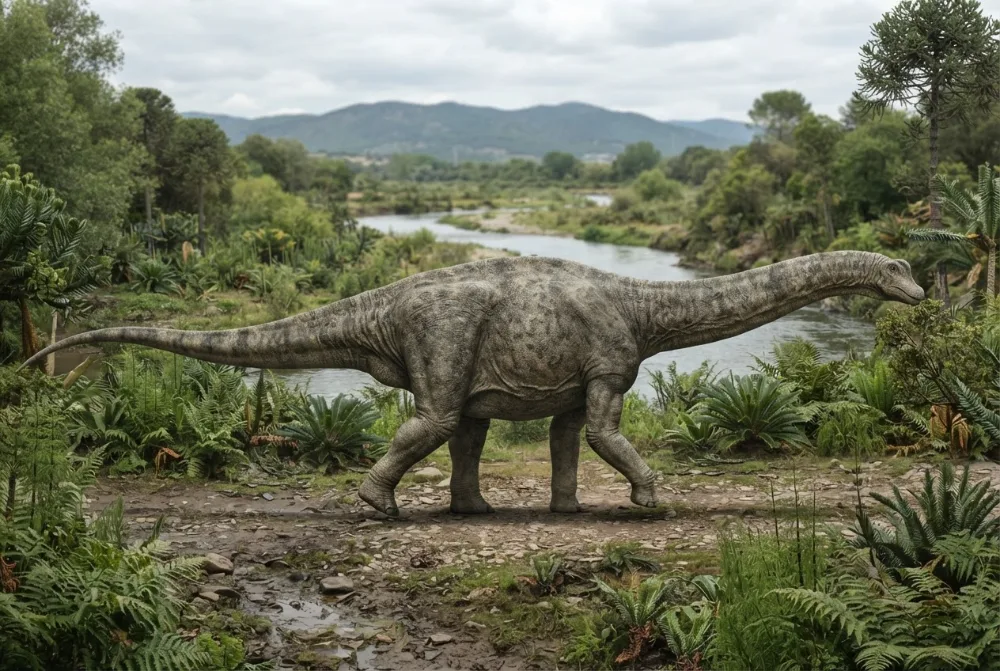
Galvesaurus lived about 150 to 146 million years ago, during the Tithonian age of the Late Jurassic.1
The first fossils were found in the 1980s by local amateur fossil hunter José María Herrero, who later gave the dinosaur its species name herreroi.1
Scientists have found more than 50 bones from one Galvesaurus skeleton, including parts of the skull, backbone, hips, and limbs.1
Galvesaurus had a slightly curved ischium (hip bone) with a simple end, unlike some other sauropods.2
It belongs to the group Brachiosauridae, making it a relative of the famous Brachiosaurus.4
Ebibuuzo ebisinga okubuuzibwa ku Galvesaurus
?How big was Galvesaurus?
It was about 16 metres long, 4 metres tall, and weighed around 9 tonnes.3
?What did Galvesaurus eat?
It was a plant-eater that used its long neck to reach leaves high up in trees.1
?When did Galvesaurus live?
It lived about 150 to 146 million years ago, during the Tithonian age of the Late Jurassic period.1
?Why does Galvesaurus have two names?
Two groups of scientists published the same dinosaur at almost the same time in 2005, so it is sometimes called Galvesaurus and sometimes Galveosaurus.1
Omumenyi w'enfumo
Enfumo: Some people think Galvesaurus and Galveosaurus are different dinosaurs.
Amazima: They are the same dinosaur. Two scientists named it separately in 2005, causing a debate over which name is correct.1
Eri abakugu mu dayinoso
- Erinnya lya ssaayansi
- Galvesaurus
- Yatuumibwa
- Barco et al. 20054
- Ekibinja
- Ez'ensingo empanvu
- Ekika / ekibinja
- Brachiosauridae4
- Engabanya
- Sauropodomorpha > Sauropoda > Macronaria4
- Emyaka gy'enjazi
- emyaka obukadde 152 okutuuka ku 145 (Kimmeridgian / Tithonian)4
- Ensengeka z'enjazi
- Villar del Arzobispo4
- Ensi
- Sipeyini4
- Ebisigalira ebyazuulibwa
- 1 mu The Paleobiology Database4
- Okuzuulibwa
- José María Herrero found the first fossils in the 1980s near Galve, Spain. A team from Zaragoza University excavated the site from 1993 to 2002 and recovered over 50 bones. In 2005, two different research groups published names for the dinosaur: one called it Galvesaurus herreroi, and the other named it Galveosaurus herreroi.1
- Kikyakubaganyizibwako ebirowoozo
- Some scientists think Galvesaurus might be the same as the Portuguese dinosaur Lusotitan, but others disagree.1
Ebituufu gye biva
- Galvesaurus (en.wikipedia.org)
- Galveosaurus herreroi, a new sauropod dinosaur from Villar del Arzobispo Formation (Tithonian-Berriasian) of Spain (biotaxa.org)
- Galvesaurus herreroi (es.wikipedia.org)
- Galvesaurus in The Paleobiology Database (CC BY 4.0): emyaka, ebifo, ensengeka z'enjazi, engabanya.
Buli kituufu ku lupapula luno kirina ennamba eraga ensibuko yaakyo. Bwe tuba nga tukoze ensobi, tusonyiwe, ffe tuli bawagizi ba dayinoso, so si magazini ya ssaayansi. Tubuulire ku [email protected] tujja kugitereeza.
 Rex alumwa enjala! Dino Wiki pulojekiti ya taata eri mutabani we ayagala ennyo dayinoso, ya bwereere, tewali bulango era tewali bikulondoola. Abakulu basobola okuwa Rex akantu ak'okulya okuyamba okugikuuma ku mutimbagano.Liisa Rex
 Brachiosaurus
 Diplodocus
 Brontosaurus
 Argentinosaurus
 Camarasaurus
 Morosaurus
 Allosaurus
 Compsognathus
 Camptosaurus
 Nanosaurus
 Rhamphorhynchus
 Ceratosaurus