 Kwizi: Oli dayinoso ki?
 Olutalo lwa dayinoso
 Empaka z'emisinde gya dayinoso
 Emizannyo emitono egya dayinoso
 Alubaamu ya sitika
 Enkalala za dayinoso eza TOP
 Mpa ekyewuunyisa!
Rhamphorhynchus
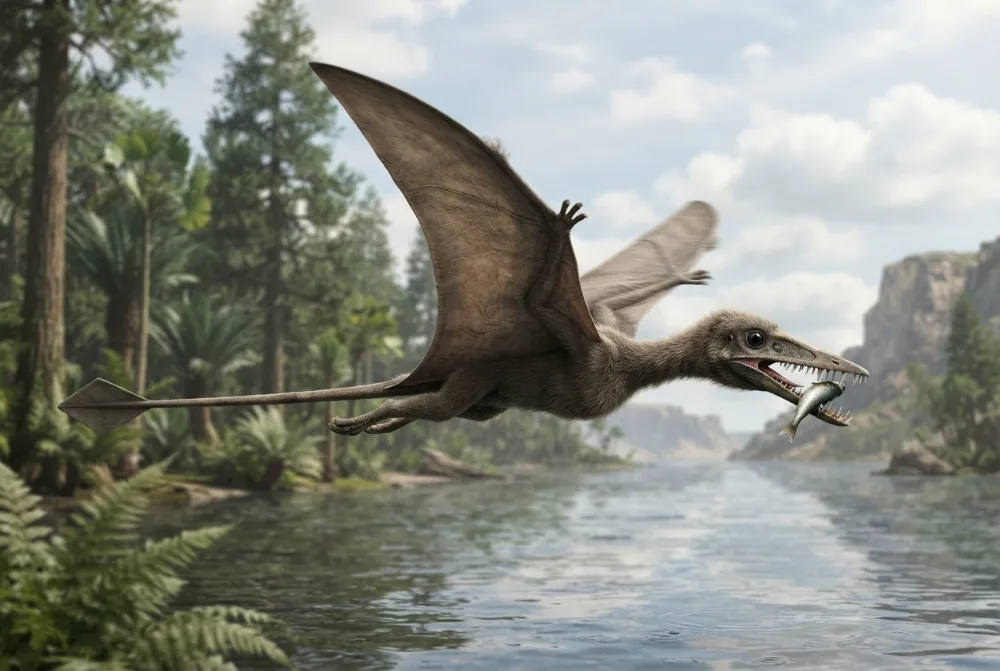
Rhamphorhynchus was a flying reptile that lived in the Late Jurassic. It had a very long tail with a diamond-shaped flap at the tip. It used its needle-like teeth to catch slippery fish.12
Yabeerawo ddi?
Yali munene atya?
Yali muwanvu kwenkana wa?
Yali muzito kwenkana wa?
 obuzito ng'obwa kkapa ow'awaka🍌obuzito ng'obw'amenvu 17🧱obuwanvu ng'amatoffaali g'ebikinisa 16 mu lunyiriri⚽yandibuuse okusomoka ekisaawe ky'omupiira kyonna mu sikonda 6.8
Rhamphorhynchus yali munene atya bw'ogeraageranya ku GGWE?
Kubala kwokka mu browser yo. Tewali kiterekebwa wadde okusindikibwa wonna.
Yali wa mbiro kwenkana wa?


Ebyewuunyisa
Its tail was stiffened with ligaments and ended in a diamond-shaped rudder, which may have helped it steer while flying.12
Rhamphorhynchus had no teeth at the very tip of its beak, but the rest of its beak held many forward-angled teeth that interlocked to trap fish.1
Fossils of Rhamphorhynchus often show impressions of soft parts, including wing membranes and fuzz-like pycnofibers.1
It probably swam and launched from the water like modern birds, not just flew over the waves.1
Rhamphorhynchus lived about 150 to 148 million years ago, during the late Jurassic Period.1
Ebibuuzo ebisinga okubuuzibwa ku Rhamphorhynchus
?How big was Rhamphorhynchus?
Most adults had a wingspan of about 1 metre (3.3 feet), but the largest known specimen reached about 1.8 metres (5.9 feet) across. A huge fragmentary fossil may have had a wingspan of over 3 metres (10 feet).15
?What did Rhamphorhynchus eat?
It mainly ate fish and squid-like animals called cephalopods. Fossil stomach contents and droppings often contain fish and cephalopod remains.12
?Could Rhamphorhynchus swim?
Yes, it probably swam and launched from the water like modern birds. Its broad feet and body shape suggest it was good at swimming.1
?When did Rhamphorhynchus live?
It lived during the Late Jurassic Period, about 150 to 148 million years ago.12
?Was Rhamphorhynchus a dinosaur?
No, it was a pterosaur, a flying reptile that is not a dinosaur. Pterosaurs are close cousins of dinosaurs.12
?Why did Rhamphorhynchus have a long tail?
The long tail ended in a diamond-shaped flap that may have helped it steer while flying. The tail was stiffened with ligaments to keep it straight.12
?Did Rhamphorhynchus have feathers?
It did not have feathers, but it had a fuzzy coat called pycnofibers, which are like simple hairs. These are different from feathers.1
?Where have Rhamphorhynchus fossils been found?
The best fossils come from the Solnhofen limestone in Bavaria, Germany. Fragmentary remains have also been found in England, Tanzania, Spain, and Portugal.1
Omumenyi w'enfumo
Enfumo: Some people think Rhamphorhynchus was a dinosaur.
Amazima: Rhamphorhynchus was a pterosaur, a flying reptile, not a dinosaur.1
Eri abakugu mu dayinoso
- Erinnya lya ssaayansi
- Rhamphorhynchus
- Yatuumibwa
- Meyer 18476
- Ekibinja
- Ebyewalula ebibuuka
- Ekika / ekibinja
- Rhamphorhynchidae6
- Engabanya
- Pterosauria > Rhamphorhynchidae6
- Emyaka gy'enjazi
- emyaka obukadde 159 okutuuka ku 143 (Oxfordian / Tithonian)6
- Ensengeka z'enjazi
- Solnhofen, Solnhofener Plattenkalk, Painten6
- Ensi
- Bugirimaani, Potugaali, Tanzaniya, Bungereza6
- Ebisigalira ebyazuulibwa
- 30 mu The Paleobiology Database6
- Okuzuulibwa
- The first specimen was brought to scientist Samuel Thomas von Sömmerring in 1825. It was later named Ornithocephalus muensteri by Goldfuss in 1831, and then renamed Rhamphorhynchus by Hermann von Meyer in 1847.13
- Kikyakubaganyizibwako ebirowoozo
- Scientists still debate exactly how many species of Rhamphorhynchus there were, because many similar fossils have been given different names.1
Ebituufu gye biva
- Rhamphorhynchus (en.wikipedia.org)
- Rhamphorhynchus | Pterosaur, Jurassic & Flying Reptile | Britannica (britannica.com)
- PBDB Taxon (paleobiodb.org)
- Life History of Rhamphorhynchus Inferred from Bone Histology and the Diversity of Pterosaurian Growth Strategies (pmc.ncbi.nlm.nih.gov)
- A giant specimen of Rhamphorhynchus muensteri and comments on the ontogeny of rhamphorhynchines (pmc.ncbi.nlm.nih.gov)
- Rhamphorhynchus in The Paleobiology Database (CC BY 4.0): emyaka, ebifo, ensengeka z'enjazi, engabanya.
Buli kituufu ku lupapula luno kirina ennamba eraga ensibuko yaakyo. Bwe tuba nga tukoze ensobi, tusonyiwe, ffe tuli bawagizi ba dayinoso, so si magazini ya ssaayansi. Tubuulire ku [email protected] tujja kugitereeza.
 Rex alumwa enjala! Dino Wiki pulojekiti ya taata eri mutabani we ayagala ennyo dayinoso, ya bwereere, tewali bulango era tewali bikulondoola. Abakulu basobola okuwa Rex akantu ak'okulya okuyamba okugikuuma ku mutimbagano.Liisa Rex
 Pteranodon
 Quetzalcoatlus
 Dorygnathus
 Anhanguera
 Pterodactylus
 Eudimorphodon
 Brachiosaurus
 Diplodocus
 Allosaurus
 Brontosaurus
 Compsognathus
 Camarasaurus