 Kwizi: Oli dayinoso ki?
 Olutalo lwa dayinoso
 Empaka z'emisinde gya dayinoso
 Emizannyo emitono egya dayinoso
 Alubaamu ya sitika
 Enkalala za dayinoso eza TOP
 Mpa ekyewuunyisa!
Jeholopterus
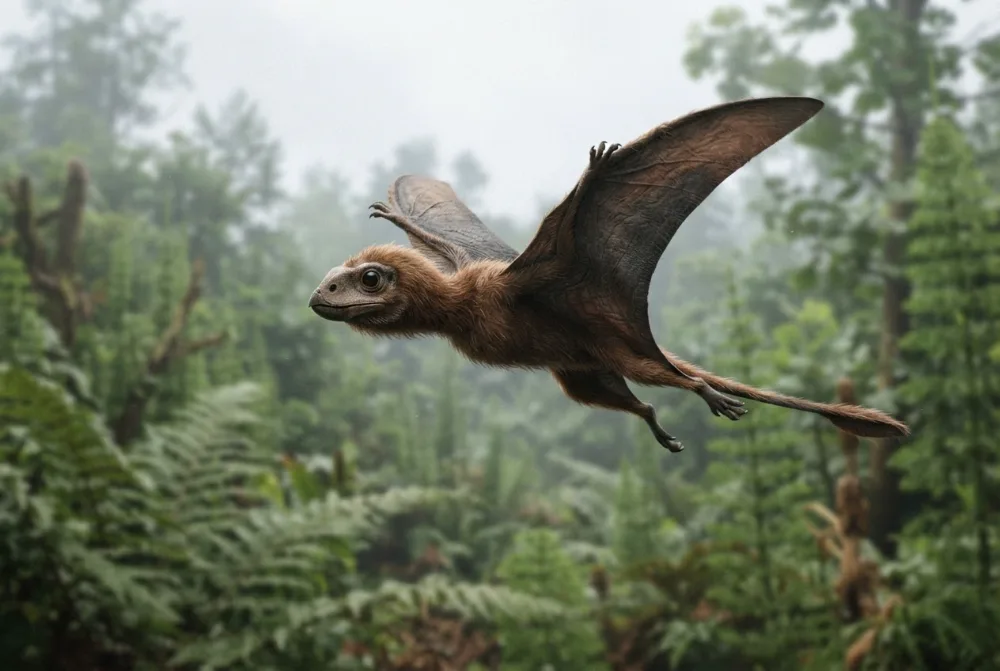
Jeholopterus was a small flying reptile that lived in what is now China. It had a very short, wide skull like a frog and its wings were attached to its ankles. Scientists think it ate insects and maybe even small fish.21
Yabeerawo ddi?
Yali munene atya?
Ebiwaawaatiro bye byali bigazi kwenkana wa?
 obuwanvu nga kkapa 2 ab'awaka, ennyindo ku mukira⚽yandibuuse okusomoka ekisaawe ky'omupiira kyonna mu sikonda 11
Jeholopterus yali munene atya bw'ogeraageranya ku GGWE?
Kubala kwokka mu browser yo. Tewali kiterekebwa wadde okusindikibwa wonna.
Yali wa mbiro kwenkana wa?


Ebyewuunyisa
Jeholopterus is one of the most complete anurognathid pterosaurs ever found, with its wing membranes and hair-like fibers preserved as fossils.2
Its skull was wider than it was long, giving it a frog-like face.2
The wing membrane attached to the ankle, and its feet were webbed, which may have helped it swim or walk on soft ground.2
Jeholopterus had a wingspan of about 90 centimeters (3 feet), making it a small to medium-sized pterosaur.21
The fossil was found in the Daohugou Beds of Inner Mongolia, which are about 165 to 160 million years old, from the Middle to Late Jurassic.1
Its wing claws were extremely long, about one and a half times the length of its foot claws.2
The hair-like fibers on its body are called pycnofibers, and they are not the same as mammalian hair.2
Ebibuuzo ebisinga okubuuzibwa ku Jeholopterus
?Was Jeholopterus a dinosaur?
No, Jeholopterus was a pterosaur, a flying reptile that is closely related to dinosaurs but not a dinosaur itself.13
?How big was Jeholopterus?
Jeholopterus had a wingspan of about 90 centimeters (35 inches), which is about the size of a Mallard Duck.13
?What did Jeholopterus eat?
Scientists think Jeholopterus mostly ate insects, but its longer, curved teeth suggest it might also have eaten small fish.14
?Did Jeholopterus have feathers?
No, Jeholopterus did not have feathers. It was covered in hair-like fibers called pycnofibers, which are different from mammalian hair.13
Eri abakugu mu dayinoso
- Erinnya lya ssaayansi
- Jeholopterus
- Yatuumibwa
- Wang et al. 20025
- Ekibinja
- Ebyewalula ebibuuka
- Ekika / ekibinja
- Anurognathidae5
- Engabanya
- Pterosauria5
- Emyaka gy'enjazi
- emyaka obukadde 165 okutuuka ku 162 (Callovian)5
- Ensengeka z'enjazi
- Tiaojishan5
- Ensi
- Cayina5
- Ebisigalira ebyazuulibwa
- 1 mu The Paleobiology Database5
- Okuzuulibwa
- Jeholopterus was named in 2002 by Wang Xiaolin, Zhou Zhonghe, and Xu Xing. The only known fossil was found in Ningcheng County, Inner Mongolia, China.12
- Kikyakubaganyizibwako ebirowoozo
- Scientists are not sure if Jeholopterus ate only insects or also caught fish, because it had both short peg-like teeth and longer curved teeth.21
Ebituufu gye biva
- Jeholopterus (en.wikipedia.org)
- A nearly completely articulated rhamphorhynchoid pterosaur with exceptionally well-preserved wing membranes and “hairs” from Inner Mongolia, northeast China (ivpp.cas.cn)
- Pterosaur: Jeholopterus ningchengensis | AMNH (amnh.org)
- A nearly completely articulated rhamphorhynchoid pterosaur with exceptionally well-preserved wing membranes and “hairs” from Inner Mongolia, northeast China (ivpp.cas.cn)
- Jeholopterus in The Paleobiology Database (CC BY 4.0): emyaka, ebifo, ensengeka z'enjazi, engabanya.
Buli kituufu ku lupapula luno kirina ennamba eraga ensibuko yaakyo. Bwe tuba nga tukoze ensobi, tusonyiwe, ffe tuli bawagizi ba dayinoso, so si magazini ya ssaayansi. Tubuulire ku [email protected] tujja kugitereeza.
 Rex alumwa enjala! Dino Wiki pulojekiti ya taata eri mutabani we ayagala ennyo dayinoso, ya bwereere, tewali bulango era tewali bikulondoola. Abakulu basobola okuwa Rex akantu ak'okulya okuyamba okugikuuma ku mutimbagano.Liisa Rex
 Pteranodon
 Quetzalcoatlus
 Dorygnathus
 Rhamphorhynchus
 Anhanguera
 Pterodactylus
 Ichthyosaurus
 Khudiakovia
 Ophthalmosaurus
 Peloneustes
 Gongbusaurus
 Shunosaurus