 Kwizi: Oli dayinoso ki?
 Olutalo lwa dayinoso
 Empaka z'emisinde gya dayinoso
 Emizannyo emitono egya dayinoso
 Alubaamu ya sitika
 Enkalala za dayinoso eza TOP
 Mpa ekyewuunyisa!
Yabeerawo ddi?

Yali munene atya?
Yali muwanvu kwenkana wa?
Yali mugulumivu kwenkana wa?
kuteebereza
Yali muzito kwenkana wa?
 obuwanvu ng'embwa 5, ennyindo ku mukira🍌obuwanvu ng'amenvu 29 nga gaddiriŋŋana🍉obuzito ng'obwa wotamerooni 240🧸obuzito ng'obw'abaana 63 ab'omu nnasale🎒obuzito ng'obw'abaana b'essomero 38🐻❄️obuzito ng'obwa ddubu enjeru 2.5🏃yandidduse mita 100 mu sikonda 16 (omuntu asinga embiro yeetaaga 9.6)
Nothronychus yali munene atya bw'ogeraageranya ku GGWE?
Kubala kwokka mu browser yo. Tewali kiterekebwa wadde okusindikibwa wonna.
Yali wa mbiro kwenkana wa?


Ebyewuunyisa
Nothronychus was the first therizinosaur ever found in the Americas. All earlier therizinosaur fossils came from China and Mongolia.1
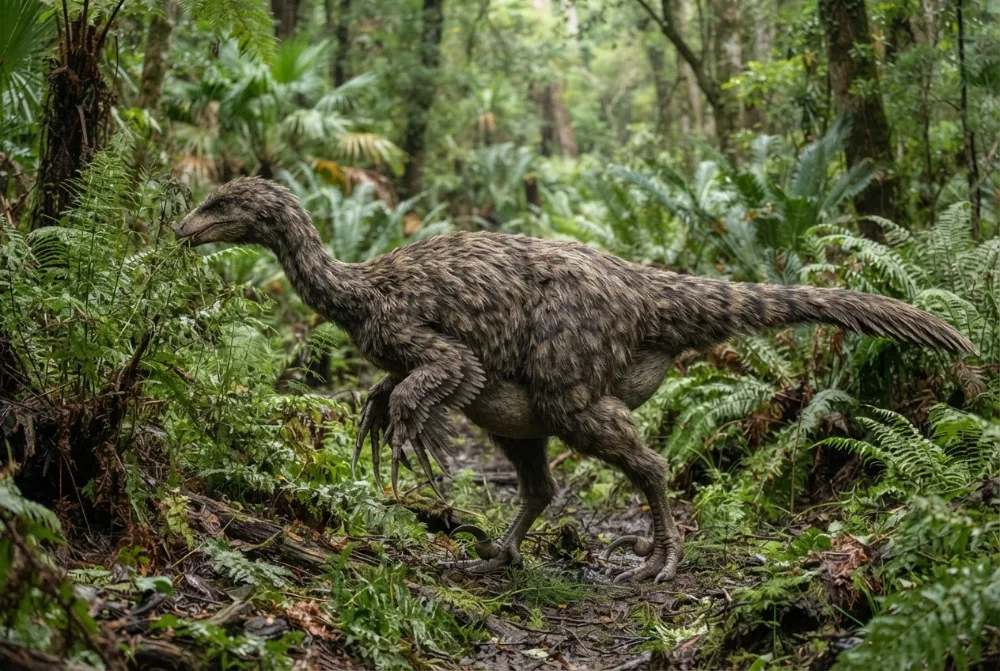
Its claws were up to 30 centimeters (12 inches) long and curved like hooks. Scientists think it used them to pull down branches to eat.1
Nothronychus had four forward-facing toes on each foot, which helped it walk slowly and steadily.1
One species, Nothronychus graffami, was found in rocks that were once under a shallow sea called the Western Interior Seaway. The dinosaur's bones were mixed with marine reptile fossils.1
The first Nothronychus bone was mistaken for part of a horned dinosaur's skull. Only later did scientists realize it was a hip bone from a therizinosaur.1
Ebibuuzo ebisinga okubuuzibwa ku Nothronychus
?How big was Nothronychus?
It was about 4.2 to 5.3 metres (14 to 17 feet) long and weighed 800 to 1,200 kilograms (1,800 to 2,600 pounds).1
?What did Nothronychus eat?
It ate plants. Even though it was a theropod dinosaur, it was a herbivore.12
?Did Nothronychus have feathers?
No feather fossils have been found, but its relatives had feathers, so scientists think it probably did too.3
?When did Nothronychus live?
It lived during the Late Cretaceous period, about 94 to 89 million years ago.2
?Why did Nothronychus have long claws?
It used its long, curved claws to pull down branches so it could eat leaves.1
Eri abakugu mu dayinoso
- Erinnya lya ssaayansi
- Nothronychus
- Yatuumibwa
- Kirkland and Wolfe 20014
- Ekibinja
- Dayinoso ez'ebyoya ez'enjawulo
- Ekika / ekibinja
- Therizinosauridae4
- Engabanya
- Theropoda > Therizinosauria4
- Emyaka gy'enjazi
- emyaka obukadde 94 okutuuka ku 90 (Turonian)4
- Ensengeka z'enjazi
- Moreno Hill, Tropic Shale4
- Ensi
- Amerika4
- Ebisigalira ebyazuulibwa
- 2 mu The Paleobiology Database4
- Okuzuulibwa
- Nothronychus was named in 2001 by paleontologists James Kirkland and Douglas Wolfe. The first fossils were found in New Mexico on land owned by rancher Bobby McKinley, who the species N. mckinleyi is named after.1
- Kikyakubaganyizibwako ebirowoozo
- Scientists are not sure if Nothronychus had feathers. Since it is a theropod closely related to birds, it might have had feathers, but no direct fossil evidence has been found yet.1
Ebituufu gye biva
- Nothronychus (en.wikipedia.org)
- Nothronychus | Natural History Museum (nhm.ac.uk)
- Nothronychus Fact Sheet - Enchanted Learning (enchantedlearning.com)
- Nothronychus in The Paleobiology Database (CC BY 4.0): emyaka, ebifo, ensengeka z'enjazi, engabanya.
Buli kituufu ku lupapula luno kirina ennamba eraga ensibuko yaakyo. Bwe tuba nga tukoze ensobi, tusonyiwe, ffe tuli bawagizi ba dayinoso, so si magazini ya ssaayansi. Tubuulire ku [email protected] tujja kugitereeza.
 Rex alumwa enjala! Dino Wiki pulojekiti ya taata eri mutabani we ayagala ennyo dayinoso, ya bwereere, tewali bulango era tewali bikulondoola. Abakulu basobola okuwa Rex akantu ak'okulya okuyamba okugikuuma ku mutimbagano.Liisa Rex
 Therizinosaurus
 Oviraptor
 Chirostenotes
 Citipes
 Leptorhynchos
 Avimimus
 Tyrannosaurus
 Triceratops
 Velociraptor
 Spinosaurus
 Ankylosaurus
 Parasaurolophus