 Kwizi: Oli dayinoso ki?
 Olutalo lwa dayinoso
 Empaka z'emisinde gya dayinoso
 Emizannyo emitono egya dayinoso
 Alubaamu ya sitika
 Enkalala za dayinoso eza TOP
 Mpa ekyewuunyisa!
Yabeerawo ddi?

Yali munene atya?
Yali muwanvu kwenkana wa?
Yali mugulumivu kwenkana wa?
Yali muzito kwenkana wa?
 obuzito ng'obwa kkapa ow'awaka🍌obuzito ng'obw'amenvu 29🪑mutono nnyo nga asobola okuyita wansi w'entebe🏃yandidduse mita 100 mu sikonda 12 (omuntu asinga embiro yeetaaga 9.6)
Shuvuuia yali munene atya bw'ogeraageranya ku GGWE?
Kubala kwokka mu browser yo. Tewali kiterekebwa wadde okusindikibwa wonna.
Yali wa mbiro kwenkana wa?


Ebyewuunyisa
Shuvuuia is known from two beautifully preserved skulls, which are the first skulls ever found for its group, the Alvarezsauridae.2
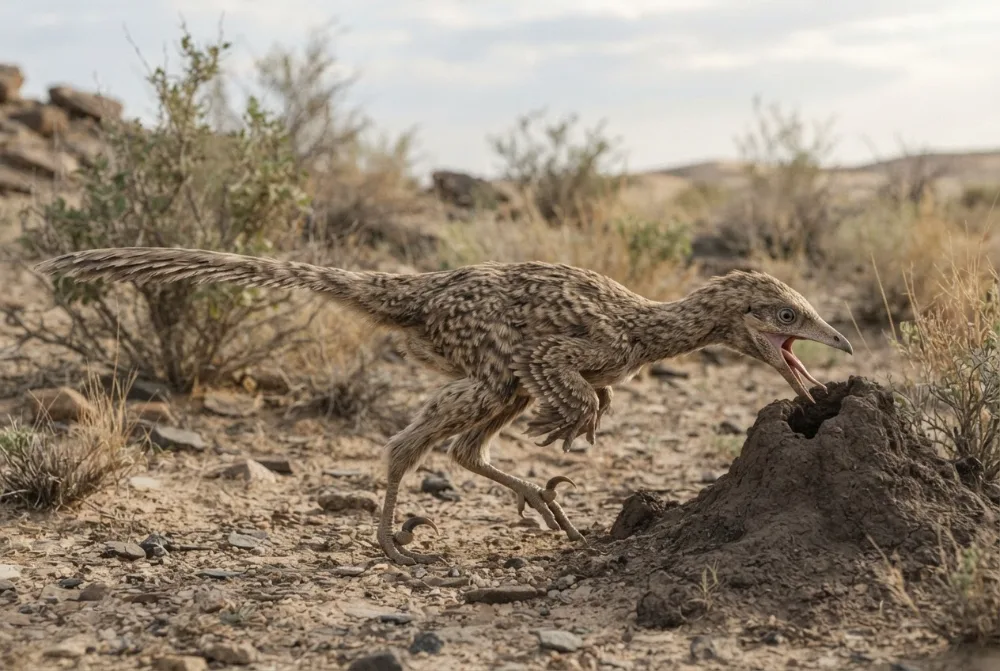
Its lower jaw was not locked to the skull, so its mouth could open very wide to catch larger prey.1
Shuvuuia lived in the Late Cretaceous period, about 75 to 81 million years ago, in what is now the Gobi Desert of Mongolia.1
Scientists think Shuvuuia may have eaten termites, because its skull and jaw look like those of modern animals that eat insects.1
The name Shuvuuia means 'bird' in Mongolian, because its skull shows features that link it to birds.1
Ebibuuzo ebisinga okubuuzibwa ku Shuvuuia
?How big was Shuvuuia?
Shuvuuia was very small, about 1 metre (3.3 feet) long and weighed around 3.5 kilograms (7.7 pounds). It is one of the smallest known non-avian dinosaurs.4
?Did Shuvuuia have feathers?
Yes, scientists think Shuvuuia had a coat of feathers. Fossils show tiny tube-like structures that contain the same proteins found in modern bird feathers.4
?What did Shuvuuia eat?
Shuvuuia probably ate insects and small animals. It may have used its strong arms to dig into insect nests and its flexible jaw to catch prey like termites or small mammals.41
?Could Shuvuuia see in the dark?
Some scientists think Shuvuuia had excellent night vision and hearing, like an owl, and could hunt in complete darkness. However, a 2025 study disagreed and said its hearing was more like a chicken's.4
Eri abakugu mu dayinoso
- Erinnya lya ssaayansi
- Shuvuuia
- Yatuumibwa
- Chiappe et al. 19985
- Ekibinja
- Dayinoso ez'ebyoya ez'enjawulo
- Ekika / ekibinja
- Alvarezsauridae5
- Engabanya
- Theropoda > Alvarezsauridae5
- Emyaka gy'enjazi
- emyaka obukadde 84 okutuuka ku 72 (Campanian)5
- Ensengeka z'enjazi
- Djadokhta5
- Ensi
- Mongoliya5
- Ebisigalira ebyazuulibwa
- 3 mu The Paleobiology Database5
- Okuzuulibwa
- Shuvuuia was named by Luis Chiappe, Mark Norell, and James Clark in 1998. The first fossils were found at Ukhaa Tolgod in Mongolia.25
- Kikyakubaganyizibwako ebirowoozo
- Scientists are still debating whether Shuvuuia was more closely related to birds or to other dinosaurs like therizinosaurs and oviraptorosaurs.2
Ebituufu gye biva
- Shuvuuia | Natural History Museum (nhm.ac.uk)
- The skull of a relative of the stem-group bird Mononykus | Nature (nature.com)
- Shuvuuia Fact Sheet - Enchanted Learning (enchantedlearning.com)
- Shuvuuia (en.wikipedia.org)
- Shuvuuia in The Paleobiology Database (CC BY 4.0): emyaka, ebifo, ensengeka z'enjazi, engabanya.
Buli kituufu ku lupapula luno kirina ennamba eraga ensibuko yaakyo. Bwe tuba nga tukoze ensobi, tusonyiwe, ffe tuli bawagizi ba dayinoso, so si magazini ya ssaayansi. Tubuulire ku [email protected] tujja kugitereeza.
 Rex alumwa enjala! Dino Wiki pulojekiti ya taata eri mutabani we ayagala ennyo dayinoso, ya bwereere, tewali bulango era tewali bikulondoola. Abakulu basobola okuwa Rex akantu ak'okulya okuyamba okugikuuma ku mutimbagano.Liisa Rex
 Therizinosaurus
 Oviraptor
 Chirostenotes
 Citipes
 Leptorhynchos
 Avimimus
 Tyrannosaurus
 Triceratops
 Velociraptor
 Spinosaurus
 Ankylosaurus
 Parasaurolophus