 Kwizi: Oli dayinoso ki?
 Olutalo lwa dayinoso
 Empaka z'emisinde gya dayinoso
 Emizannyo emitono egya dayinoso
 Alubaamu ya sitika
 Enkalala za dayinoso eza TOP
 Mpa ekyewuunyisa!
Simolestes
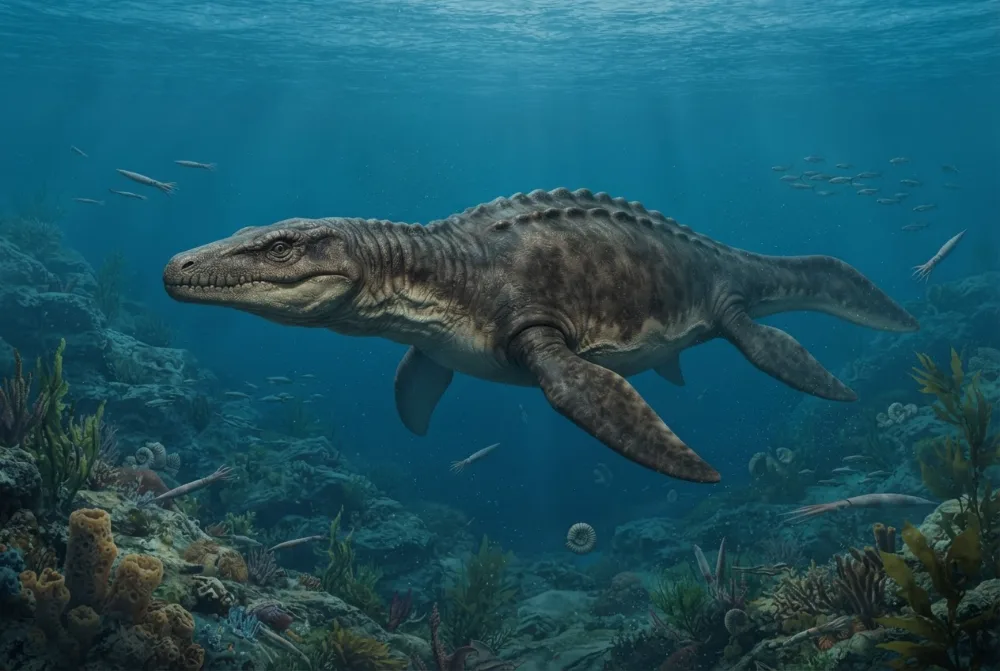
Simolestes was a pliosaur, a kind of short-necked plesiosaur that lived in the Jurassic seas. It had a short, high, and wide skull built to handle twisting forces when hunting. It probably ate squid-like animals and ammonites.1
Yabeerawo ddi?
Yali munene atya?
Yali muwanvu kwenkana wa?
 obuwanvu ng'embwa 5, ennyindo ku mukira🍌obuwanvu ng'amenvu 26 nga gaddiriŋŋana🏊yandiwuze obuwanvu bw'ekidiba ekinene (50 m) mu sikonda 6.4
Simolestes yali munene atya bw'ogeraageranya ku GGWE?
Kubala kwokka mu browser yo. Tewali kiterekebwa wadde okusindikibwa wonna.
Yali wa mbiro kwenkana wa?


Ebyewuunyisa
Simolestes had salt-secreting glands, which helped it drink seawater and keep its salt balance.1
The type specimen of Simolestes vorax is an almost complete but crushed skeleton found in the Oxford Clay of England.1
Simolestes lived from the Middle to Late Jurassic, about 171 to 145 million years ago.1
Scientists think Simolestes might have hunted in deeper waters or at night, because its prey (cephalopods) move up at night to feed.1
The species Simolestes keileni from France was moved to a new genus called Lorrainosaurus in 2023.1
Ebibuuzo ebisinga okubuuzibwa ku Simolestes
?How big was Simolestes?
The largest Simolestes vorax specimens reached about 4.6 metres (15 feet) long, based on a head to body ratio similar to Liopleurodon.1
?What did Simolestes eat?
Simolestes probably ate squid-like animals, belemnites, and ammonites. Its exact feeding habits are unclear, but it likely hunted in deeper waters or at night.1
?Was Simolestes a dinosaur?
No, Simolestes was a pliosaur, a type of short-necked plesiosaur, which is a marine reptile, not a dinosaur.1
?When did Simolestes live?
Simolestes lived during the Middle to Late Jurassic, about 171 to 145 million years ago.1
Eri abakugu mu dayinoso
- Erinnya lya ssaayansi
- Simolestes
- Yatuumibwa
- Andrews 19092
- Ekibinja
- Pulesiyosawulu
- Ekika / ekibinja
- Pliosauridae2
- Engabanya
- Plesiosauria > Pliosauridae > Sauropterygia2
- Emyaka gy'enjazi
- emyaka obukadde 169 okutuuka ku 143 (Bajocian / Tithonian)2
- Ensengeka z'enjazi
- Umia, Oxford Clay, Marnes de Gravelotte (=La Gravclotte Marls)2
- Ensi
- Buyindi, Bungereza, Bufalansa2
- Ebisigalira ebyazuulibwa
- 5 mu The Paleobiology Database2
- Okuzuulibwa
- Simolestes was named by C. W. Andrews in 1909 based on a skeleton from the Oxford Clay of Peterborough, England.12
- Kikyakubaganyizibwako ebirowoozo
- Scientists are unsure about the exact feeding habits of Simolestes, though the current consensus is that it ate cephalopods.1
Ebituufu gye biva
- Simolestes (en.wikipedia.org)
- Simolestes in The Paleobiology Database (CC BY 4.0): emyaka, ebifo, ensengeka z'enjazi, engabanya.
Buli kituufu ku lupapula luno kirina ennamba eraga ensibuko yaakyo. Bwe tuba nga tukoze ensobi, tusonyiwe, ffe tuli bawagizi ba dayinoso, so si magazini ya ssaayansi. Tubuulire ku [email protected] tujja kugitereeza.
 Rex alumwa enjala! Dino Wiki pulojekiti ya taata eri mutabani we ayagala ennyo dayinoso, ya bwereere, tewali bulango era tewali bikulondoola. Abakulu basobola okuwa Rex akantu ak'okulya okuyamba okugikuuma ku mutimbagano.Liisa Rex
 Elasmosaurus
 Pliosaurus
 Plesiosaurus
 Cimoliasaurus
 Colymbosaurus
 Trinacromerum
 Brachiosaurus
 Diplodocus
 Allosaurus
 Brontosaurus
 Compsognathus
 Camarasaurus