 Kwizi: Oli dayinoso ki?
 Olutalo lwa dayinoso
 Empaka z'emisinde gya dayinoso
 Emizannyo emitono egya dayinoso
 Alubaamu ya sitika
 Enkalala za dayinoso eza TOP
 Mpa ekyewuunyisa!
Tupandactylus
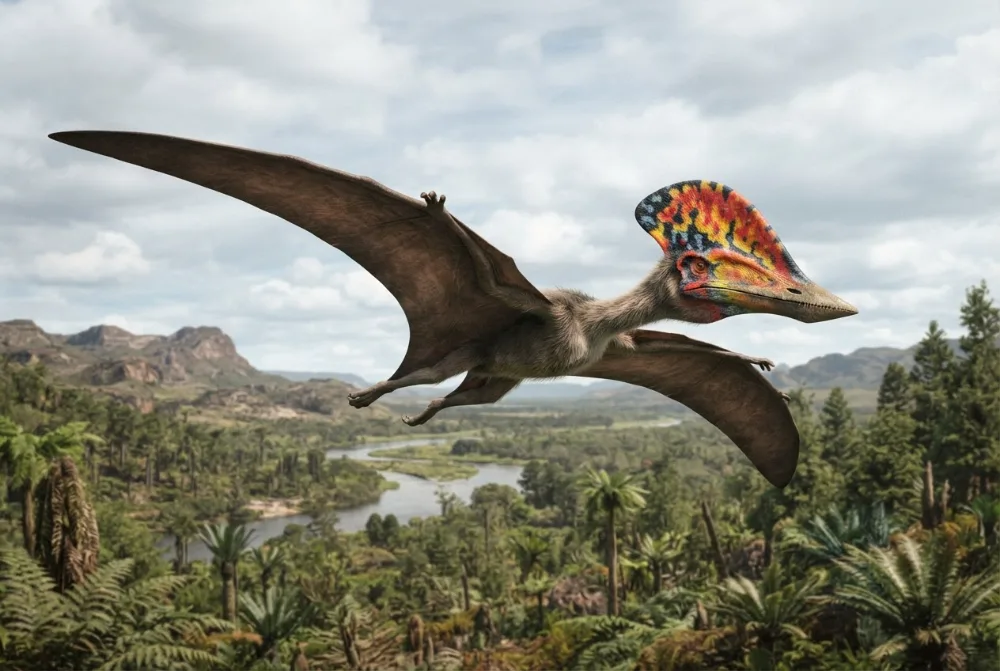
Tupandactylus was a flying reptile with a huge, colorful crest on its head. It lived in what is now Brazil about 115 million years ago and probably ate plants like a flying fruit-lover.12
Yabeerawo ddi?
Yali munene atya?
Ebiwaawaatiro bye byali bigazi kwenkana wa?
Yali mugulumivu kwenkana wa?
 ebiwaawaatiro bigazi ng'obugaali 2 mu lunyiriri⚽yandibuuse okusomoka ekisaawe ky'omupiira kyonna mu sikonda 6
Tupandactylus yali munene atya bw'ogeraageranya ku GGWE?
Kubala kwokka mu browser yo. Tewali kiterekebwa wadde okusindikibwa wonna.
Yali wa mbiro kwenkana wa?


Ebyewuunyisa
Tupandactylus had a giant head crest made of soft tissue and supported by bone spines. In T. imperator the crest was round, while in T. navigans it was tall and vertical.1
Its name comes from Tupã, the Tupi thunder god, and daktylos, the Greek word for finger.1
Tupandactylus probably spent a lot of time on the ground and only flew short distances, because its big crest made flying harder.1
The first fossil of Tupandactylus was a skull and partial lower jaw found in the Crato Formation of Brazil.1
Scientists think Tupandactylus may have been a terrestrial forager, walking around on the ground to find food.1
Tupandactylus had a fifth toe on its foot with a single bone, a feature seen in some other azhdarchoid pterosaurs.3
Ebibuuzo ebisinga okubuuzibwa ku Tupandactylus
?How big was Tupandactylus?
Tupandactylus imperator had a wingspan of about 3 to 4 metres (9.8 to 13.1 feet) and stood about 1.5 metres (4.9 feet) tall to the tip of its crest. The smaller species, T. navigans, had a wingspan of about 2.7 metres (8.9 feet).14
?Why did Tupandactylus have a crest?
Scientists think the crest was used for social or sexual display, like a peacock's tail. It was made of soft tissue and bone, and it was so big it may have made flying harder.14
?What did Tupandactylus eat?
Tupandactylus probably ate plants, like fruit, and may have used its long neck to reach food from higher bushes. Some fossils show plant material near its skull, hinting it was a herbivore.14
?Was Tupandactylus a dinosaur?
No, Tupandactylus was a pterosaur, a flying reptile that is not a dinosaur. It is closely related to dinosaurs but belongs to a separate group.1
?When did Tupandactylus live?
Tupandactylus lived about 112 million years ago, during the Early Cretaceous period, in what is now Brazil.1
Omumenyi w'enfumo
Enfumo: Some people think Tupandactylus was a dinosaur.
Amazima: Tupandactylus was a pterosaur, a flying reptile that is not a dinosaur.1
Eri abakugu mu dayinoso
- Erinnya lya ssaayansi
- Tupandactylus
- Yatuumibwa
- Kellner and Campos 20075
- Ekibinja
- Ebyewalula ebibuuka
- Ekika / ekibinja
- Tapejaridae5
- Engabanya
- Pterosauria > Pterodactyloidea5
- Emyaka gy'enjazi
- emyaka obukadde 120 okutuuka ku 113 (Aptian)5
- Ensengeka z'enjazi
- Crato5
- Ensi
- Buraziiri5
- Ebisigalira ebyazuulibwa
- 3 mu The Paleobiology Database5
- Okuzuulibwa
- Tupandactylus was first described in 1997 as a species of Tapejara by D. A. Campos and Alexander W. A. Kellner. In 2007, Campos and Kellner gave it its own genus name Tupandactylus.1
- Kikyakubaganyizibwako ebirowoozo
- Scientists are not sure if Tupandactylus imperator and Tupandactylus navigans are two different species or just males and females of the same species.1
Ebituufu gye biva
- Tupandactylus (en.wikipedia.org)
- PBDB Taxon (paleobiodb.org)
- Redescription of Tupandactylus imperator Campos & Keller, 1997 (Pterosauria, Tapejaridae) based on a new complete specimen from the Crato Formation (Aptian-Albian) of the Araripe Basin, Ceará, Brazil (doi.org)
- Pterosaur had a head crest so tall it may have made it hard to fly | New Scientist (newscientist.com)
- Tupandactylus in The Paleobiology Database (CC BY 4.0): emyaka, ebifo, ensengeka z'enjazi, engabanya.
Buli kituufu ku lupapula luno kirina ennamba eraga ensibuko yaakyo. Bwe tuba nga tukoze ensobi, tusonyiwe, ffe tuli bawagizi ba dayinoso, so si magazini ya ssaayansi. Tubuulire ku [email protected] tujja kugitereeza.
 Rex alumwa enjala! Dino Wiki pulojekiti ya taata eri mutabani we ayagala ennyo dayinoso, ya bwereere, tewali bulango era tewali bikulondoola. Abakulu basobola okuwa Rex akantu ak'okulya okuyamba okugikuuma ku mutimbagano.Liisa Rex
 Pteranodon
 Quetzalcoatlus
 Dorygnathus
 Rhamphorhynchus
 Anhanguera
 Pterodactylus
 Stegosaurus
 Iguanodon
 Archaeopteryx
 Giganotosaurus
 Microraptor
 Deinonychus