 Kwizi: Oli dayinoso ki?
 Olutalo lwa dayinoso
 Empaka z'emisinde gya dayinoso
 Emizannyo emitono egya dayinoso
 Alubaamu ya sitika
 Enkalala za dayinoso eza TOP
 Mpa ekyewuunyisa!
Vegasaurus
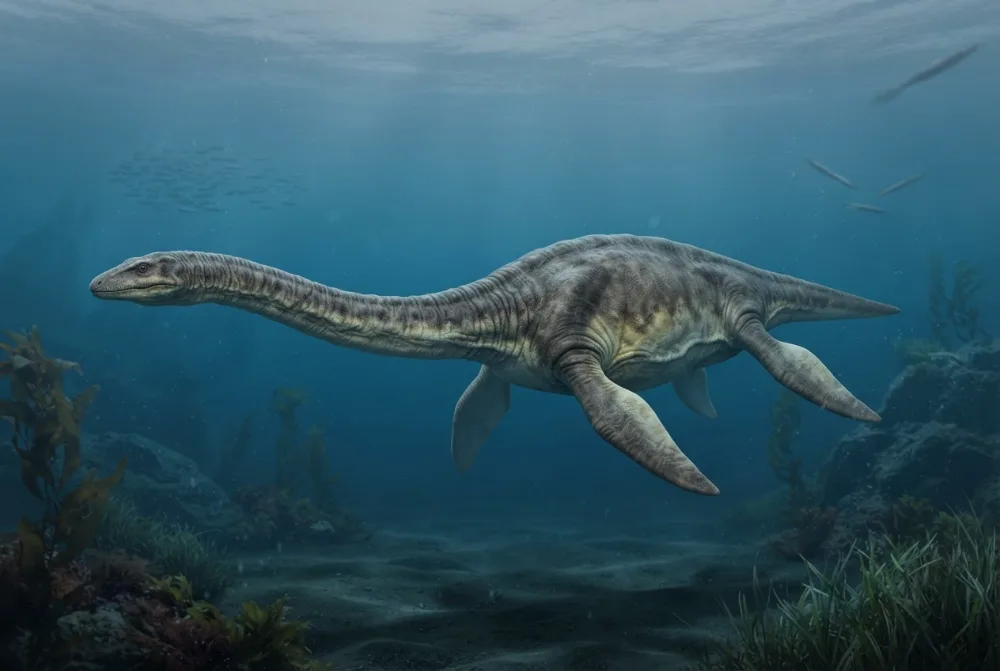
Vegasaurus was a long-necked marine reptile that swam in the cold seas near Antarctica about 72 million years ago. It was not a dinosaur, but a plesiosaur, and it used its four flippers to paddle through the water. This ancient creature is one of the few Late Cretaceous plesiosaurs from the Southern Hemisphere whose skeleton is well known.21
Yabeerawo ddi?
Yali munene atya?
Yali muwanvu kwenkana wa?
Yali muzito kwenkana wa?
 obuwanvu ng'embwa 6, ennyindo ku mukira🍌obuwanvu ng'amenvu 36 nga gaddiriŋŋana🍉obuzito ng'obwa wotamerooni 170🧸obuzito ng'obw'abaana 44 ab'omu nnasale🎒obuzito ng'obw'abaana b'essomero 26🏊yandiwuze obuwanvu bw'ekidiba ekinene (50 m) mu sikonda 6.7
Vegasaurus yali munene atya bw'ogeraageranya ku GGWE?
Kubala kwokka mu browser yo. Tewali kiterekebwa wadde okusindikibwa wonna.
Yali wa mbiro kwenkana wa?


Ebyewuunyisa
Vegasaurus had 54 neck vertebrae, which is more than most other plesiosaurs.1
The only known fossil of Vegasaurus was found in 1989 by a team of scientists on Vega Island, Antarctica.1
This plesiosaur had gastroliths, or stomach stones, which may have helped it digest food or control its buoyancy.1
Vegasaurus is named after Vega Island, where it was discovered, and the Greek word for lizard, 'sauros'.1
Its humerus (upper arm bone) had a forward-facing knee and a backward projection with an extra joint surface, a feature only shared with a few other plesiosaurs.1
Ebibuuzo ebisinga okubuuzibwa ku Vegasaurus
?How big was Vegasaurus?
About 6.15 to 6.5 metres long and weighed around 839 kilograms.1
?What did Vegasaurus eat?
Scientists are not sure exactly what it ate, but it had gastroliths (stomach stones) that may have helped grind up food like fish or squid.1
?Where was Vegasaurus found?
Its only fossil was found on Vega Island, near the Antarctic Peninsula, in 1989.1
Eri abakugu mu dayinoso
- Erinnya lya ssaayansi
- Vegasaurus
- Yatuumibwa
- O'Gorman et al. 20153
- Ekibinja
- Pulesiyosawulu
- Ekika / ekibinja
- Elasmosauridae3
- Engabanya
- Plesiosauria > Elasmosauridae > Sauropterygia3
- Emyaka gy'enjazi
- emyaka obukadde 72 okutuuka ku 66 (Maastrichtian)3
- Ensengeka z'enjazi
- Snow Hill Island3
- Ensi
- Antaakitika3
- Ebisigalira ebyazuulibwa
- 1 mu The Paleobiology Database3
- Okuzuulibwa
- Vegasaurus was named in 2015 by José P. O'Gorman and colleagues. The only fossil was found in 1989 on Vega Island, Antarctica, and was collected during three Antarctic summer expeditions in 1993, 1999, and 2005.1
- Kikyakubaganyizibwako ebirowoozo
- Scientists are still debating exactly how Vegasaurus is related to other plesiosaurs, especially the aristonectines.21
Ebituufu gye biva
- Vegasaurus (en.wikipedia.org)
- Vegasaurus molyi, gen. et sp. nov. (Plesiosauria, Elasmosauridae), from the Cape Lamb Member (lower maastrichtian) of the Snow Hill Island Formation, Vega Island, Antarctica, and remarks on Wedellian Elasmosauridae: Journal of Vertebrate Paleontology: Vol 35 , No 3 - Get Access (tandfonline.com)
- Vegasaurus in The Paleobiology Database (CC BY 4.0): emyaka, ebifo, ensengeka z'enjazi, engabanya.
Buli kituufu ku lupapula luno kirina ennamba eraga ensibuko yaakyo. Bwe tuba nga tukoze ensobi, tusonyiwe, ffe tuli bawagizi ba dayinoso, so si magazini ya ssaayansi. Tubuulire ku [email protected] tujja kugitereeza.
 Rex alumwa enjala! Dino Wiki pulojekiti ya taata eri mutabani we ayagala ennyo dayinoso, ya bwereere, tewali bulango era tewali bikulondoola. Abakulu basobola okuwa Rex akantu ak'okulya okuyamba okugikuuma ku mutimbagano.Liisa Rex
 Elasmosaurus
 Pliosaurus
 Plesiosaurus
 Cimoliasaurus
 Colymbosaurus
 Trinacromerum
 Tyrannosaurus
 Triceratops
 Velociraptor
 Spinosaurus
 Ankylosaurus
 Parasaurolophus