 Kwizi: Oli dayinoso ki?
 Olutalo lwa dayinoso
 Empaka z'emisinde gya dayinoso
 Emizannyo emitono egya dayinoso
 Alubaamu ya sitika
 Enkalala za dayinoso eza TOP
 Mpa ekyewuunyisa!
Zhengheornis
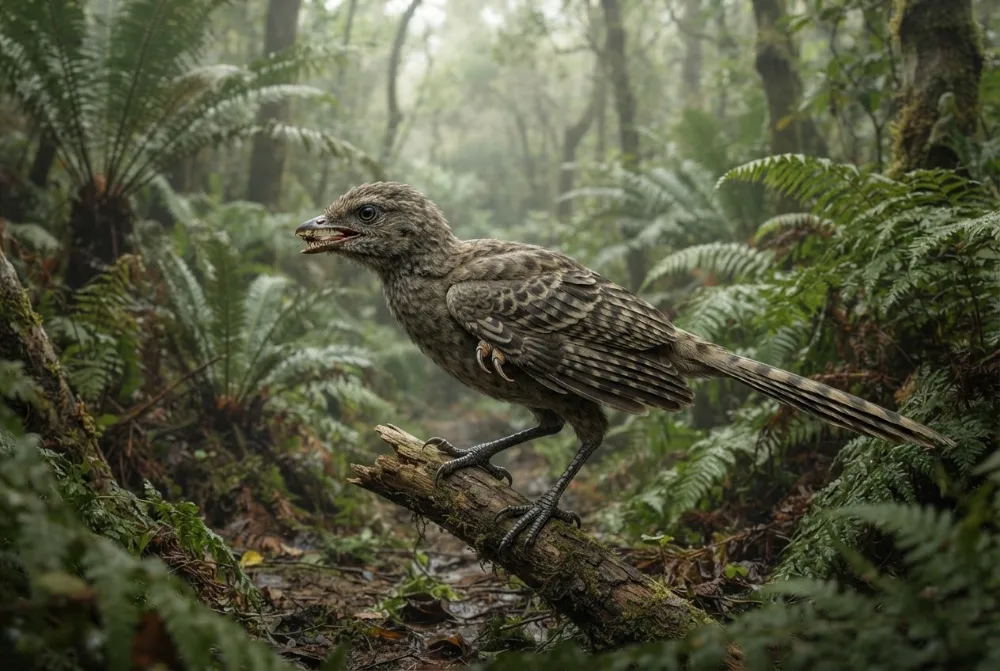
Zhengheornis was a tiny bird-like dinosaur that lived about 150 million years ago in what is now China. It had a short tail made of 15 bones, but no pygostyle, which is the fused tailbone modern birds have. This little creature helps scientists understand how bird tails evolved step by step.21
Yabeerawo ddi?
Yali munene atya?
Yali muzito kwenkana wa?
Zhengheornis yali munene atya bw'ogeraageranya ku GGWE?
Kubala kwokka mu browser yo. Tewali kiterekebwa wadde okusindikibwa wonna.
Yali wa mbiro kwenkana wa?


Ebyewuunyisa
Zhengheornis is one of the smallest known early bird relatives, weighing only about as much as a modern robin (74 to 163 grams).2
Its tail had 15 short vertebrae but no pygostyle, showing that tail shortening happened before the bones fused together in bird evolution.2
The name 'buyu' means 'unexpected' in Mandarin, because scientists were surprised by its unusual tail and pelvis.1
Zhengheornis lived alongside other early birds like Fujianvenator and Baminornis in the Zhenghe Fauna of Late Jurassic China.2
Scientists think Zhengheornis was not especially good at climbing trees or walking on the ground, unlike some of its relatives.2
The only known fossil was found in 2024 and includes bones, feather traces, and parts of the arms, legs, and pelvis.1
Ebibuuzo ebisinga okubuuzibwa ku Zhengheornis
?How big was Zhengheornis?
Zhengheornis was incredibly tiny, weighing only about 74 to 163 grams, similar to a modern robin. It is one of the smallest known long-tailed early bird relatives.34
?When did Zhengheornis live?
Zhengheornis lived during the Early Cretaceous period, about 120 to 130 million years ago, in what is now China.13
Eri abakugu mu dayinoso
- Erinnya lya ssaayansi
- Zhengheornis
- Yatuumibwa
- Wang et al. 20265
- Ekibinja
- Ebinyonyi eby'olubereberye
- Ekika / ekibinja
- Avialae5
- Engabanya
- Theropoda > Avialae5
- Emyaka gy'enjazi
- emyaka obukadde 152 okutuuka ku 145 (Kimmeridgian / Tithonian)5
- Ensengeka z'enjazi
- Nanyuan5
- Ensi
- Cayina5
- Ebisigalira ebyazuulibwa
- 1 mu The Paleobiology Database5
- Okuzuulibwa
- Zhengheornis was discovered in 2024 during fieldwork in Fujian Province, China, and named by Min Wang and colleagues in 2026.1
- Kikyakubaganyizibwako ebirowoozo
- Scientists are still debating exactly where Zhengheornis fits on the family tree of early birds, though most agree it is one of the earliest avialans.2
Ebituufu gye biva
- Zhengheornis (en.wikipedia.org)
- Jurassic avialan reveals stepwise evolution of bony tail in birds (dinodata.de)
- China Jurassic Pocket-Sized Bird Fills a Puzzle of the Evolution of Bird Tail_Headline_Institute of Vertebrate Paleontology and Paleoanthropology, Chinese Academy of Sciences (english.ivpp.cas.cn)
- China Jurassic Pocket-Sized Bird Fills a Puzzle of the Evolution of Bird Tail_Research Progress_Institute of Vertebrate Paleontology and Paleoanthropology, Chinese Academy of Sciences (english.ivpp.cas.cn)
- Zhengheornis in The Paleobiology Database (CC BY 4.0): emyaka, ebifo, ensengeka z'enjazi, engabanya.
Buli kituufu ku lupapula luno kirina ennamba eraga ensibuko yaakyo. Bwe tuba nga tukoze ensobi, tusonyiwe, ffe tuli bawagizi ba dayinoso, so si magazini ya ssaayansi. Tubuulire ku [email protected] tujja kugitereeza.
 Rex alumwa enjala! Dino Wiki pulojekiti ya taata eri mutabani we ayagala ennyo dayinoso, ya bwereere, tewali bulango era tewali bikulondoola. Abakulu basobola okuwa Rex akantu ak'okulya okuyamba okugikuuma ku mutimbagano.Liisa Rex
 Archaeopteryx
 Hesperornis
 Ichthyornis
 Baptornis
 Jurapteryx
 Gobipteryx
 Brachiosaurus
 Diplodocus
 Allosaurus
 Brontosaurus
 Compsognathus
 Camarasaurus