 Ozali dino nini? Kwizi
 Etumba ya badino
 Mbangu ya badino
 Masano mike ya badino
 Albumu ya bastika
 Bilisti TOP ya badino
 Kamwisa ngai!
Alexandronectes
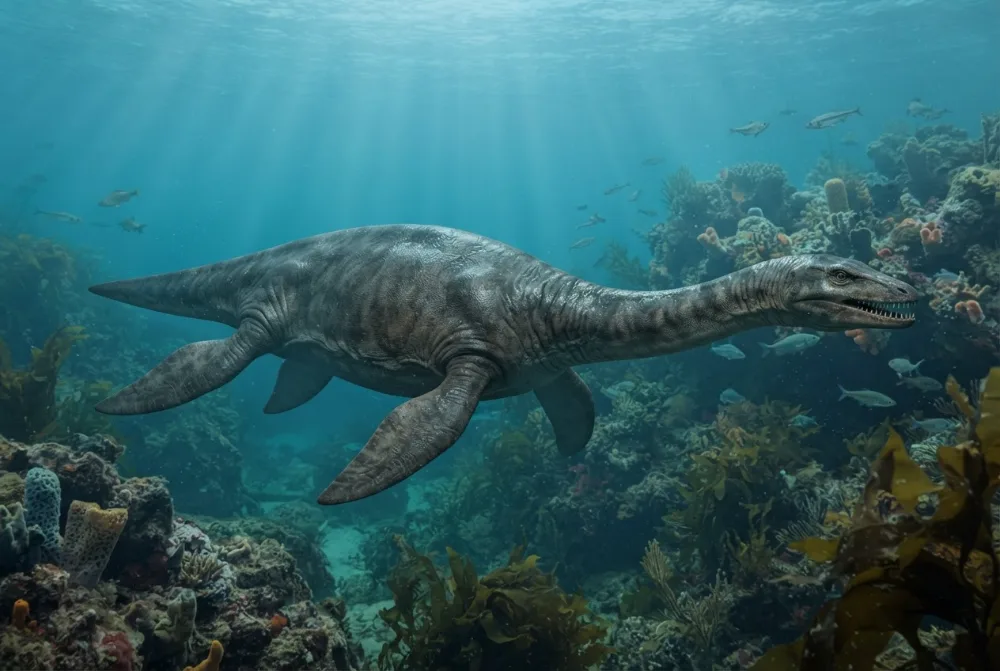
Alexandronectes was a long-necked marine reptile that swam in the seas around New Zealand near the end of the Age of Dinosaurs. It was a type of plesiosaur called an elasmosaurid, with a big head and a short neck compared to other elasmosaurids. It used its strong flippers to paddle through the water and hunt for fish and squid.12
Azalaki na bomoi ntango nini?
Azalaki na mbangu boni?


Makambo ya kosepelisa
Alexandronectes was a type of plesiosaur called an aristonectine, a group known for having unusually large skulls compared to other elasmosaurids.1
Its skull was smaller than those of other aristonectines like Kaiwhekea and Aristonectes, showing that not all members of this group were giants.1
The fossils of Alexandronectes were collected in 1872 by Alexander McKay, a famous New Zealand fossil hunter, but scientists did not name the animal until 2016.13
Its name means 'Alexander's swimmer from Zealandia', referring to the ancient continent that New Zealand is part of.1
Alexandronectes lived about 70 million years ago, during the early Maastrichtian stage of the Late Cretaceous.13
The only known fossils are two pieces of the back of the skull, which were originally thought to belong to two different animals.1
Mituna oyo batunaka mingi na ntina na Alexandronectes
?Was Alexandronectes a dinosaur?
No, it was a plesiosaur, a type of long-necked marine reptile that lived in the oceans, not a dinosaur.3
?How big was Alexandronectes?
Scientists do not know its exact size because only parts of its skull have been found. Its skull was smaller than those of other aristonectines like Kaiwhekea and Aristonectes.31
?What did Alexandronectes eat?
It likely ate fish and squid, using its strong flippers to paddle through the water and hunt.3
Mpo na bayebi ya badino
- Nkombo ya siansi
- Alexandronectes
- Nkombo epesamaki na
- Otero et al. 20164
- Lisanga
- Baplezozore
- Libota / klade
- Elasmosauridae4
- Klasifikasio
- Plesiosauria > Elasmosauridae > Sauropterygia4
- Mbula ya mabanga
- mbula milio 84 kino 66 (Campanian / Maastrichtian)4
- Milongo ya mabanga
- Conway4
- Bikolo
- Zelandi ya Sika4
- Bafosile oyo ekomami
- 1 na The Paleobiology Database4
- Ntango bamonaki yango
- The fossils were found in 1872 by Alexander McKay near the Waipara River in New Zealand. They were stored at the Canterbury Museum for over 140 years before being studied and named Alexandronectes zealandiensis in 2016.13
- Naino bazali kowelana
- Scientists are not sure exactly how big Alexandronectes was, because only a partial skull has been found.1
Esika makambo euti
- UJVP_A_1054494_O (sedici.unlp.edu.ar)
- PBDB Taxon (paleobiodb.org)
- Alexandronectes (en.wikipedia.org)
- Alexandronectes in The Paleobiology Database (CC BY 4.0): mbula, bisika, milongo ya mabanga, klasifikasio.
Likambo nyonso na lokasa oyo ezali na nimero oyo elakisi liziba na yango. Soki tosali libunga, limbisa biso, tozali bato balingaka badino, zulunalo ya siansi te. Yebisa biso na [email protected] mpe tokobongisa yango.
 Rex azali na nzala! Dino Wiki ezali mosala ya tata moko mpo na mwana na ye ya mobali oyo alingaka badino, ofele, piblisite te mpe batrakere te. Bato bakolo bakoki kopesa Rex biskwi mpo na kosalisa ete etikala na internet.Leisa Rex
 Elasmosaurus
 Pliosaurus
 Plesiosaurus
 Cimoliasaurus
 Colymbosaurus
 Trinacromerum
 Tyrannosaurus
 Triceratops
 Velociraptor
 Spinosaurus
 Ankylosaurus
 Parasaurolophus