 Ozali dino nini? Kwizi
 Etumba ya badino
 Mbangu ya badino
 Masano mike ya badino
 Albumu ya bastika
 Bilisti TOP ya badino
 Kamwisa ngai!
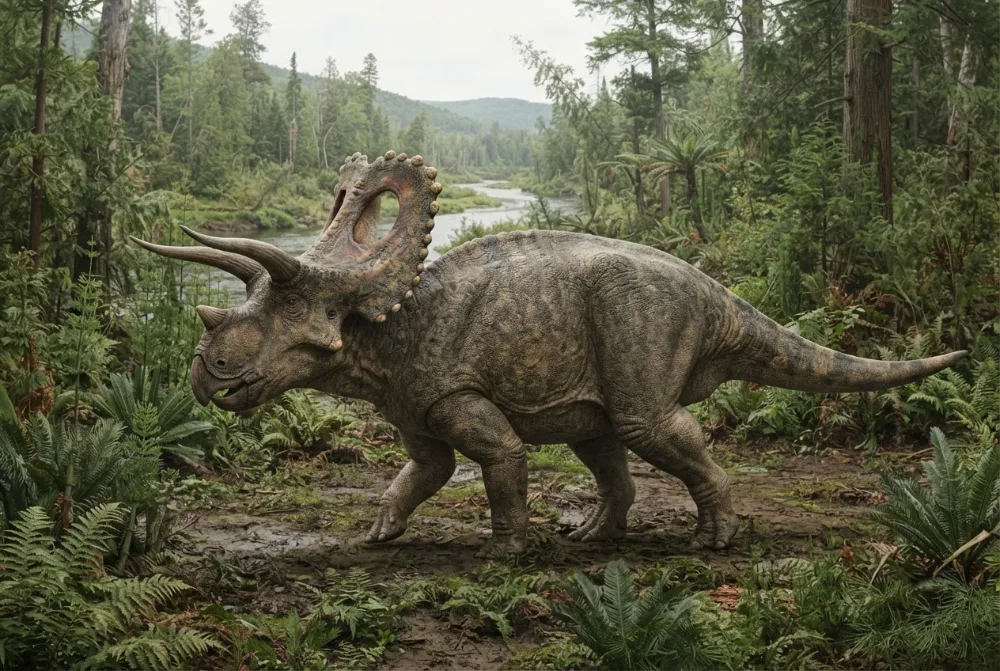
Anchiceratops
Anchiceratops was a horned dinosaur that lived in Canada about 73 to 68 million years ago. It had two long horns above its eyes and a short horn on its nose. Its frill was long and rectangular with bumpy edges.1
Azalaki na bomoi ntango nini?
Azalaki monene boni?
Azalaki molai boni?
Azalaki molai boni na likolo?
kokanisa
Azalaki kilo boni?
 molai lokola bambwa 6 zolo kino mokila🍌molai lokola matoko 33 oyo balandani🍉kilo lokola bapasteke 240🧸kilo lokola bana 63 ya eteyelo ya bana mike🎒kilo lokola bana 38 ya kelasi🐻❄️kilo lokola ba-urs ya pembe 2,5🏃akokaki kopota metele 100 na sekonde 9,5 (moto oyo aleki mbangu asalelaka 9,6)
Anchiceratops azalaki monene boni soki tokokanisi na YO?
Kaka matematiki na navigatere na yo. Eloko moko te ebombami to etindami esika moko.
Azalaki na mbangu boni?


Makambo ya kosepelisa
Anchiceratops is rare compared to other horned dinosaurs in the same area, and its fossils are often found near ancient marine sediments.1
The name Anchiceratops means 'near horned face' because Barnum Brown thought it was a close relative of Triceratops.1
Its frill had coarse triangular projections along the edge, which is why the species name ornatus means 'ornate'.1
Anchiceratops lived in estuaries and coastal areas, where other ceratopsids did not live.1
The first fossils were found along the Red Deer River in Alberta, Canada, in 1912 by an expedition led by Barnum Brown.1
Anchiceratops shared its environment with dinosaurs like Albertosaurus, Edmontosaurus, and Pachyrhinosaurus.1
Mituna oyo batunaka mingi na ntina na Anchiceratops
?How big was Anchiceratops?
About 4.3 metres long and weighed around 1.2 tonnes.1
?What did Anchiceratops eat?
It was a herbivore, eating plants like conifers, cycads, and ferns.1
?Could Anchiceratops swim?
Some scientists think it may have lived in swamps and estuaries like a hippopotamus, but others disagree.1
?Why did Anchiceratops have a frill?
Probably for display and to recognize other members of its species, not for defense.1
?How many horns did Anchiceratops have?
Three: two long horns above its eyes and a short horn on its nose.1
Mpo na bayebi ya badino
- Nkombo ya siansi
- Anchiceratops
- Nkombo epesamaki na
- Brown 19143
- Lisanga
- Badino na maseke
- Libota / klade
- Ceratopsidae3
- Klasifikasio
- Ornithischia > Ceratopsia > Ceratopsidae3
- Mbula ya mabanga
- mbula milio 84 kino 66 (Campanian / Maastrichtian)3
- Milongo ya mabanga
- Horseshoe Canyon, St. Mary River3
- Bikolo
- Kanada3
- Bafosile oyo ekomami
- 7 na The Paleobiology Database3
- Ntango bamonaki yango
- Anchiceratops was named by American paleontologist Barnum Brown in 1914. He found the first fossils in 1912 along the Red Deer River in Alberta, Canada.1
- Naino bazali kowelana
- Scientists still debate whether some frill fragments from older rock formations belong to Anchiceratops or to a different, related species.1
Esika makambo euti
- Anchiceratops (en.wikipedia.org)
- Anchiceratops | Natural History Museum (nhm.ac.uk)
- Anchiceratops in The Paleobiology Database (CC BY 4.0): mbula, bisika, milongo ya mabanga, klasifikasio.
Likambo nyonso na lokasa oyo ezali na nimero oyo elakisi liziba na yango. Soki tosali libunga, limbisa biso, tozali bato balingaka badino, zulunalo ya siansi te. Yebisa biso na [email protected] mpe tokobongisa yango.
 Rex azali na nzala! Dino Wiki ezali mosala ya tata moko mpo na mwana na ye ya mobali oyo alingaka badino, ofele, piblisite te mpe batrakere te. Bato bakolo bakoki kopesa Rex biskwi mpo na kosalisa ete etikala na internet.Leisa Rex
 Triceratops
 Protoceratops
 Ojoceratops
 Tatankaceratops
 Psittacosaurus
 Centrosaurus
 Tyrannosaurus
 Velociraptor
 Spinosaurus
 Ankylosaurus
 Parasaurolophus
 Pteranodon