 Ozali dino nini? Kwizi
 Etumba ya badino
 Mbangu ya badino
 Masano mike ya badino
 Albumu ya bastika
 Bilisti TOP ya badino
 Kamwisa ngai!
Argentinonectes
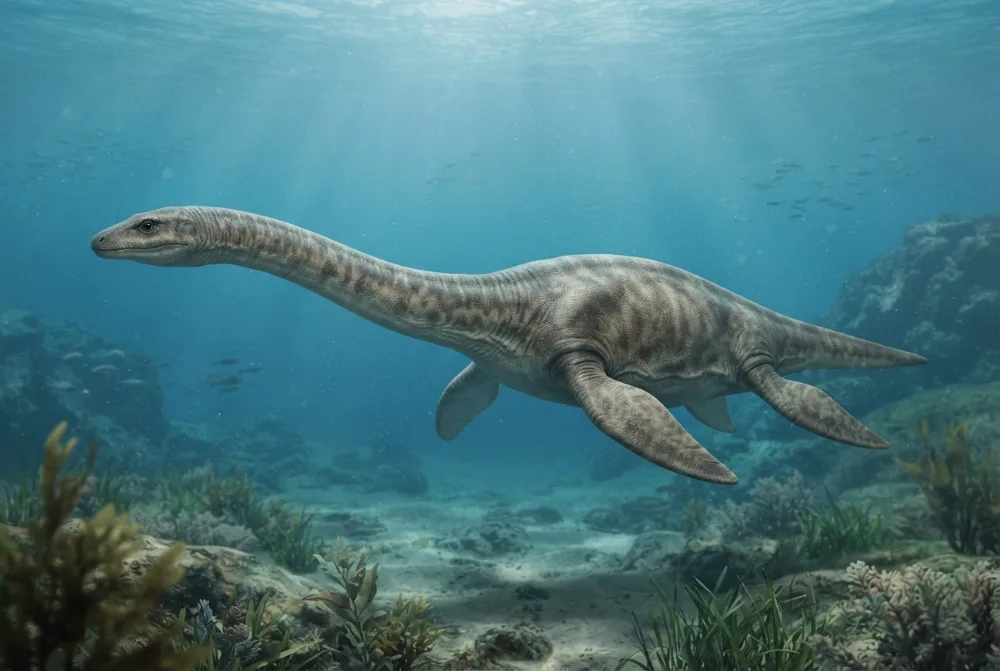
Argentinonectes was a huge, long-necked marine reptile that swam in the seas near Antarctica 66 million years ago. It had four flipper-like legs and a stiff tail that may have had a fin on the end. This plesiosaur is the most complete one ever found in Argentina!1
Azalaki na bomoi ntango nini?
Azalaki monene boni?
Azalaki molai boni?
 molai lokola bamotuka 2 oyo batelemi na molongo🍌molai lokola matoko 50 oyo balandani🏊akokaki kobeta mai bolai ya pisine monene (50 m) na sekonde 7,8
Argentinonectes azalaki monene boni soki tokokanisi na YO?
Kaka matematiki na navigatere na yo. Eloko moko te ebombami to etindami esika moko.
Azalaki na mbangu boni?


Makambo ya kosepelisa
The fossil was found under 50 cm (20 inches) of water in Lake Argentino, making it tricky to dig out.1
Its rib cage and belly bones were very stiff, which helped it dive without its lungs collapsing.1
Shark teeth and scratches on its bones show that sharks ate the dead plesiosaur's body.1
The tail had eight tightly locked vertebrae at the tip, probably supporting a small tail fin.1
Its forelimbs were about 1.8 metres (5.9 feet) long, and the hindlimbs were a bit shorter at 1.3 metres (4.3 feet).1
The skeleton is missing the skull and most of the neck, possibly because they floated away after death.1
Mituna oyo batunaka mingi na ntina na Argentinonectes
?How big was Argentinonectes?
It was about 7 to 9 metres (23 to 30 feet) long. That is roughly as long as a school bus.1
?What did Argentinonectes eat?
Scientists do not know for sure because the skull is missing. But like other plesiosaurs, it probably ate fish and squid.1
?When did Argentinonectes live?
It lived at the very end of the Cretaceous Period, about 66 million years ago.1
?Is Argentinonectes a dinosaur?
No, it is a plesiosaur, a marine reptile that swam in the ocean. It is not a dinosaur.1
Mobuki masapo
Lisapo: Some people think all plesiosaurs were slow and clumsy on land.
Solo: Argentinonectes and other plesiosaurs were fully aquatic and never came onto land. They were fast swimmers in the ocean.1
Mpo na bayebi ya badino
- Nkombo ya siansi
- Argentinonectes
- Nkombo epesamaki na
- Novas et al. 20263
- Lisanga
- Baplezozore
- Libota / klade
- Elasmosauridae3
- Klasifikasio
- Plesiosauria > Elasmosauridae > Sauropterygia3
- Mbula ya mabanga
- mbula milio 72 kino 66 (Maastrichtian)3
- Milongo ya mabanga
- Calafate3
- Bikolo
- Arzantine3
- Bafosile oyo ekomami
- 1 na The Paleobiology Database3
- Ntango bamonaki yango
- The fossil was found in 2009 in Lake Argentino, Argentina, and was named Argentinonectes calafatensis by Fernando Novas and colleagues in 2026.1
- Naino bazali kowelana
- Scientists are not sure why the skull and neck are missing. They may have been eroded by waves or detached when the body bloated and floated.1
Esika makambo euti
- Argentinonectes (en.wikipedia.org)
- PBDB Taxon (paleobiodb.org)
- Argentinonectes in The Paleobiology Database (CC BY 4.0): mbula, bisika, milongo ya mabanga, klasifikasio.
Likambo nyonso na lokasa oyo ezali na nimero oyo elakisi liziba na yango. Soki tosali libunga, limbisa biso, tozali bato balingaka badino, zulunalo ya siansi te. Yebisa biso na [email protected] mpe tokobongisa yango.
 Rex azali na nzala! Dino Wiki ezali mosala ya tata moko mpo na mwana na ye ya mobali oyo alingaka badino, ofele, piblisite te mpe batrakere te. Bato bakolo bakoki kopesa Rex biskwi mpo na kosalisa ete etikala na internet.Leisa Rex
 Elasmosaurus
 Pliosaurus
 Plesiosaurus
 Cimoliasaurus
 Colymbosaurus
 Trinacromerum
 Tyrannosaurus
 Triceratops
 Velociraptor
 Spinosaurus
 Ankylosaurus
 Parasaurolophus