 Ozali dino nini? Kwizi
 Etumba ya badino
 Mbangu ya badino
 Masano mike ya badino
 Albumu ya bastika
 Bilisti TOP ya badino
 Kamwisa ngai!
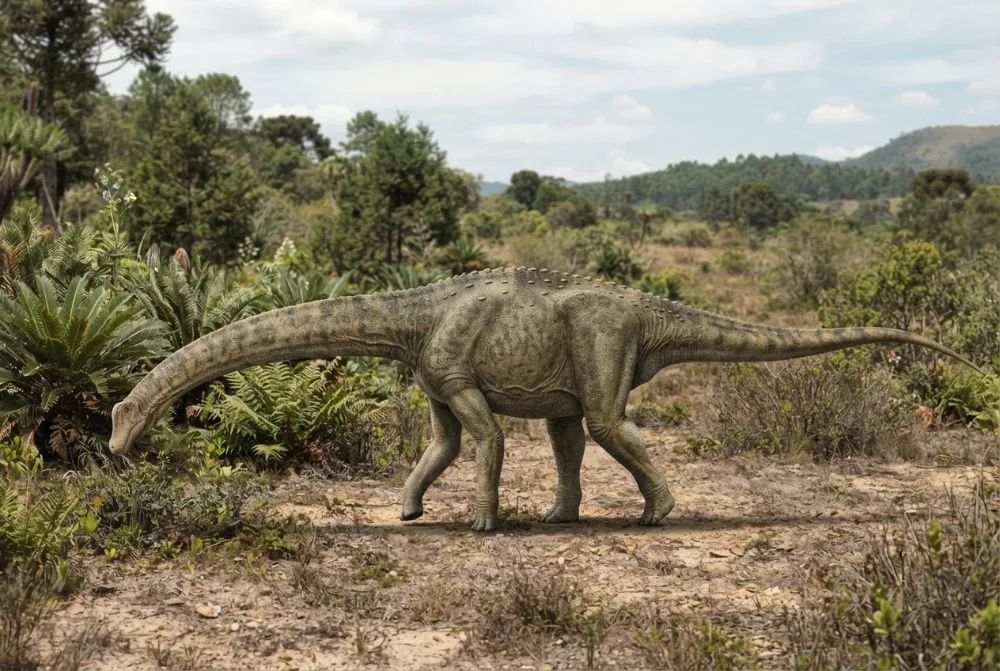
Arrudatitan
Arrudatitan was a huge, long-necked plant-eater that lived in Brazil during the Late Cretaceous. It was a titanosaur, a group of sauropods that included some of the biggest land animals ever. Even though it was giant, Arrudatitan was more slender and graceful than many of its relatives.1
Azalaki na bomoi ntango nini?
Azalaki monene boni?
Azalaki molai boni?
Azalaki molai boni na likolo?
kokanisa
Azalaki kilo boni?

 molai lokola bamotuka 3 oyo batelemi na molongo🍌molai lokola matoko 83 oyo balandanikilo lokola bamotuka 8🍉kilo lokola bapasteke 2500🎒kilo lokola bakelasi 15 mobimba ya bana🐻❄️kilo lokola ba-urs ya pembe 27🏃akokaki kopota metele 100 na sekonde 26 (moto oyo aleki mbangu asalelaka 9,6)
Arrudatitan azalaki monene boni soki tokokanisi na YO?
Kaka matematiki na navigatere na yo. Eloko moko te ebombami to etindami esika moko.
Azalaki na mbangu boni?


Makambo ya kosepelisa
Arrudatitan was first thought to be a species of Aeolosaurus, but scientists later gave it its own genus name in 2021.12
The first fossils were found in 1997 by a farmer and his 12-year-old nephew in a field in Cândido Rodrigues, Brazil.1
Its femur (thigh bone) was 1.55 metres (5.1 feet) long, which helps scientists estimate its total length at about 15 metres (49 feet).1
Crocodylomorph and theropod teeth were found near the Arrudatitan skeleton, but there were no bite marks on the bones.1
Arrudatitan lived during the Campanian to Maastrichtian stages of the Late Cretaceous, about 72 to 68 million years ago.1
The name Arrudatitan honors Brazilian paleontologist Antônio Celso de Arruda Campos.1
Mituna oyo batunaka mingi na ntina na Arrudatitan
?How big was Arrudatitan?
Arrudatitan grew up to about 15 metres (49 feet) long, based on its fossils. Its thigh bone was 1.55 metres (5.1 feet) long.1
?What did Arrudatitan eat?
It was a plant-eater, or herbivore. As a titanosaur sauropod, it ate plants.4
?When did Arrudatitan live?
Arrudatitan lived during the Late Cretaceous, about 72 to 68 million years ago.1
?Where was Arrudatitan found?
Its fossils were found in the Adamantina Formation of Brazil, in a field near Cândido Rodrigues.1
Mpo na bayebi ya badino
- Nkombo ya siansi
- Arrudatitan
- Nkombo epesamaki na
- Silva Junior et al. 20224
- Lisanga
- Nkingo milai
- Libota / klade
- Rinconsauria4
- Klasifikasio
- Sauropodomorpha > Sauropoda > Titanosauria > Macronaria4
- Mbula ya mabanga
- mbula milio 84 kino 66 (Campanian / Maastrichtian)4
- Milongo ya mabanga
- Adamantina4
- Bikolo
- Brezili4
- Bafosile oyo ekomami
- 1 na The Paleobiology Database4
- Ntango bamonaki yango
- The first fossils were found in 1997 by Ademir Frare and his 12-year-old nephew Luiz Augusto dos Santos Frare in a field in Cândido Rodrigues, Brazil. They told paleontologist Antônio Celso de Arruda Campos, and the bones were collected by staff of the Museu de Paleontologia de Monte Alto. The species was first named Aeolosaurus maximus in 2011, but moved to its own genus Arrudatitan in 2021.1
- Naino bazali kowelana
- Scientists are still debating exactly how Arrudatitan is related to other titanosaurs, and whether it belongs in the group Rinconsauria or is closer to other South American giants.14
Esika makambo euti
- Arrudatitan (en.wikipedia.org)
- Reassessment of Aeolosaurus maximus, a titanosaur dinosaur from the Late Cretaceous of Southeastern Brazil (exa.ai)
- Arrudatitan maximus | Dinosaur Database by DinoAnimals.com (dinoanimals.com)
- Arrudatitan in The Paleobiology Database (CC BY 4.0): mbula, bisika, milongo ya mabanga, klasifikasio.
Likambo nyonso na lokasa oyo ezali na nimero oyo elakisi liziba na yango. Soki tosali libunga, limbisa biso, tozali bato balingaka badino, zulunalo ya siansi te. Yebisa biso na [email protected] mpe tokobongisa yango.
 Rex azali na nzala! Dino Wiki ezali mosala ya tata moko mpo na mwana na ye ya mobali oyo alingaka badino, ofele, piblisite te mpe batrakere te. Bato bakolo bakoki kopesa Rex biskwi mpo na kosalisa ete etikala na internet.Leisa Rex
 Brachiosaurus
 Diplodocus
 Brontosaurus
 Argentinosaurus
 Camarasaurus
 Morosaurus
 Tyrannosaurus
 Triceratops
 Velociraptor
 Spinosaurus
 Ankylosaurus
 Parasaurolophus