 Ozali dino nini? Kwizi
 Etumba ya badino
 Mbangu ya badino
 Masano mike ya badino
 Albumu ya bastika
 Bilisti TOP ya badino
 Kamwisa ngai!
Azalaki na bomoi ntango nini?

Azalaki monene boni?
Azalaki molai boni?
Azalaki molai boni na likolo?
kokanisa
Azalaki kilo boni?

 molai lokola bapusu 3 ya ndako zolo kino mokila🍌molai lokola matoko 8 oyo balandanikilo lokola bapusu ya ndako 11🍉kilo lokola bapasteke 9🧸kilo lokola bana 2,5 ya eteyelo ya bana mike🎒kilo lokola bana 1,5 ya kelasi🏃akokaki kopota metele 100 na sekonde 10 (moto oyo aleki mbangu asalelaka 9,6)
Bagaceratops azalaki monene boni soki tokokanisi na YO?
Kaka matematiki na navigatere na yo. Eloko moko te ebombami to etindami esika moko.
Azalaki na mbangu boni?


Makambo ya kosepelisa
Bagaceratops had no teeth at the front of its upper jaw, unlike its relative Protoceratops.1
It lived about 72 to 71 million years ago, near the end of the age of dinosaurs.1
Scientists once thought that fossils of Bagaceratops were several different dinosaurs, like Gobiceratops and Magnirostris, but now they think those are just Bagaceratops.1
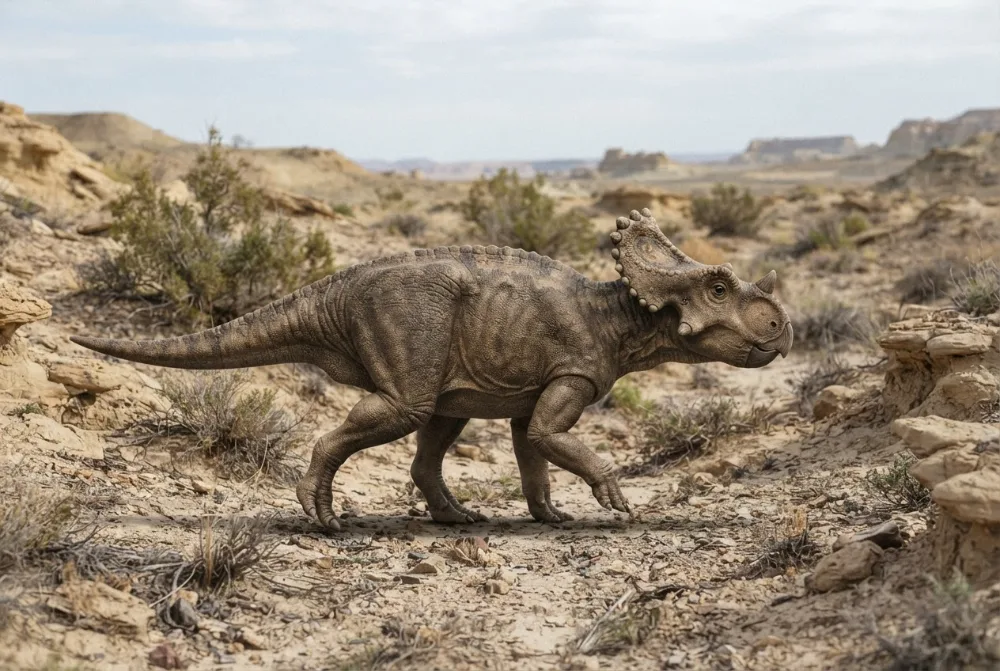
Bagaceratops had a small frill on its head, much smaller than the frills of later horned dinosaurs.1
Its skull was more triangular than that of its close cousin Protoceratops.1
Mituna oyo batunaka mingi na ntina na Bagaceratops
?How big was Bagaceratops?
Bagaceratops was about 1 to 1.5 metres (3.3 to 4.9 feet) long and weighed around 22 to 45 kilograms (49 to 99 pounds). It was one of the smallest horned dinosaurs.12
?What did Bagaceratops eat?
Bagaceratops was an herbivore, meaning it ate plants. It used its parrot-like beak to chomp on plants and had about ten grinding teeth per jaw to chew them.12
?Where did Bagaceratops live?
Bagaceratops lived in Asia, in what is now the Gobi Desert in Mongolia. Its fossils have been found in the Barun Goyot Formation and Bayan Mandahu Formation.12
?When did Bagaceratops live?
Bagaceratops lived during the Late Cretaceous Period, about 72 to 71 million years ago. That was near the very end of the age of dinosaurs.12
?Did Bagaceratops have horns?
Bagaceratops did not have large horns like Triceratops. Its name means 'small-horned face,' and it had a small frill on its head but no big horns.1
Mpo na bayebi ya badino
- Nkombo ya siansi
- Bagaceratops
- Nkombo epesamaki na
- Maryanska and Osmólska 19753
- Lisanga
- Badino na maseke
- Libota / klade
- Protoceratopsidae3
- Klasifikasio
- Ornithischia > Ceratopsia3
- Mbula ya mabanga
- mbula milio 84 kino 66 (Campanian / Maastrichtian)3
- Milongo ya mabanga
- Baruungoyot, Djadokhta, Bayan Mandahu3
- Bikolo
- Mongoli, Sina3
- Bafosile oyo ekomami
- 18 na The Paleobiology Database3
- Bayebi ye mpe na nkombo
- Gobiceratops, Lamaceratops, Magnirostris, Platyceratops (bankombo ya kala oyo sikoyo batangaka lokola nyama moko)3
- Ntango bamonaki yango
- Bagaceratops was named in 1975 by Polish paleontologists Teresa Maryańska and Halszka Osmólska, based on fossils found in the Gobi Desert during the Polish-Mongolian expeditions.12
- Naino bazali kowelana
- Scientists are still debating whether some other ceratopsians, like Breviceratops, are really a separate genus or just Bagaceratops.1
Esika makambo euti
- Bagaceratops (en.wikipedia.org)
- Bagaceratops | Natural History Museum (nhm.ac.uk)
- Bagaceratops in The Paleobiology Database (CC BY 4.0): mbula, bisika, milongo ya mabanga, klasifikasio.
Likambo nyonso na lokasa oyo ezali na nimero oyo elakisi liziba na yango. Soki tosali libunga, limbisa biso, tozali bato balingaka badino, zulunalo ya siansi te. Yebisa biso na [email protected] mpe tokobongisa yango.
 Rex azali na nzala! Dino Wiki ezali mosala ya tata moko mpo na mwana na ye ya mobali oyo alingaka badino, ofele, piblisite te mpe batrakere te. Bato bakolo bakoki kopesa Rex biskwi mpo na kosalisa ete etikala na internet.Leisa Rex
 Triceratops
 Protoceratops
 Ojoceratops
 Tatankaceratops
 Psittacosaurus
 Centrosaurus
 Tyrannosaurus
 Velociraptor
 Spinosaurus
 Ankylosaurus
 Parasaurolophus
 Pteranodon