 Ozali dino nini? Kwizi
 Etumba ya badino
 Mbangu ya badino
 Masano mike ya badino
 Albumu ya bastika
 Bilisti TOP ya badino
 Kamwisa ngai!
Caenagnathus
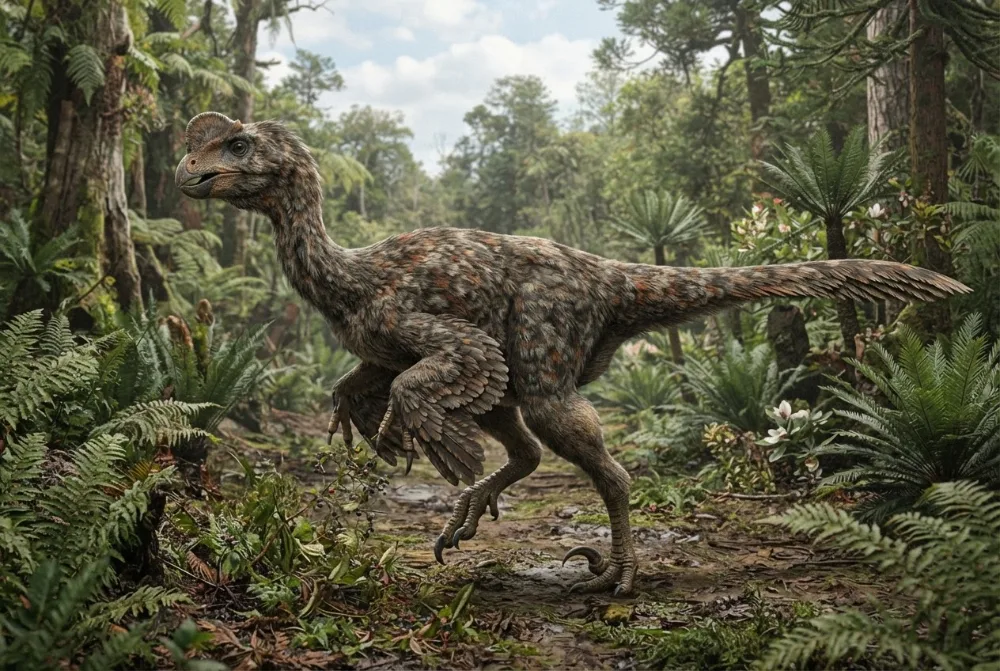
Caenagnathus was a big, bird-like dinosaur with a toothless beak. It lived in what is now Canada and the United States during the Late Cretaceous. Scientists think it ate both plants and meat, like a modern-day crow.41
Azalaki na bomoi ntango nini?
Azalaki monene boni?
Azalaki molai boni?
Azalaki molai boni na likolo?
Azalaki kilo boni?
 molai lokola bambwa 4 zolo kino mokila🍌molai lokola matoko 19 oyo balandani🍉kilo lokola bapasteke 20🧸kilo lokola bana 5 ya eteyelo ya bana mike🎒kilo lokola bana 3 ya kelasi🏃akokaki kopota metele 100 na sekonde 7,5 (moto oyo aleki mbangu asalelaka 9,6)
Caenagnathus azalaki monene boni soki tokokanisi na YO?
Kaka matematiki na navigatere na yo. Eloko moko te ebombami to etindami esika moko.
Azalaki na mbangu boni?


Makambo ya kosepelisa
Caenagnathus was first thought to be a bird because its jaw looked so bird-like.4
It was one of the largest caenagnathids, rivaling the size of Anzu wyliei.1
Its beak had three ridges on the tip, which may have helped it grip food.2
Caenagnathus lived alongside other caenagnathids like Citipes and Chirostenotes in the Dinosaur Park Formation.1
The type specimen is a lower jaw (mandible) found in Alberta, Canada.2
It was a ground-dwelling dinosaur that walked on two legs.4
Mituna oyo batunaka mingi na ntina na Caenagnathus
?How big was Caenagnathus?
Caenagnathus was about 2.5 metres (8.2 feet) long and weighed around 85 to 100 kilograms (187 to 220 pounds). It was one of the largest caenagnathids, similar in size to its relative Anzu.3
?What did Caenagnathus eat?
Scientists think Caenagnathus ate both plants and meat, like a modern-day crow. Its toothless beak likely helped it grip a variety of foods.3
?Did Caenagnathus have feathers?
Yes, like all oviraptorosaurs, Caenagnathus would most likely have had a coat of feathers over its body.3
?Is Caenagnathus a dinosaur?
Yes, Caenagnathus is a dinosaur. It is a genus of caenagnathid oviraptorosaurian dinosaur from the Late Cretaceous.3
Mobuki masapo
Lisapo: Caenagnathus was a bird.
Solo: Caenagnathus was a feathered dinosaur, not a bird. It belongs to the oviraptorosaur group.4
Mpo na bayebi ya badino
- Nkombo ya siansi
- Caenagnathus
- Nkombo epesamaki na
- Sternberg 19404
- Lisanga
- Badino ya nsala ya kokamwa
- Libota / klade
- Caenagnathidae4
- Klasifikasio
- Theropoda > Oviraptorosauria4
- Mbula ya mabanga
- mbula milio 84 kino 66 (Campanian / Maastrichtian)4
- Milongo ya mabanga
- Dinosaur Park, Hell Creek4
- Bikolo
- Kanada, Amerika4
- Bafosile oyo ekomami
- 8 na The Paleobiology Database4
- Ntango bamonaki yango
- Caenagnathus was named by R. M. Sternberg in 1940 based on a jaw fossil from the Dinosaur Park Formation in Alberta, Canada.4
- Naino bazali kowelana
- Scientists are still debating whether some fossils belong to Caenagnathus or to other similar caenagnathids.1
Esika makambo euti
- Caenagnathids of the Dinosaur Park Formation (Campanian) of Alberta, Canada: anatomy, osteohistology, taxonomy, and evolution | Vertebrate Anatomy Morphology Palaeontology (journals.library.ualberta.ca)
- PBDB Taxon (paleobiodb.org)
- Caenagnathus (en.wikipedia.org)
- Caenagnathus in The Paleobiology Database (CC BY 4.0): mbula, bisika, milongo ya mabanga, klasifikasio.
Likambo nyonso na lokasa oyo ezali na nimero oyo elakisi liziba na yango. Soki tosali libunga, limbisa biso, tozali bato balingaka badino, zulunalo ya siansi te. Yebisa biso na [email protected] mpe tokobongisa yango.
 Rex azali na nzala! Dino Wiki ezali mosala ya tata moko mpo na mwana na ye ya mobali oyo alingaka badino, ofele, piblisite te mpe batrakere te. Bato bakolo bakoki kopesa Rex biskwi mpo na kosalisa ete etikala na internet.Leisa Rex
 Therizinosaurus
 Oviraptor
 Chirostenotes
 Citipes
 Leptorhynchos
 Avimimus
 Tyrannosaurus
 Triceratops
 Velociraptor
 Spinosaurus
 Ankylosaurus
 Parasaurolophus