 Ozali dino nini? Kwizi
 Etumba ya badino
 Mbangu ya badino
 Masano mike ya badino
 Albumu ya bastika
 Bilisti TOP ya badino
 Kamwisa ngai!
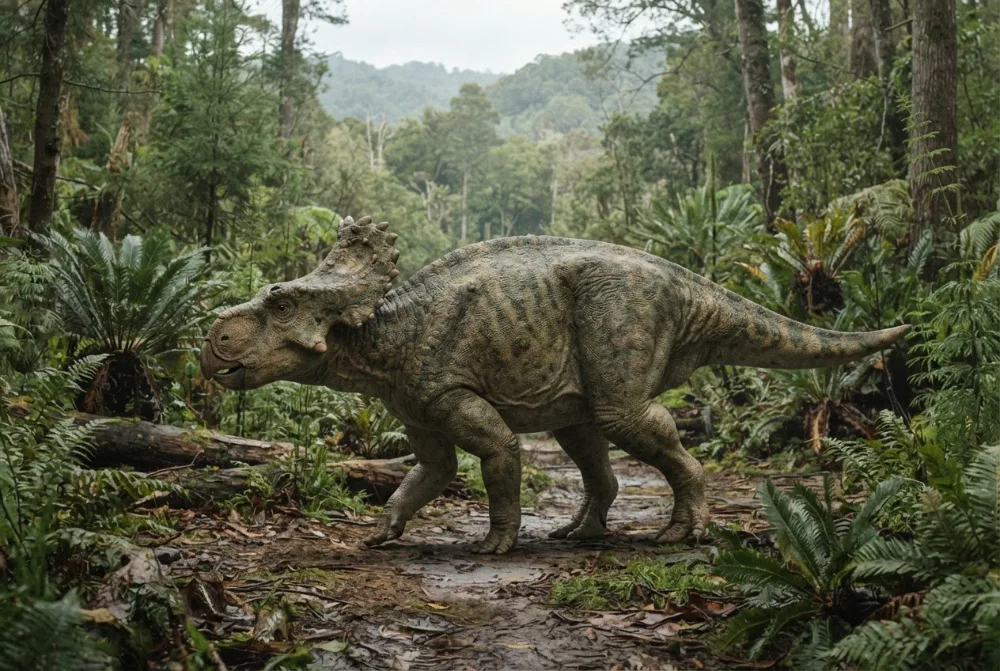
Cerasinops
Cerasinops was a small, plant-eating dinosaur that lived about 80 million years ago. It had a parrot-like beak and a frill on its head, but no big horns like its famous cousin Triceratops. This dinosaur was about as long as a small car and weighed as much as a large pig.1
Azalaki na bomoi ntango nini?
Azalaki monene boni?
Azalaki molai boni?
Azalaki molai boni na likolo?
Azalaki kilo boni?
 molai lokola bambwa 2,5 zolo kino mokila🍌molai lokola matoko 14 oyo balandani🍉kilo lokola bapasteke 35🧸kilo lokola bana 9 ya eteyelo ya bana mike🎒kilo lokola bana 5 ya kelasi🏃akokaki kopota metele 100 na sekonde 9,7 (moto oyo aleki mbangu asalelaka 9,6)
Cerasinops azalaki monene boni soki tokokanisi na YO?
Kaka matematiki na navigatere na yo. Eloko moko te ebombami to etindami esika moko.
Azalaki na mbangu boni?


Makambo ya kosepelisa
Cerasinops is known from a skeleton that is almost 80% complete, which is very rare for a small dinosaur.1
Its name means 'cherry face' because the fossils were found in red-colored rocks that look like cherries.1
Cerasinops lived between 80.2 and 77 million years ago, during the Campanian stage of the Late Cretaceous.1
It belonged to a group called leptoceratopsids, which were small, horned dinosaurs without big horns.1
The first fossils of Cerasinops were collected in 1935 by George Fryer Sternberg, but they were thought to be another dinosaur until 2007.1
The specimen that became the type of Cerasinops was nicknamed 'Cera' for over 20 years before it got its official name.1
Mituna oyo batunaka mingi na ntina na Cerasinops
?How big was Cerasinops?
About 2.5 metres (8.2 feet) long and weighed around 175 kilograms (386 pounds). That is about as long as a small motorcycle and as heavy as a large pig.1
?What did Cerasinops eat?
It was a plant-eater (herbivore). It used its parrot-like beak to bite off plants.1
?Did Cerasinops have horns?
No, it did not have big horns like Triceratops. It had a small frill on its head but no large horns.1
?Could Cerasinops walk on two legs?
Maybe. Scientists found features in its bones that suggest it might have been able to walk on two legs, which would be unusual for a small horned dinosaur.3
Mpo na bayebi ya badino
- Nkombo ya siansi
- Cerasinops
- Nkombo epesamaki na
- Chinnery and Horner 20074
- Lisanga
- Badino na maseke
- Libota / klade
- Leptoceratopsidae4
- Klasifikasio
- Ornithischia > Ceratopsia4
- Mbula ya mabanga
- mbula milio 84 kino 72 (Campanian)4
- Milongo ya mabanga
- Two Medicine4
- Bikolo
- Amerika4
- Bafosile oyo ekomami
- 3 na The Paleobiology Database4
- Ntango bamonaki yango
- Cerasinops was named and described by Brenda Chinnery and Jack Horner in 2007. The main fossil, MOR 300, was found in the 1980s on land owned by the Hodgskiss family in Montana.1
- Naino bazali kowelana
- Scientists are not sure whether Cerasinops belongs inside the family Leptoceratopsidae or is a close relative outside it.1
Esika makambo euti
- Cerasinops (en.wikipedia.org)
- New Dinosaur Species Found In Montana | ScienceDaily (sciencedaily.com)
- A new neoceratopsian dinosaur linking North American and Asian taxa (tandfonline.com)
- Cerasinops in The Paleobiology Database (CC BY 4.0): mbula, bisika, milongo ya mabanga, klasifikasio.
Likambo nyonso na lokasa oyo ezali na nimero oyo elakisi liziba na yango. Soki tosali libunga, limbisa biso, tozali bato balingaka badino, zulunalo ya siansi te. Yebisa biso na [email protected] mpe tokobongisa yango.
 Rex azali na nzala! Dino Wiki ezali mosala ya tata moko mpo na mwana na ye ya mobali oyo alingaka badino, ofele, piblisite te mpe batrakere te. Bato bakolo bakoki kopesa Rex biskwi mpo na kosalisa ete etikala na internet.Leisa Rex
 Triceratops
 Protoceratops
 Ojoceratops
 Tatankaceratops
 Psittacosaurus
 Centrosaurus
 Tyrannosaurus
 Velociraptor
 Spinosaurus
 Ankylosaurus
 Parasaurolophus
 Pteranodon