 Ozali dino nini? Kwizi
 Etumba ya badino
 Mbangu ya badino
 Masano mike ya badino
 Albumu ya bastika
 Bilisti TOP ya badino
 Kamwisa ngai!
Coahuilaceratops
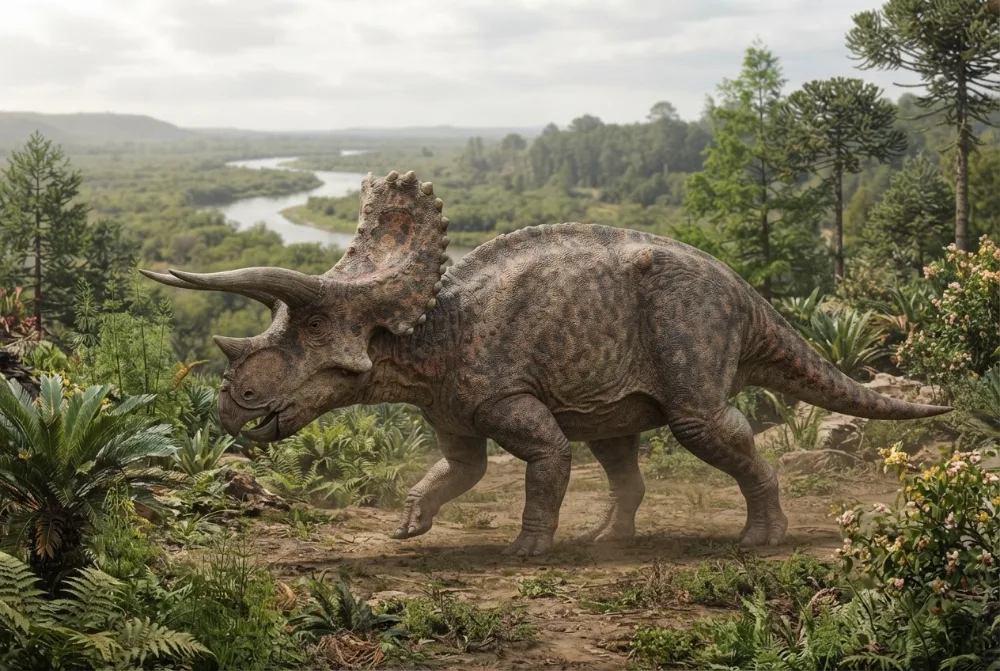
Coahuilaceratops was a horned dinosaur that lived in what is now Mexico. It had huge horns on its face, as big as those of Triceratops. This dinosaur was a plant-eater that roamed the land about 71 to 70 million years ago.12
Azalaki na bomoi ntango nini?
Azalaki monene boni?
Azalaki molai boni?
Azalaki molai boni na likolo?
Azalaki kilo boni?

 molai lokola bambwa 7 zolo kino mokila🍌molai lokola matoko 37 oyo balandani
 pene kilo lokola nzoku🍉kilo lokola bapasteke 1000🎒kilo lokola bakelasi 6 mobimba ya bana🐻❄️kilo lokola ba-urs ya pembe 11🏃akokaki kopota metele 100 na sekonde 11 (moto oyo aleki mbangu asalelaka 9,6)
Coahuilaceratops azalaki monene boni soki tokokanisi na YO?
Kaka matematiki na navigatere na yo. Eloko moko te ebombami to etindami esika moko.
Azalaki na mbangu boni?


Makambo ya kosepelisa
Coahuilaceratops had horns that were about 0.91 to 1.22 meters (3 to 4 feet) long, as big as those of Triceratops.1
Its name means 'horned face from Coahuila', after the Mexican state where it was found.1
Its fossils were discovered in 2001 by Claudio de Leon near Porvenir de Jalpa, Coahuila.1
Scientists think Coahuilaceratops may be an early relative of Triceratops.3
Mituna oyo batunaka mingi na ntina na Coahuilaceratops
?How big was Coahuilaceratops?
An adult was about 6.7 meters (22 feet) long, 1.8 to 2.1 meters (6 to 7 feet) tall at the shoulders and hips, and probably weighed about 4 to 5 metric tons. Another estimate says it was about 4 meters (13 feet) long and weighed 1 to 1.5 metric tons.14
?What did Coahuilaceratops eat?
It was a plant-eater, like other horned dinosaurs.4
?When did Coahuilaceratops live?
It lived about 71.5 to 70.5 million years ago, during the Late Cretaceous period.1
?Where was Coahuilaceratops found?
Its fossils were found in Coahuila, Mexico, near the town of Porvenir de Jalpa.1
?Why did Coahuilaceratops have such big horns?
Scientists are not sure, but the most widely accepted idea is that the horns were used to attract mates and fight with rivals of the same species.4
Mpo na bayebi ya badino
- Nkombo ya siansi
- Coahuilaceratops
- Nkombo epesamaki na
- Loewen et al. 20105
- Lisanga
- Badino na maseke
- Libota / klade
- Ceratopsidae5
- Klasifikasio
- Ornithischia > Ceratopsia > Ceratopsidae5
- Mbula ya mabanga
- mbula milio 72 kino 66 (Maastrichtian)5
- Bikolo
- Meksike5
- Bafosile oyo ekomami
- 1 na The Paleobiology Database5
- Ntango bamonaki yango
- Coahuilaceratops was named by Mark A. Loewen and colleagues in 2010. The fossils were found in 2001 and dug up in 2003 in Coahuila, Mexico.12
- Naino bazali kowelana
- Scientists are not sure exactly how big Coahuilaceratops was, because different estimates give lengths from 4 to 6.7 meters.1
Esika makambo euti
- Coahuilaceratops (en.wikipedia.org)
- PBDB Taxon (paleobiodb.org)
- Stratigraphic Reassessment of the Mexican Chasmosaurine Coahuilaceratops magnacuerna as the First Diagnostic Dinosaur Remains from the Cerro Huerta Formation (Lower Maastrichtian) Supporting the Southern Origin of the Triceratopsini (dinosaurier-info.de)
- First horned dinosaur from Mexico (phys.org)
- Coahuilaceratops in The Paleobiology Database (CC BY 4.0): mbula, bisika, milongo ya mabanga, klasifikasio.
Likambo nyonso na lokasa oyo ezali na nimero oyo elakisi liziba na yango. Soki tosali libunga, limbisa biso, tozali bato balingaka badino, zulunalo ya siansi te. Yebisa biso na [email protected] mpe tokobongisa yango.
 Rex azali na nzala! Dino Wiki ezali mosala ya tata moko mpo na mwana na ye ya mobali oyo alingaka badino, ofele, piblisite te mpe batrakere te. Bato bakolo bakoki kopesa Rex biskwi mpo na kosalisa ete etikala na internet.Leisa Rex
 Triceratops
 Protoceratops
 Ojoceratops
 Tatankaceratops
 Psittacosaurus
 Centrosaurus
 Tyrannosaurus
 Velociraptor
 Spinosaurus
 Ankylosaurus
 Parasaurolophus
 Pteranodon