 Ozali dino nini? Kwizi
 Etumba ya badino
 Mbangu ya badino
 Masano mike ya badino
 Albumu ya bastika
 Bilisti TOP ya badino
 Kamwisa ngai!
Eucoelophysis
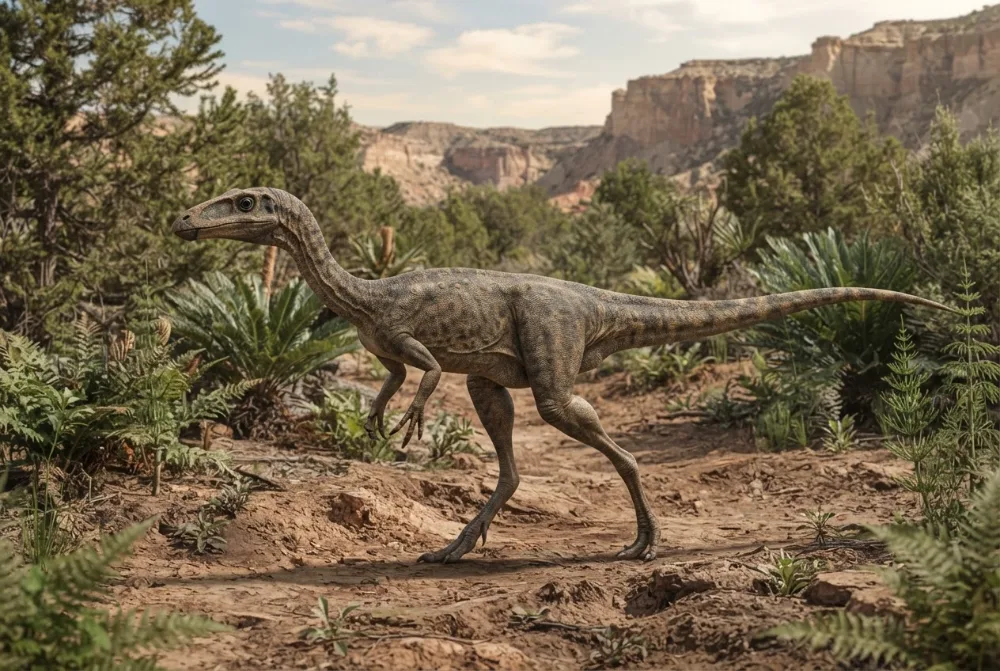
Eucoelophysis was a small, plant-eating dinosaur that lived about 212 million years ago in what is now New Mexico. It had a beak and walked on two legs, looking a bit like a long-legged lizard. Scientists once thought it was a meat-eater, but now they know it munched on plants.12
Azalaki na bomoi ntango nini?
Azalaki monene boni?
Azalaki molai boni?
Azalaki molai boni na likolo?
kokanisa
 molai lokola bambwa 3 zolo kino mokila🍌molai lokola matoko 17 oyo balandani🏃akokaki kopota metele 100 na sekonde 7,8 (moto oyo aleki mbangu asalelaka 9,6)
Eucoelophysis azalaki monene boni soki tokokanisi na YO?
Kaka matematiki na navigatere na yo. Eloko moko te ebombami to etindami esika moko.
Azalaki na mbangu boni?


Makambo ya kosepelisa
Its fossils were first found in the 1880s by David Baldwin, but were mixed up with another dinosaur called Coelophysis.1
For a long time, scientists thought Eucoelophysis was a meat-eating dinosaur, but in 2007 a study showed it was actually a plant-eater related to Silesaurus.1
Eucoelophysis lived during the Late Triassic period, about 212 million years ago.1
The name Eucoelophysis means 'true hollow form' because it was thought to be the real Coelophysis at first.1
Only a few bones of Eucoelophysis have been found, including parts of the hip and hind legs.1
Eucoelophysis is now placed in a group called Silesauridae, which are close relatives of dinosaurs.1
Mituna oyo batunaka mingi na ntina na Eucoelophysis
?Was Eucoelophysis a dinosaur?
No, it is not a dinosaur. Scientists now place it in a group called Silesauridae, which are close relatives of dinosaurs but not true dinosaurs.1
?How big was Eucoelophysis?
The exact size is not known from the few bones found, but it was a small animal, probably about the size of a modern turkey or a small dog.1
?What did Eucoelophysis eat?
It was a plant-eater. It had a beak and munched on plants, unlike the meat-eating dinosaurs it was once mistaken for.1
?When did Eucoelophysis live?
It lived during the Late Triassic period, about 212 million years ago, in what is now New Mexico.1
Mpo na bayebi ya badino
- Nkombo ya siansi
- Eucoelophysis
- Nkombo epesamaki na
- Sullivan and Lucas 19992
- Lisanga
- Badino ya monoko ya ndeke
- Libota / klade
- Silesauridae2
- Klasifikasio
- Ornithischia2
- Mbula ya mabanga
- mbula milio 227 kino 201 (Norian / Rhaetian)2
- Milongo ya mabanga
- Chinle2
- Bikolo
- Amerika2
- Bafosile oyo ekomami
- 2 na The Paleobiology Database2
- Ntango bamonaki yango
- Eucoelophysis was named in 1999 by Robert Sullivan and Spencer Lucas based on a skeleton found in New Mexico. The species name baldwini honors David Baldwin, who collected the first fossils in the 1880s.12
- Naino bazali kowelana
- Scientists are still debating whether some fossils from the Snyder Quarry and Hayden Quarry belong to Eucoelophysis or to other animals.1
Esika makambo euti
- Eucoelophysis (en.wikipedia.org)
- Eucoelophysis in The Paleobiology Database (CC BY 4.0): mbula, bisika, milongo ya mabanga, klasifikasio.
Likambo nyonso na lokasa oyo ezali na nimero oyo elakisi liziba na yango. Soki tosali libunga, limbisa biso, tozali bato balingaka badino, zulunalo ya siansi te. Yebisa biso na [email protected] mpe tokobongisa yango.
 Rex azali na nzala! Dino Wiki ezali mosala ya tata moko mpo na mwana na ye ya mobali oyo alingaka badino, ofele, piblisite te mpe batrakere te. Bato bakolo bakoki kopesa Rex biskwi mpo na kosalisa ete etikala na internet.Leisa Rex
 Iguanodon
 Tenontosaurus
 Thescelosaurus
 Zalmoxes
 Camptosaurus
 Rhabdodon
 Nothosaurus
 Massospondylus
 Plateosaurus
 Coelophysis
 Podokesaurus
 Simosaurus