 Ozali dino nini? Kwizi
 Etumba ya badino
 Mbangu ya badino
 Masano mike ya badino
 Albumu ya bastika
 Bilisti TOP ya badino
 Kamwisa ngai!
Zalmoxes
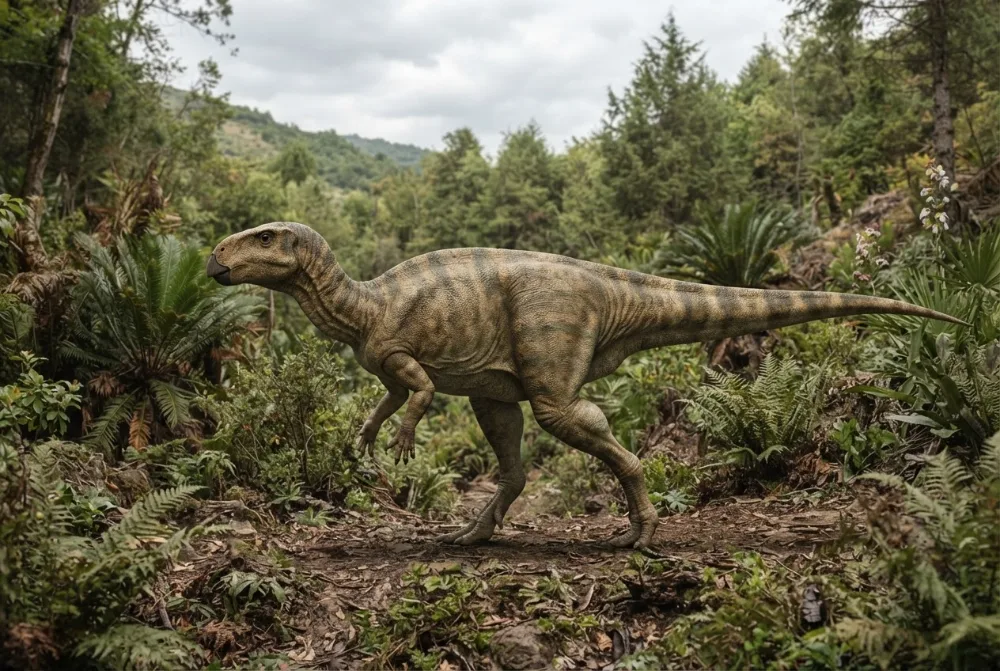
Zalmoxes was a small, plant-eating dinosaur that lived on an island called Hateg, in what is now Romania. It walked on two legs, had a beak, and ate tough plants. It was about the size of a small car, but some were even smaller!1
Azalaki na bomoi ntango nini?
Azalaki monene boni?
Azalaki molai boni?
Azalaki molai boni na likolo?
kokanisa
Azalaki kilo boni?
 molai lokola bambwa 3 zolo kino mokila🍌molai lokola matoko 16 oyo balandani
 kilo lokola bapusu ya ndako 11🍉kilo lokola bapasteke 9🧸kilo lokola bana 2,5 ya eteyelo ya bana mike🎒kilo lokola bana 1,5 ya kelasi🏃akokaki kopota metele 100 na sekonde 8,2 (moto oyo aleki mbangu asalelaka 9,6)
Zalmoxes azalaki monene boni soki tokokanisi na YO?
Kaka matematiki na navigatere na yo. Eloko moko te ebombami to etindami esika moko.
Azalaki na mbangu boni?


Makambo ya kosepelisa
Zalmoxes had a slow growth rate and a long growth period, which is different from many other dinosaurs.1
It lived on an island, and scientists think it might have been smaller than its relatives because of island dwarfism, though some think it was already small.1
Zalmoxes had a large triangular head and a beak, which helped it eat tough plants.1
Fossils of Zalmoxes have been found in Austria and France too, not just Romania.4
One species of Zalmoxes, called Z. shqiperorum, was later reclassified as a different type of dinosaur, a ceratopsian, not an ornithopod.1
Zalmoxes was one of the most common vertebrates in Transylvania during the latest Cretaceous period.1
Mituna oyo batunaka mingi na ntina na Zalmoxes
?How big was Zalmoxes?
Zalmoxes was small, with adults of Z. robustus reaching about 2.5 metres (8.2 feet) long and weighing about 45 kilograms (99 pounds). An unnamed species grew to about 2.9 metres (9.5 feet) long.1
?What did Zalmoxes eat?
Zalmoxes ate tough, fibrous plants like soft shoots, horsetails, angiosperms, pteridophytes, and ferns. It had a beak and could process C3 plants.1
?When did Zalmoxes live?
Zalmoxes lived during the Maastrichtian age of the Late Cretaceous, about 70 to 66 million years ago. It was one of the most common vertebrates in Transylvania at that time.13
?Where was Zalmoxes found?
Fossils of Zalmoxes have been found in Romania, specifically in the Hateg Basin of Transylvania. Some sources also mention finds in Austria and France, but the main site is Romania.13
?Was Zalmoxes a dinosaur?
Yes, Zalmoxes was a dinosaur, specifically a small ornithopod. It is classified as a probable rhabdodontid ornithopod, not a ceratopsian, though one species was later reclassified.13
?Why was Zalmoxes small?
Scientists once thought Zalmoxes was small due to island dwarfism, but later studies suggest it was already close to the size of its ancestors. Some related species were larger or smaller due to island effects.1
Mobuki masapo
Lisapo: Some people think Zalmoxes was a dwarf dinosaur because it lived on an island.
Solo: Scientists now think Zalmoxes was already small, and its larger relative Rhabdodon had island gigantism, while a smaller relative Mochlodon had island dwarfism.1
Mpo na bayebi ya badino
- Nkombo ya siansi
- Zalmoxes
- Nkombo epesamaki na
- Weishampel et al. 20034
- Lisanga
- Badino ya monoko ya ndeke
- Libota / klade
- Rhabdodontoidea4
- Klasifikasio
- Ornithischia > Ornithopoda > Iguanodontia4
- Mbula ya mabanga
- mbula milio 84 kino 66 (Campanian / Maastrichtian)4
- Milongo ya mabanga
- Sebeş, Sînpetru, Densuș-Ciula4
- Bikolo
- Romani, Otrishi, Falansa4
- Bafosile oyo ekomami
- 44 na The Paleobiology Database4
- Bayebi ye mpe na nkombo
- Onychosaurus (bankombo ya kala oyo sikoyo batangaka lokola nyama moko)4
- Ntango bamonaki yango
- The first fossils were named Mochlodon robustus by Baron Franz Nopcsa in 1899. In 2003, scientists renamed them Zalmoxes robustus after studying new remains.12
- Naino bazali kowelana
- Scientists still debate whether Zalmoxes was a dwarf species or just naturally small, and how it is related to other similar dinosaurs.1
Esika makambo euti
- Zalmoxes (en.wikipedia.org)
- Osteology and phylogeny of Zalmoxes (n. g.), an unusual Euornithopod dinosaur from the latest Cretaceous of Romania (tandfonline.com)
- Zalmoxes | Natural History Museum (nhm.ac.uk)
- Zalmoxes in The Paleobiology Database (CC BY 4.0): mbula, bisika, milongo ya mabanga, klasifikasio.
Likambo nyonso na lokasa oyo ezali na nimero oyo elakisi liziba na yango. Soki tosali libunga, limbisa biso, tozali bato balingaka badino, zulunalo ya siansi te. Yebisa biso na [email protected] mpe tokobongisa yango.
 Rex azali na nzala! Dino Wiki ezali mosala ya tata moko mpo na mwana na ye ya mobali oyo alingaka badino, ofele, piblisite te mpe batrakere te. Bato bakolo bakoki kopesa Rex biskwi mpo na kosalisa ete etikala na internet.Leisa Rex
 Iguanodon
 Tenontosaurus
 Thescelosaurus
 Camptosaurus
 Rhabdodon
 Nanosaurus
 Tyrannosaurus
 Triceratops
 Velociraptor
 Spinosaurus
 Ankylosaurus
 Parasaurolophus