 Ozali dino nini? Kwizi
 Etumba ya badino
 Mbangu ya badino
 Masano mike ya badino
 Albumu ya bastika
 Bilisti TOP ya badino
 Kamwisa ngai!
Euoplocephalus
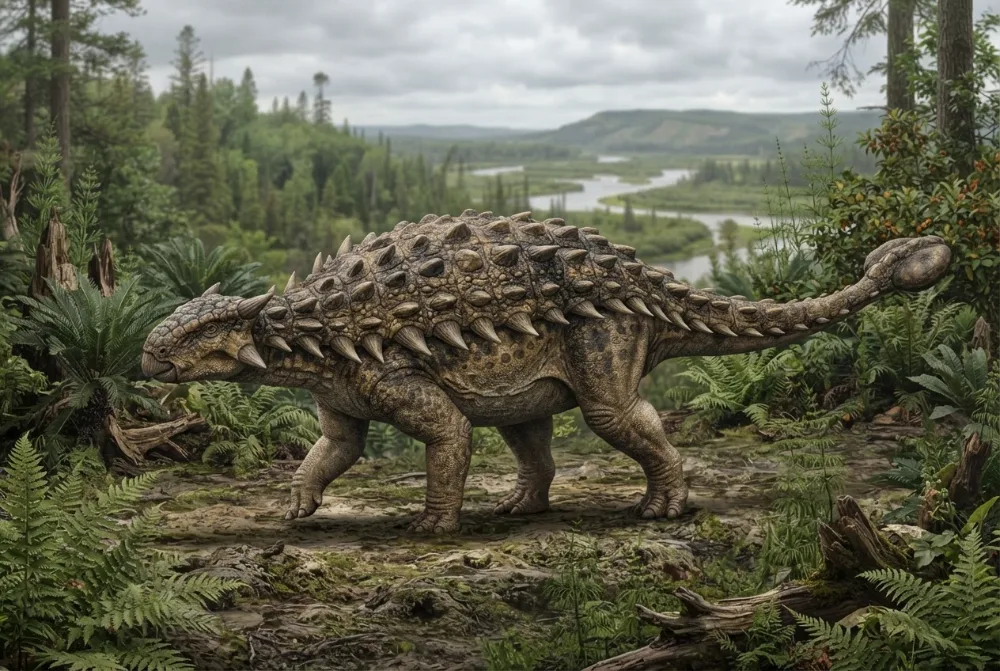
Euoplocephalus was a tank-like dinosaur covered in bony armour and a heavy club on its tail. It lived in what is now Canada and the USA during the Late Cretaceous period. This slow-moving plant-eater could defend itself from big predators like Albertosaurus.1
Azalaki na bomoi ntango nini?
Azalaki monene boni?
Azalaki molai boni?
Azalaki molai boni na likolo?
Azalaki kilo boni?

 molai lokola bambwa 5 zolo kino mokila🍌molai lokola matoko 29 oyo balandanikilo lokola bambwa 100🍉kilo lokola bapasteke 400🎒kilo lokola bakelasi 2,5 mobimba ya bana🐻❄️kilo lokola ba-urs ya pembe 4🏃akokaki kopota metele 100 na sekonde 24 (moto oyo aleki mbangu asalelaka 9,6)
Euoplocephalus azalaki monene boni soki tokokanisi na YO?
Kaka matematiki na navigatere na yo. Eloko moko te ebombami to etindami esika moko.
Azalaki na mbangu boni?


Makambo ya kosepelisa
Euoplocephalus had a heavy club at the end of its tail made of bone. It could swing this club to fight off predators.1
Its body was covered in rows of bony plates called scutes. It also had two bone rings around its neck for extra protection.1
Euoplocephalus was about 5.3 metres (17 feet) long and weighed around 2 metric tons (2.2 short tons). That is as heavy as a small car.1
The first fossil was found in 1897 in Alberta, Canada. It was originally named Stereocephalus, but that name was already used for an insect, so it was changed to Euoplocephalus in 1910.1
Euoplocephalus lived between about 76 and 75 million years ago, during the late Campanian stage of the Late Cretaceous.1
Scientists once thought many different ankylosaur fossils all belonged to Euoplocephalus, but now they know most are separate species like Scolosaurus and Platypelta.1
Euoplocephalus had a short, drooping snout and a horny beak to bite off plants. Its teeth show it could chew tough plant material.1
Mituna oyo batunaka mingi na ntina na Euoplocephalus
?How big was Euoplocephalus?
About 5.3 metres (17 feet) long and 2 tonnes (2.2 short tons) in weight, as heavy as a small car.13
?What did Euoplocephalus eat?
It was a plant-eater. It used a horny beak to bite off plants and had small teeth to chew tough plant material.13
?Did Euoplocephalus have a tail club?
Yes, it had a heavy bony club at the end of its tail. It could swing this club to defend itself from predators like Albertosaurus.13
?Was Euoplocephalus bigger than Ankylosaurus?
No, Ankylosaurus was bigger. Among ankylosaurids, Euoplocephalus was exceeded in size only by Ankylosaurus and perhaps Tarchia and Cedarpelta.1
?When did Euoplocephalus live?
It lived during the Late Cretaceous period, about 76 to 70 million years ago.3
?Where was Euoplocephalus found?
Fossils have been found in Canada (Alberta) and the United States (Montana).13
?How fast could Euoplocephalus run?
Nobody knows for sure, but it was a slow-moving dinosaur with short, sturdy legs built for walking, not running.1
?What does the name Euoplocephalus mean?
It means 'well-armed head', from Greek words for 'well', 'armed', and 'head'.1
Mobuki masapo
Lisapo: Euoplocephalus could roll into a ball like an armadillo to protect itself.
Solo: Euoplocephalus could not roll into a ball. It relied on its armour and tail club for defence.1
Mpo na bayebi ya badino
- Nkombo ya siansi
- Euoplocephalus
- Nkombo epesamaki na
- Lambe 19104
- Lisanga
- Badino na ebateli
- Libota / klade
- Ankylosauridae4
- Klasifikasio
- Ornithischia > Ankylosauria > Ankylosauridae > Thyreophora4
- Mbula ya mabanga
- mbula milio 84 kino 66 (Campanian / Maastrichtian)4
- Milongo ya mabanga
- Dinosaur Park, Judith River, Two Medicine4
- Bikolo
- Kanada, Amerika, Sina4
- Bafosile oyo ekomami
- 18 na The Paleobiology Database4
- Bayebi ye mpe na nkombo
- Stereocephalus (bankombo ya kala oyo sikoyo batangaka lokola nyama moko)4
- Ntango bamonaki yango
- Canadian paleontologist Lawrence Morris Lambe discovered the first Euoplocephalus fossil on 18 August 1897 in what is now Dinosaur Provincial Park, Alberta. He named it Stereocephalus in 1902, but changed the name to Euoplocephalus in 1910 because the old name was already taken.1
- Naino bazali kowelana
- Scientists still debate exactly which fossils belong to Euoplocephalus and which belong to other closely related ankylosaurs like Anodontosaurus and Scolosaurus.1
Esika makambo euti
- Euoplocephalus (en.wikipedia.org)
- PBDB Taxon (paleobiodb.org)
- Euoplocephalus | Natural History Museum (nhm.ac.uk)
- Euoplocephalus in The Paleobiology Database (CC BY 4.0): mbula, bisika, milongo ya mabanga, klasifikasio.
Likambo nyonso na lokasa oyo ezali na nimero oyo elakisi liziba na yango. Soki tosali libunga, limbisa biso, tozali bato balingaka badino, zulunalo ya siansi te. Yebisa biso na [email protected] mpe tokobongisa yango.
 Rex azali na nzala! Dino Wiki ezali mosala ya tata moko mpo na mwana na ye ya mobali oyo alingaka badino, ofele, piblisite te mpe batrakere te. Bato bakolo bakoki kopesa Rex biskwi mpo na kosalisa ete etikala na internet.Leisa Rex
 Ankylosaurus
 Sauropelta
 Pinacosaurus
 Scutellosaurus
 Struthiosaurus
 Edmontonia
 Tyrannosaurus
 Triceratops
 Velociraptor
 Spinosaurus
 Parasaurolophus
 Pteranodon