 Ozali dino nini? Kwizi
 Etumba ya badino
 Mbangu ya badino
 Masano mike ya badino
 Albumu ya bastika
 Bilisti TOP ya badino
 Kamwisa ngai!
Hatzegopteryx
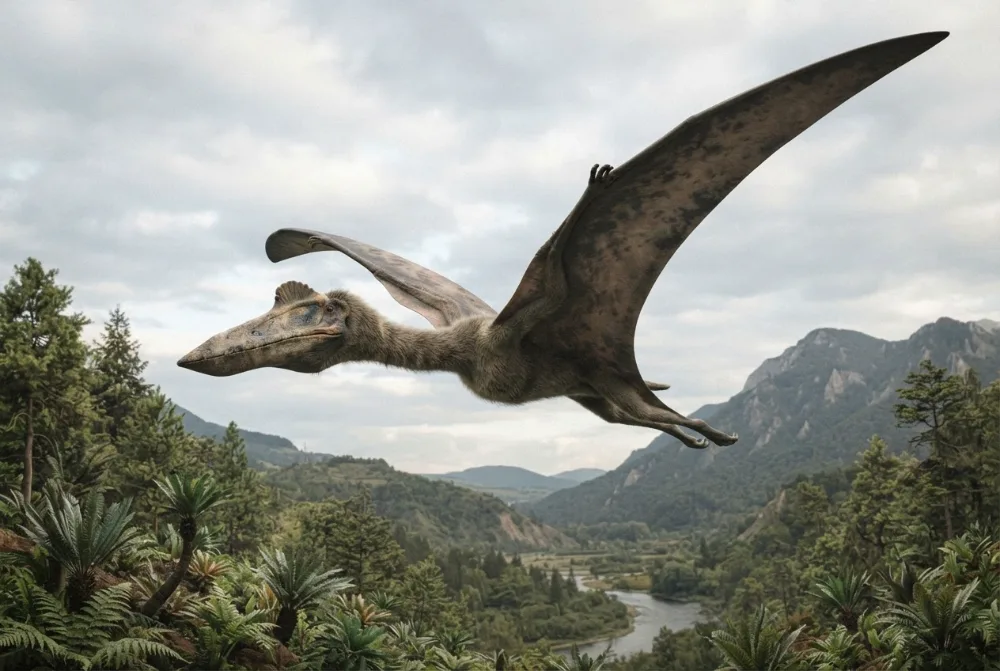
Hatzegopteryx was a giant flying reptile that lived on an island in what is now Romania. It had a huge, strong skull and a short, muscular neck, and it was probably the top predator on its island home.1
Azalaki na bomoi ntango nini?
Azalaki monene boni?
Mapapu na ye ezalaki monene boni?
Azalaki kilo boni?

 mapapu monene lokola bamotuka 2,5 na molongo🍉kilo lokola bapasteke 50🧸kilo lokola bana 13 ya eteyelo ya bana mike🎒kilo lokola bana 8 ya kelasi⚽akokaki kopumbwa kokatisa esika mobimba ya ndembo na sekonde 3,9
Hatzegopteryx azalaki monene boni soki tokokanisi na YO?
Kaka matematiki na navigatere na yo. Eloko moko te ebombami to etindami esika moko.
Azalaki na mbangu boni?


Makambo ya kosepelisa
Hatzegopteryx had a skull that was about 2.5 meters (8 feet) long, one of the largest skulls of any non-marine animal.1
Its neck was only 1.5 meters (5 feet) long, which is half the length of other giant pterosaurs with the same wingspan.1
The bones of Hatzegopteryx were filled with tiny pits and hollows, making them lightweight but strong, like Styrofoam.1
It lived on Hațeg Island, a subtropical island in the ancient Tethys Sea, where dinosaurs were small due to island dwarfism.1
Hatzegopteryx was probably the top predator on its island because there were no large meat-eating dinosaurs there.1
The first fossils of Hatzegopteryx were found in the late 1970s by students, but were at first mistaken for dinosaur bones.1
Mituna oyo batunaka mingi na ntina na Hatzegopteryx
?How big was Hatzegopteryx?
It had a wingspan of about 10 to 12 meters (33 to 39 feet), making it one of the biggest pterosaurs ever.1
?Could Hatzegopteryx fly?
Yes, it could fly. Its wing bones were similar to other flying pterosaurs, and its skull was lightweight thanks to a spongy internal structure.14
?What did Hatzegopteryx eat?
It was a predator that probably ate dwarf dinosaurs like titanosaurs and iguanodontians, and it could tackle prey too big to swallow whole.1
?Is Hatzegopteryx a dinosaur?
No, it is a pterosaur, which is a flying reptile and not a dinosaur.1
?When did Hatzegopteryx live?
It lived about 72 million years ago, during the Late Cretaceous Period.1
?Where was Hatzegopteryx found?
Its fossils were found in Transylvania, Romania, on what was once Hațeg Island.1
?How heavy was Hatzegopteryx?
Its weight has been estimated at around 250 kilograms (550 pounds).4
?Was Hatzegopteryx bigger than Quetzalcoatlus?
It was about the same size or slightly smaller. Both had wingspans around 10 to 12 meters, but Hatzegopteryx had a shorter, stronger neck.1
?Why did Hatzegopteryx have a short neck?
Its short, thick neck was very strong and helped it hunt large prey, like dwarf dinosaurs, by catching them.15
?Could Hatzegopteryx swim?
Nobody knows for sure, but it probably spent most of its time on land hunting, like other azhdarchid pterosaurs.1
Mobuki masapo
Lisapo: Hatzegopteryx was too heavy to fly.
Solo: Its bones had a spongy, lightweight internal structure that made the skull strong but light enough for flight.1
Mpo na bayebi ya badino
- Nkombo ya siansi
- Hatzegopteryx
- Nkombo epesamaki na
- Buffetaut et al. 20026
- Lisanga
- Bareptile oyo bapumbwaka
- Libota / klade
- Azhdarchidae6
- Klasifikasio
- Pterosauria > Pterodactyloidea > Azhdarchidae6
- Mbula ya mabanga
- mbula milio 72 kino 66 (Maastrichtian)6
- Milongo ya mabanga
- Densuș-Ciula, Sebeş, Râul Mare6
- Bikolo
- Romani6
- Bafosile oyo ekomami
- 4 na The Paleobiology Database6
- Ntango bamonaki yango
- Hatzegopteryx was named in 2002 by paleontologists Eric Buffetaut, Dan Grigorescu, and Zoltan Csiki, based on skull fragments and a wing bone found in Romania.1
- Naino bazali kowelana
- Scientists are not sure exactly how wide its wingspan was, with estimates ranging from 10 to 12 meters (33 to 39 feet).1
Esika makambo euti
- Hatzegopteryx (en.wikipedia.org)
- PBDB Taxon (paleobiodb.org)
- A new giant pterosaur with a robust skull from the latest cretaceous of Romania (pubmed.ncbi.nlm.nih.gov)
- Eons | When a Giant Pterosaur Ruled the European Islands | Season 4 | Episode 23 | PBS (pbs.org)
- Neck biomechanics indicate that giant Transylvanian azhdarchid pterosaurs were short-necked arch predators (pmc.ncbi.nlm.nih.gov)
- Hatzegopteryx in The Paleobiology Database (CC BY 4.0): mbula, bisika, milongo ya mabanga, klasifikasio.
Likambo nyonso na lokasa oyo ezali na nimero oyo elakisi liziba na yango. Soki tosali libunga, limbisa biso, tozali bato balingaka badino, zulunalo ya siansi te. Yebisa biso na [email protected] mpe tokobongisa yango.
 Rex azali na nzala! Dino Wiki ezali mosala ya tata moko mpo na mwana na ye ya mobali oyo alingaka badino, ofele, piblisite te mpe batrakere te. Bato bakolo bakoki kopesa Rex biskwi mpo na kosalisa ete etikala na internet.Leisa Rex
 Pteranodon
 Quetzalcoatlus
 Dorygnathus
 Rhamphorhynchus
 Anhanguera
 Pterodactylus
 Tyrannosaurus
 Triceratops
 Velociraptor
 Spinosaurus
 Ankylosaurus
 Parasaurolophus