 Ozali dino nini? Kwizi
 Etumba ya badino
 Mbangu ya badino
 Masano mike ya badino
 Albumu ya bastika
 Bilisti TOP ya badino
 Kamwisa ngai!
Malawania
Malawania was a small ichthyosaur that lived in the Early Cretaceous seas. It looked a bit like a dolphin, with flippers instead of legs and a long snout. It is special because it was one of the last ichthyosaurs that did not belong to the ophthalmosaurid group.12
Azalaki na bomoi ntango nini?
Azalaki monene boni?
Azalaki molai boni?
 molai lokola bambwa 3 zolo kino mokila🍌molai lokola matoko 17 oyo balandani🏊akokaki kobeta mai bolai ya pisine monene (50 m) na sekonde 3,8
Malawania azalaki monene boni soki tokokanisi na YO?
Kaka matematiki na navigatere na yo. Eloko moko te ebombami to etindami esika moko.
Azalaki na mbangu boni?


Makambo ya kosepelisa
Malawania is the first non-ophthalmosaurid ichthyosaur known from after the Jurassic,Cretaceous boundary, meaning it survived a time when most of its relatives had died out.1
Its scientific name means 'out-of-time swimmer' because it seemed to belong to an earlier time period.1
The only fossil of Malawania was found in 1952, but scientists did not know its age until 2013 when they studied tiny fossils called palynomorphs in the rock.2
Malawania had a short, trapezoid-shaped humerus (upper arm bone) and an intermedium bone in its flipper that was almost as big as the radius.2
Its forefin had four main fingers and no extra digits, unlike many later ichthyosaurs.2
The fossil was found in Iraq, which is the first post-Triassic ichthyosaur ever reported from the Middle East.2
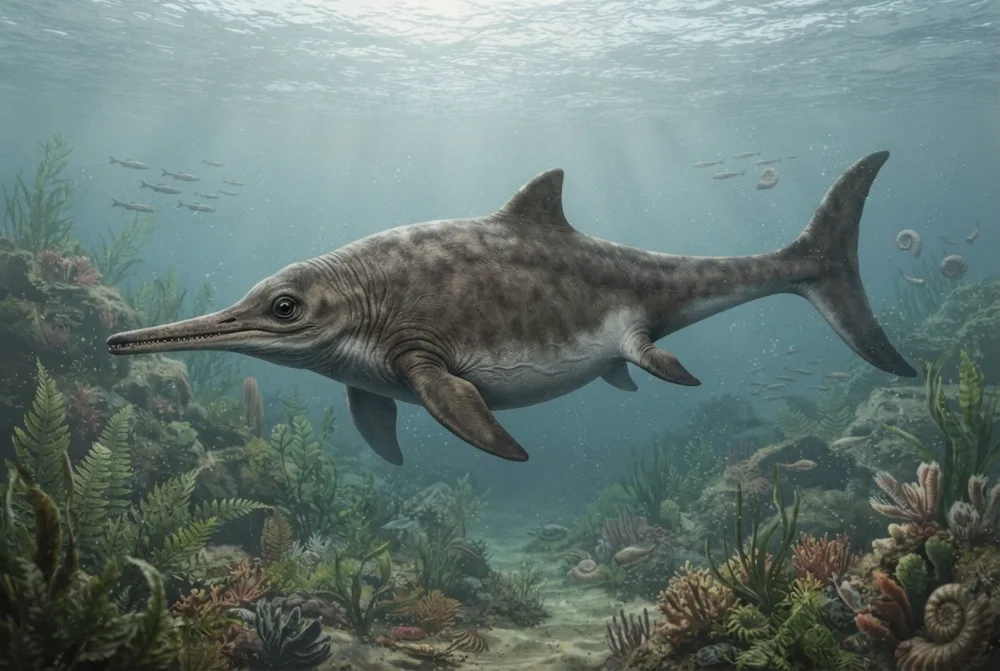
Mituna oyo batunaka mingi na ntina na Malawania
?How big was Malawania?
About 3 metres (9.8 feet) long. That is roughly as long as a small car.1
?What did Malawania eat?
Scientists are not sure exactly, but like other ichthyosaurs it probably ate fish and squid. Its long snout and sharp teeth were good for catching slippery prey.1
?When did Malawania live?
It lived during the Early Cretaceous period, about 130 to 125 million years ago. That is after most of its relatives had already died out.12
?Where was Malawania found?
The only fossil was discovered in 1952 in Iraqi Kurdistan, near the town of Amadia. It is the first post-Triassic ichthyosaur ever found in the Middle East.1
Mpo na bayebi ya badino
- Nkombo ya siansi
- Malawania
- Nkombo epesamaki na
- Fischer et al. 20133
- Lisanga
- Baiktiozore
- Libota / klade
- Thunnosauria3
- Klasifikasio
- Ichthyosauria > Ichthyosauromorpha3
- Mbula ya mabanga
- mbula milio 133 kino 121 (Hauterivian / Barremian)3
- Bikolo
- Irak3
- Bafosile oyo ekomami
- 1 na The Paleobiology Database3
- Ntango bamonaki yango
- The only known fossil of Malawania was discovered in 1952 near Amadia in Iraq. It was named Malawania anachronus by Fischer and colleagues in 2013.12
- Naino bazali kowelana
- Scientists are still debating exactly how Malawania is related to other ichthyosaurs, because it has a mix of ancient and modern features.2
Esika makambo euti
- Malawania (en.wikipedia.org)
- biblio.naturalsciences.be (biblio.naturalsciences.be)
- Malawania in The Paleobiology Database (CC BY 4.0): mbula, bisika, milongo ya mabanga, klasifikasio.
Likambo nyonso na lokasa oyo ezali na nimero oyo elakisi liziba na yango. Soki tosali libunga, limbisa biso, tozali bato balingaka badino, zulunalo ya siansi te. Yebisa biso na [email protected] mpe tokobongisa yango.
 Rex azali na nzala! Dino Wiki ezali mosala ya tata moko mpo na mwana na ye ya mobali oyo alingaka badino, ofele, piblisite te mpe batrakere te. Bato bakolo bakoki kopesa Rex biskwi mpo na kosalisa ete etikala na internet.Leisa Rex
 Ichthyosaurus
 Platypterygius
 Stenopterygius
 Khudiakovia
 Ophthalmosaurus
 Chonespondylus
 Stegosaurus
 Iguanodon
 Archaeopteryx
 Giganotosaurus
 Microraptor
 Deinonychus