 Ozali dino nini? Kwizi
 Etumba ya badino
 Mbangu ya badino
 Masano mike ya badino
 Albumu ya bastika
 Bilisti TOP ya badino
 Kamwisa ngai!
Monoclonius
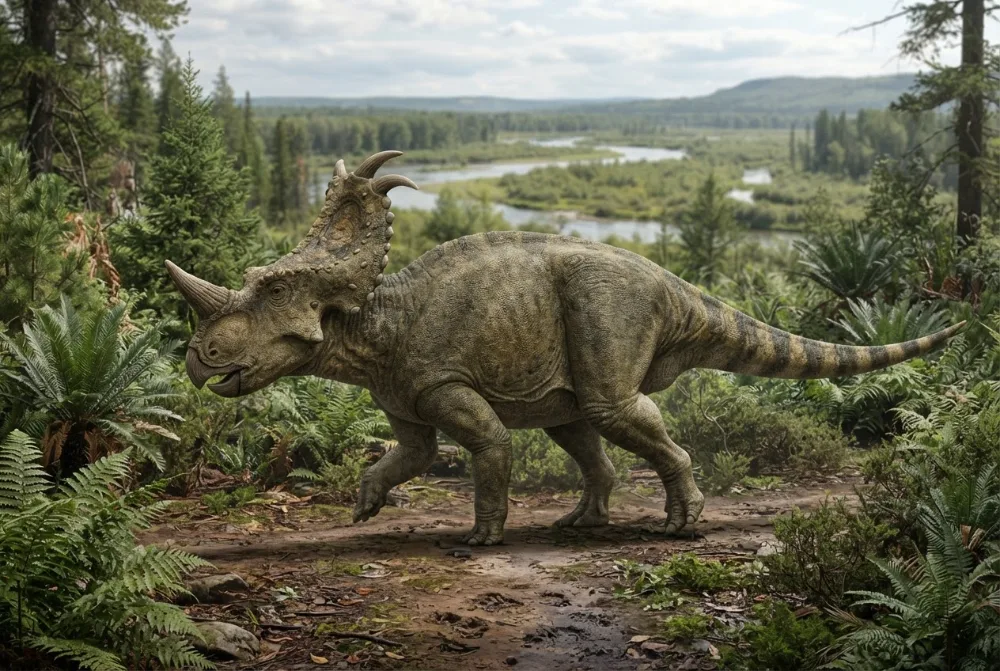
Monoclonius was a plant-eating dinosaur with a big frill on its head and a horn on its nose. It lived about 75 million years ago in what is now Montana and Alberta. Scientists are not sure if Monoclonius is really its own dinosaur or just a young version of another dinosaur called Centrosaurus.12
Azalaki na bomoi ntango nini?
Azalaki monene boni?
Azalaki molai boni?
Azalaki molai boni na likolo?
kokanisa
Azalaki kilo boni?

 molai lokola bambwa 6 zolo kino mokila🍌molai lokola matoko 31 oyo balandanikilo lokola bambwa 110🍉kilo lokola bapasteke 430🎒kilo lokola bakelasi 2,5 mobimba ya bana🐻❄️kilo lokola ba-urs ya pembe 5🏃akokaki kopota metele 100 na sekonde 11 (moto oyo aleki mbangu asalelaka 9,6)
Monoclonius azalaki monene boni soki tokokanisi na YO?
Kaka matematiki na navigatere na yo. Eloko moko te ebombami to etindami esika moko.
Azalaki na mbangu boni?


Makambo ya kosepelisa
Monoclonius was named in 1876 by the famous fossil hunter Edward Drinker Cope, just months after the Battle of the Little Bighorn.1
The name Monoclonius means 'single sprout' and refers to how its teeth grew, not to a horn. Cope thought only one set of teeth was used at a time.1
Many fossils once called Monoclonius are now thought to belong to other dinosaurs, like Centrosaurus or Styracosaurus.1
The type species is Monoclonius crassus, which means 'the fat one' in Latin.1
Monoclonius fossils have been found in the Judith River Formation in Montana and the Dinosaur Park Formation in Alberta.12
When Cope first described Monoclonius, he did not realize it was a horned dinosaur. He thought the skull frill was part of the breastbone.1
Mituna oyo batunaka mingi na ntina na Monoclonius
?How big was Monoclonius?
Monoclonius was up to 5 metres (16.5 feet) long and may have weighed about 2,170 kilograms (4,780 pounds).4
?What did Monoclonius eat?
Monoclonius was an herbivore, a plant eater. It probably ate cycads, palms, and other prehistoric plants with its tough, hook-like beak.4
?When did Monoclonius live?
Monoclonius lived in the Late Cretaceous period, about 76 to 73 million years ago, toward the end of the age of dinosaurs.4
?Why is Monoclonius called a nomen dubium?
Monoclonius is often considered a nomen dubium, or doubtful name, because the fossils are too incomplete or immature to be confidently matched with adult specimens. Many are thought to be young Centrosaurus.1
?Did Monoclonius have a horn on its nose?
Yes, Monoclonius had a single nose horn that pointed upwards and two smaller horns over its eyes, plus a small frill on its head.4
?Where were Monoclonius fossils found?
Monoclonius fossils have been found in Montana, USA, and Alberta, Canada.4
Mobuki masapo
Lisapo: Monoclonius means 'single horn'.
Solo: Monoclonius actually means 'single sprout', referring to its teeth, not a horn. Cope named it before he knew it was a horned dinosaur.1
Mpo na bayebi ya badino
- Nkombo ya siansi
- Monoclonius
- Nkombo epesamaki na
- Cope 18765
- Lisanga
- Badino na maseke
- Libota / klade
- Ceratopsidae5
- Klasifikasio
- Ornithischia > Ceratopsia > Ceratopsidae5
- Mbula ya mabanga
- mbula milio 84 kino 72 (Campanian)5
- Milongo ya mabanga
- Oldman, Judith River, Kirtland5
- Bikolo
- Amerika, Kanada5
- Bafosile oyo ekomami
- 13 na The Paleobiology Database5
- Ntango bamonaki yango
- Edward Drinker Cope named Monoclonius in 1876 based on fossils found near the Judith River in Montana by himself and a young Charles Sternberg.1
- Naino bazali kowelana
- Scientists debate whether Monoclonius is a valid genus or just a mix of juvenile Centrosaurus and other ceratopsids. Many consider it a nomen dubium (doubtful name).12
Esika makambo euti
- Monoclonius (en.wikipedia.org)
- PBDB Taxon (paleobiodb.org)
- Monoclonius Cope 1876 - Encyclopedia of Life (eol.org)
- enchantedlearning.com (enchantedlearning.com)
- Monoclonius in The Paleobiology Database (CC BY 4.0): mbula, bisika, milongo ya mabanga, klasifikasio.
Likambo nyonso na lokasa oyo ezali na nimero oyo elakisi liziba na yango. Soki tosali libunga, limbisa biso, tozali bato balingaka badino, zulunalo ya siansi te. Yebisa biso na [email protected] mpe tokobongisa yango.
 Rex azali na nzala! Dino Wiki ezali mosala ya tata moko mpo na mwana na ye ya mobali oyo alingaka badino, ofele, piblisite te mpe batrakere te. Bato bakolo bakoki kopesa Rex biskwi mpo na kosalisa ete etikala na internet.Leisa Rex
 Triceratops
 Protoceratops
 Ojoceratops
 Tatankaceratops
 Psittacosaurus
 Centrosaurus
 Tyrannosaurus
 Velociraptor
 Spinosaurus
 Ankylosaurus
 Parasaurolophus
 Pteranodon