 Ozali dino nini? Kwizi
 Etumba ya badino
 Mbangu ya badino
 Masano mike ya badino
 Albumu ya bastika
 Bilisti TOP ya badino
 Kamwisa ngai!
Azalaki na bomoi ntango nini?

Azalaki monene boni?
Azalaki molai boni?
Azalaki molai boni na likolo?
Azalaki kilo boni?
 molai lokola bambwa 6 zolo kino mokila🍌molai lokola matoko 33 oyo balandani🍉kilo lokola bapasteke 200🧸kilo lokola bana 53 ya eteyelo ya bana mike🎒kilo lokola bana 31 ya kelasi🐻❄️kilo lokola ba-urs ya pembe 2🏃akokaki kopota metele 100 na sekonde 12 (moto oyo aleki mbangu asalelaka 9,6)
Paludititan azalaki monene boni soki tokokanisi na YO?
Kaka matematiki na navigatere na yo. Eloko moko te ebombami to etindami esika moko.
Azalaki na mbangu boni?


Makambo ya kosepelisa
Paludititan lived on Hațeg Island, which was a real island during the Late Cretaceous. Many animals there were smaller than their relatives on the mainland.1
The first skeleton of Paludititan was found in 2002 by a Belgian-Romanian team. It was the most complete sauropod skeleton ever found in Romania at that time.1
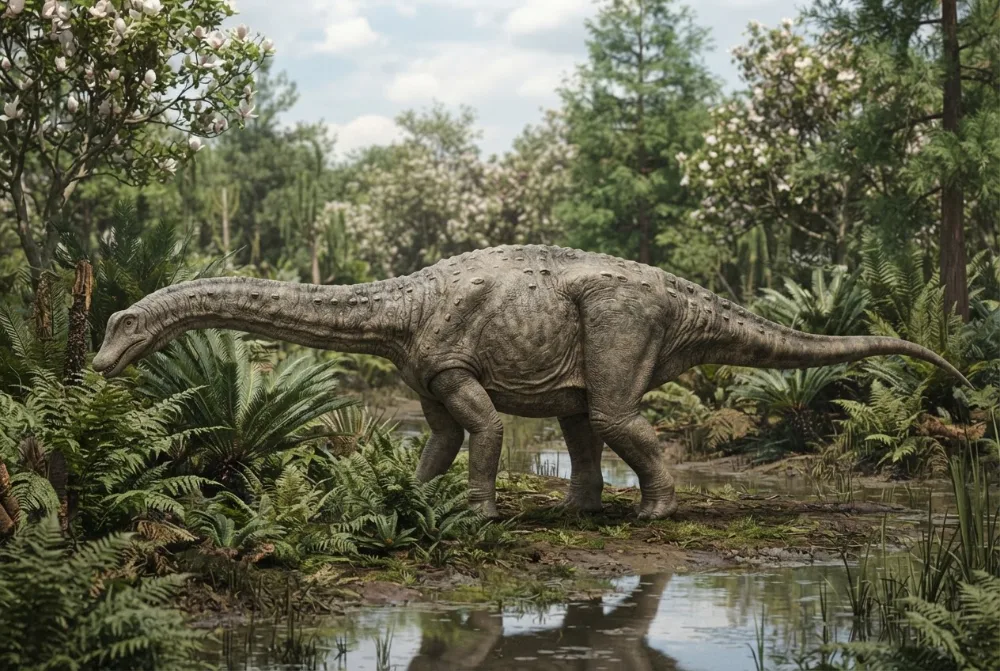
Paludititan was about 6 metres long and weighed around 1 metric ton. That is small for a sauropod, about the size of a car.1
The fossil bones were found close together, so scientists think they belong to one single animal.1
Some tail vertebrae of Paludititan are flat on both ends, while others are cup-shaped on the front. This mix is unusual among titanosaurs.1
Paludititan shared its island home with other dwarf dinosaurs like Magyarosaurus, Telmatosaurus, and Zalmoxes. The top predator was a giant flying reptile called Hatzegopteryx.1
Mituna oyo batunaka mingi na ntina na Paludititan
?How big was Paludititan?
Paludititan was about 6 metres (20 ft) long and weighed around 1 metric ton (1.1 short tons). That is small for a sauropod, about the size of a car.1
?What did Paludititan eat?
Paludititan was a sauropod, so it was a plant-eater. It likely ate ferns and other plants that grew on its island home.1
?When did Paludititan live?
Paludititan lived during the Late Cretaceous, about 70 to 66 million years ago. That was near the very end of the age of dinosaurs.1
?Was Paludititan a dinosaur?
Yes, Paludititan was a dinosaur. It was a titanosaurian sauropod, a kind of long-necked plant-eating dinosaur.1
Mpo na bayebi ya badino
- Nkombo ya siansi
- Paludititan
- Nkombo epesamaki na
- Csiki et al. 20103
- Lisanga
- Nkingo milai
- Libota / klade
- Eutitanosauria3
- Klasifikasio
- Sauropodomorpha > Sauropoda > Titanosauria > Macronaria3
- Mbula ya mabanga
- mbula milio 72 kino 66 (Maastrichtian)3
- Milongo ya mabanga
- Râul Mare3
- Bikolo
- Romani3
- Bafosile oyo ekomami
- 2 na The Paleobiology Database3
- Ntango bamonaki yango
- Paludititan was named in 2010 by Zoltán Csiki, Vlad Codrea, Cătălin Jipa-Murzea, and Pascal Godefroit. The skeleton was found in a riverbed at Nălaț-Vad in Romania.13
- Naino bazali kowelana
- Scientists are not sure if Paludititan is a separate species or just a young Magyarosaurus. More fossils are needed to settle this debate.1
Esika makambo euti
- Paludititan (en.wikipedia.org)
- Paludititan - piglix.com (piglix.com)
- Paludititan in The Paleobiology Database (CC BY 4.0): mbula, bisika, milongo ya mabanga, klasifikasio.
Likambo nyonso na lokasa oyo ezali na nimero oyo elakisi liziba na yango. Soki tosali libunga, limbisa biso, tozali bato balingaka badino, zulunalo ya siansi te. Yebisa biso na [email protected] mpe tokobongisa yango.
 Rex azali na nzala! Dino Wiki ezali mosala ya tata moko mpo na mwana na ye ya mobali oyo alingaka badino, ofele, piblisite te mpe batrakere te. Bato bakolo bakoki kopesa Rex biskwi mpo na kosalisa ete etikala na internet.Leisa Rex
 Brachiosaurus
 Diplodocus
 Brontosaurus
 Argentinosaurus
 Camarasaurus
 Morosaurus
 Tyrannosaurus
 Triceratops
 Velociraptor
 Spinosaurus
 Ankylosaurus
 Parasaurolophus