 Ozali dino nini? Kwizi
 Etumba ya badino
 Mbangu ya badino
 Masano mike ya badino
 Albumu ya bastika
 Bilisti TOP ya badino
 Kamwisa ngai!
Azalaki na bomoi ntango nini?

Azalaki monene boni?
Azalaki molai boni?
Azalaki molai boni na likolo?
kokanisa
 molai lokola bapusu 2 ya ndako zolo kino mokila🍌molai lokola matoko 5 oyo balandani🪑moke ete akoka koleka na nse ya kiti🏊akokaki kobeta mai bolai ya pisine monene (50 m) na sekonde 20
Parahesperornis azalaki monene boni soki tokokanisi na YO?
Kaka matematiki na navigatere na yo. Eloko moko te ebombami to etindami esika moko.
Azalaki na mbangu boni?


Makambo ya kosepelisa
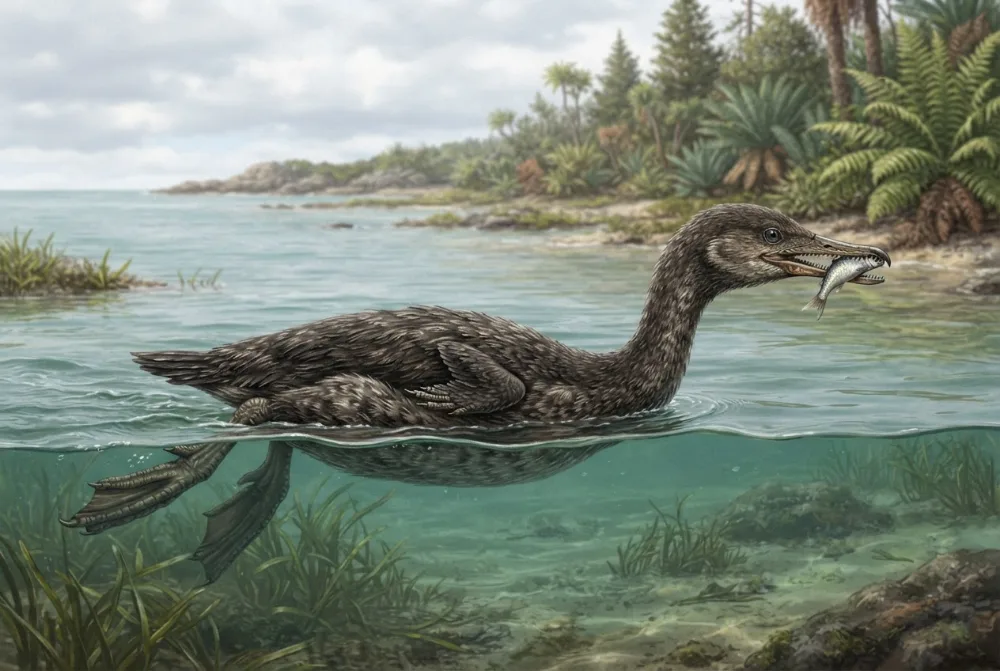
Parahesperornis could not fly. Its wings were tiny and useless for flying, but its legs were strong for swimming.12
It had sharp teeth in its beak, which is unusual for modern birds. These teeth helped it grab slippery fish.12
Parahesperornis is known from two nearly complete skeletons, which is rare for ancient birds. Most are found as just a few bones.2
It lived in the Western Interior Seaway, a shallow sea that covered central North America during the Cretaceous.1
The first fossil of Parahesperornis was found in 1894, but it was not named until 1984 by scientist L. D. Martin.24
Parahesperornis was about the size of a modern loon or a small penguin, around 60 to 90 centimeters long.2
Mituna oyo batunaka mingi na ntina na Parahesperornis
?Was Parahesperornis a dinosaur?
Yes, it was a type of prehistoric bird. While birds are descendants of dinosaurs, scientists classify Parahesperornis as an avialan bird rather than a dinosaur.1
?How big was Parahesperornis?
It was about 60 to 90 centimetres (2 to 3 feet) long, roughly the size of a modern loon or a small penguin.1
?Did Parahesperornis have teeth?
Yes, it had sharp teeth in its beak, which helped it grab slippery fish.2
?Could Parahesperornis swim?
Yes, it was a foot-propelled diving bird that swam like a penguin, using its strong legs to chase fish underwater.3
Mpo na bayebi ya badino
- Nkombo ya siansi
- Parahesperornis
- Nkombo epesamaki na
- Martin 19844
- Lisanga
- Bandeke ya liboso
- Libota / klade
- Hesperornithidae4
- Klasifikasio
- Theropoda > Avialae4
- Mbula ya mabanga
- mbula milio 90 kino 84 (Coniacian / Santonian)4
- Milongo ya mabanga
- Niobrara4
- Bikolo
- Amerika4
- Bafosile oyo ekomami
- 3 na The Paleobiology Database4
- Ntango bamonaki yango
- The first fossil of Parahesperornis alexi was found in 1894 by H. T. Martin in Graham County, Kansas. It was later named by L. D. Martin in 1984.24
- Naino bazali kowelana
- Scientists are not sure if some fossils from Mongolia belong to Parahesperornis or a different, similar bird.1
Esika makambo euti
- Parahesperornis (en.wikipedia.org)
- Anatomy of Parahesperornis: Evolutionary Mosaicism in the Cretaceous Hesperornithiformes (Aves) (mdpi.com)
- Anatomy of Parahesperornis: Evolutionary Mosaicism in the Cretaceous Hesperornithiformes (Aves) (pmc.ncbi.nlm.nih.gov)
- Parahesperornis in The Paleobiology Database (CC BY 4.0): mbula, bisika, milongo ya mabanga, klasifikasio.
Likambo nyonso na lokasa oyo ezali na nimero oyo elakisi liziba na yango. Soki tosali libunga, limbisa biso, tozali bato balingaka badino, zulunalo ya siansi te. Yebisa biso na [email protected] mpe tokobongisa yango.
 Rex azali na nzala! Dino Wiki ezali mosala ya tata moko mpo na mwana na ye ya mobali oyo alingaka badino, ofele, piblisite te mpe batrakere te. Bato bakolo bakoki kopesa Rex biskwi mpo na kosalisa ete etikala na internet.Leisa Rex
 Archaeopteryx
 Hesperornis
 Ichthyornis
 Baptornis
 Jurapteryx
 Gobipteryx
 Tyrannosaurus
 Triceratops
 Velociraptor
 Spinosaurus
 Ankylosaurus
 Parasaurolophus