 Ozali dino nini? Kwizi
 Etumba ya badino
 Mbangu ya badino
 Masano mike ya badino
 Albumu ya bastika
 Bilisti TOP ya badino
 Kamwisa ngai!
Azalaki na bomoi ntango nini?

Azalaki monene boni?
Azalaki molai boni?
Azalaki molai boni na likolo?
Azalaki kilo boni?

 molai lokola bambwa 6 zolo kino mokila🍌molai lokola matoko 33 oyo balandani
 pene kilo lokola nzoku🍉kilo lokola bapasteke 900🎒kilo lokola bakelasi 6 mobimba ya bana🐻❄️kilo lokola ba-urs ya pembe 10🏃akokaki kopota metele 100 na sekonde 28 (moto oyo aleki mbangu asalelaka 9,6)
Peloroplites azalaki monene boni soki tokokanisi na YO?
Kaka matematiki na navigatere na yo. Eloko moko te ebombami to etindami esika moko.
Azalaki na mbangu boni?


Makambo ya kosepelisa
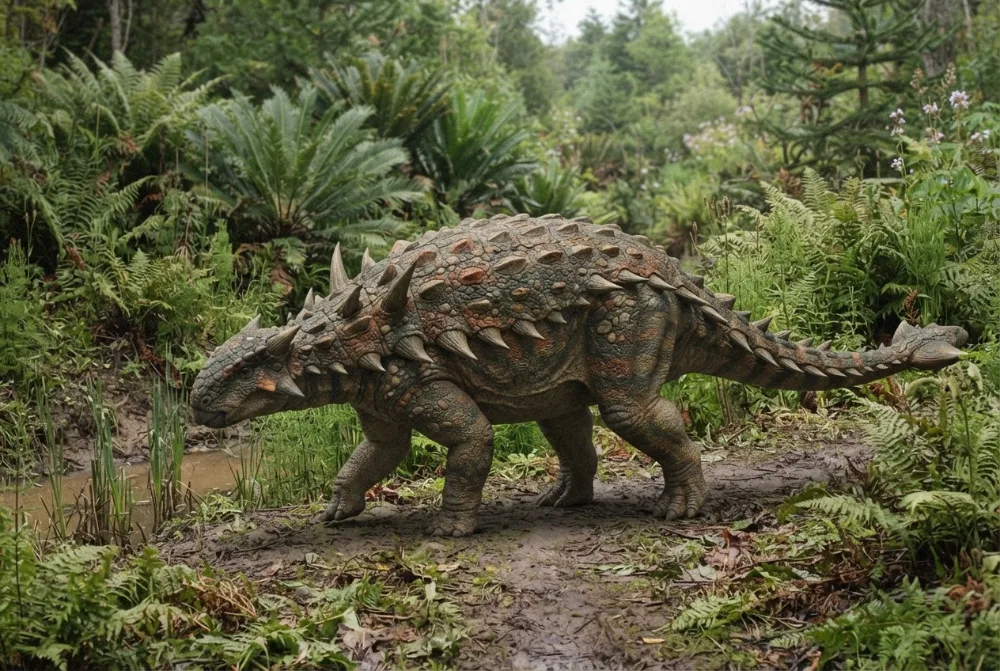
Peloroplites is one of the largest known nodosaurids, a group of armored dinosaurs.1
Its body was covered in bony armor plates and long spikes that protected it from big predators like Acrocanthosaurus.2
The name Peloroplites means 'monstrous heavy one' in Greek, referring to its huge size and heavy armor.1
Only one species is known: Peloroplites cedrimontanus, named after the Cedar Mountain Formation where it was found.1
Its skeleton was put together from bones dug up by staff and volunteers from the USU Prehistoric Museum.2
Utah has more species of armored dinosaurs than any other U.S. state, and Peloroplites is one of them.2
Peloroplites lived in a wet, swampy environment near the edge of the Western Interior Seaway.1
Mituna oyo batunaka mingi na ntina na Peloroplites
?How big was Peloroplites?
Peloroplites was about 6 metres (20 feet) long and weighed around 2 tonnes (4,410 lbs). That makes it one of the largest known nodosaurids.12
?What did Peloroplites eat?
Peloroplites was a plant-eater. It had small teeth and a wide beak at the front of its mouth to crop low vegetation.23
?When did Peloroplites live?
Peloroplites lived during the Late Cretaceous Period, about 98 to 93 million years ago.1
?Where was Peloroplites found?
Peloroplites was discovered in the Cedar Mountain Formation in Emery County, Utah, USA.12
?Was Peloroplites a dinosaur?
Yes, Peloroplites was a dinosaur. It belongs to a group of armored dinosaurs called nodosaurids.1
Mpo na bayebi ya badino
- Nkombo ya siansi
- Peloroplites
- Nkombo epesamaki na
- Carpenter et al. 20084
- Lisanga
- Badino na ebateli
- Libota / klade
- Nodosauridae4
- Klasifikasio
- Ornithischia > Ankylosauria > Nodosauridae > Thyreophora4
- Mbula ya mabanga
- mbula milio 121 kino 100 (Aptian / Albian)4
- Milongo ya mabanga
- Cedar Mountain4
- Bikolo
- Amerika4
- Bafosile oyo ekomami
- 1 na The Paleobiology Database4
- Ntango bamonaki yango
- Peloroplites was named in 2008 by Kenneth Carpenter and colleagues from a partial skull and other bones found in the Price River II quarry in Utah.1
- Naino bazali kowelana
- Scientists are not sure exactly how large Peloroplites grew, because different estimates give lengths from 5 to 6 metres.1
Esika makambo euti
- Peloroplites (en.wikipedia.org)
- Armored Monster Invades USU Eastern Prehistoric Museum (usu.edu)
- Peloroplites cedrimontanus (eastern.usu.edu)
- Peloroplites in The Paleobiology Database (CC BY 4.0): mbula, bisika, milongo ya mabanga, klasifikasio.
Likambo nyonso na lokasa oyo ezali na nimero oyo elakisi liziba na yango. Soki tosali libunga, limbisa biso, tozali bato balingaka badino, zulunalo ya siansi te. Yebisa biso na [email protected] mpe tokobongisa yango.
 Rex azali na nzala! Dino Wiki ezali mosala ya tata moko mpo na mwana na ye ya mobali oyo alingaka badino, ofele, piblisite te mpe batrakere te. Bato bakolo bakoki kopesa Rex biskwi mpo na kosalisa ete etikala na internet.Leisa Rex
 Ankylosaurus
 Sauropelta
 Pinacosaurus
 Scutellosaurus
 Struthiosaurus
 Euoplocephalus
 Stegosaurus
 Iguanodon
 Archaeopteryx
 Giganotosaurus
 Microraptor
 Deinonychus